Tag: natural stone

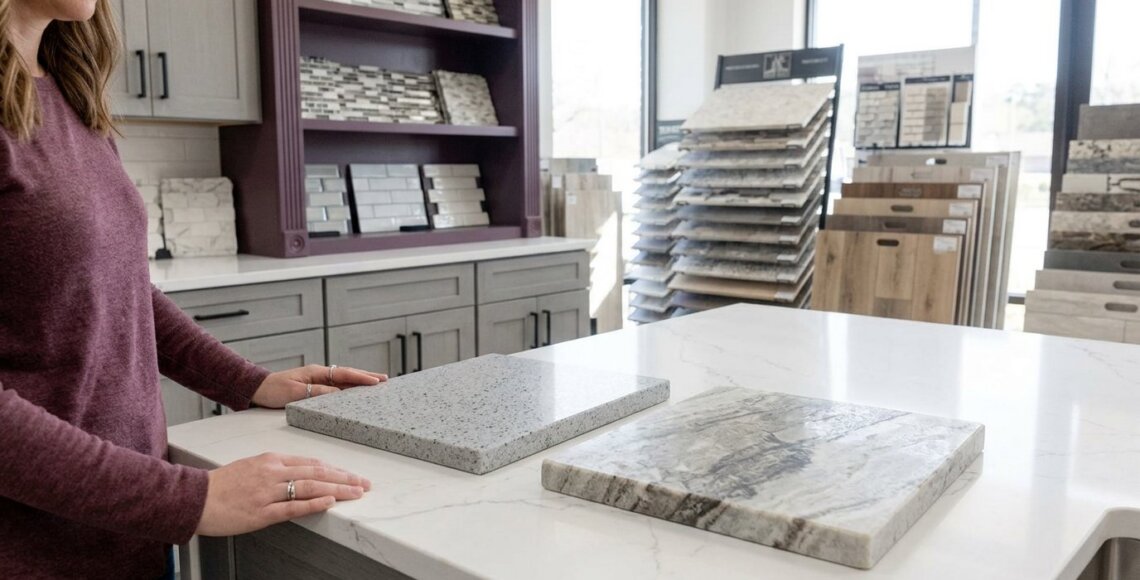
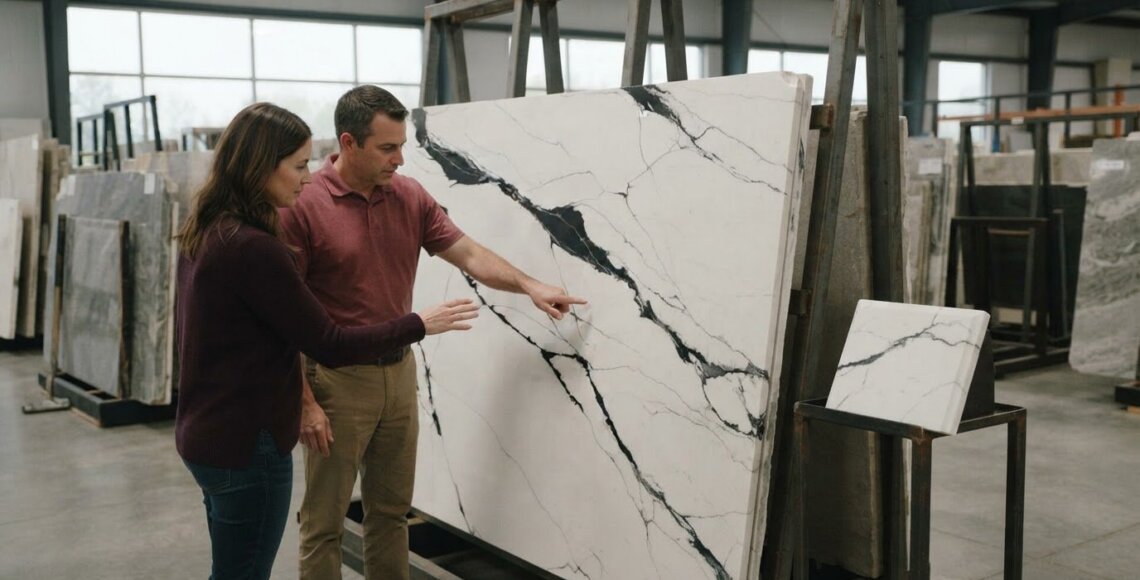
Homeowner inspecting a veined Super White stone slab with a specialist in a Richmond showroom

Super White Quartzite for Kitchen Countertops

Stone sold as super white quartzite is identified as dolomite marble, not true quartzite. Its signature look is a white background crossed by deep gray veins.

If you’re drawn to its pale, expressive look, consider whether its composition and care needs suit your kitchen. Natural-stone slabs vary in pattern, so assess the actual slab before choosing.

This guide compares it with Taj Mahal and Cristallo, describes its veining, and covers kitchen use, lemon-juice etching, and why a cutting board is preferable to chopping directly on the stone.

Key Takeaways

  • Learn what to consider when deciding whether this stone fits your kitchen and how its Brazilian origin informs your selection.
  • See how natural pattern variation can shape the look of your counters and why viewing slabs in person helps with choosing.
  • Understand the differences among Super White, Taj Mahal, Cristallo, quartzite, and engineered quartz before you settle on a material.
  • Follow the key planning stages, from selecting a slab and measuring the kitchen to fabrication and installation.

Super White’s use as a kitchen countertop

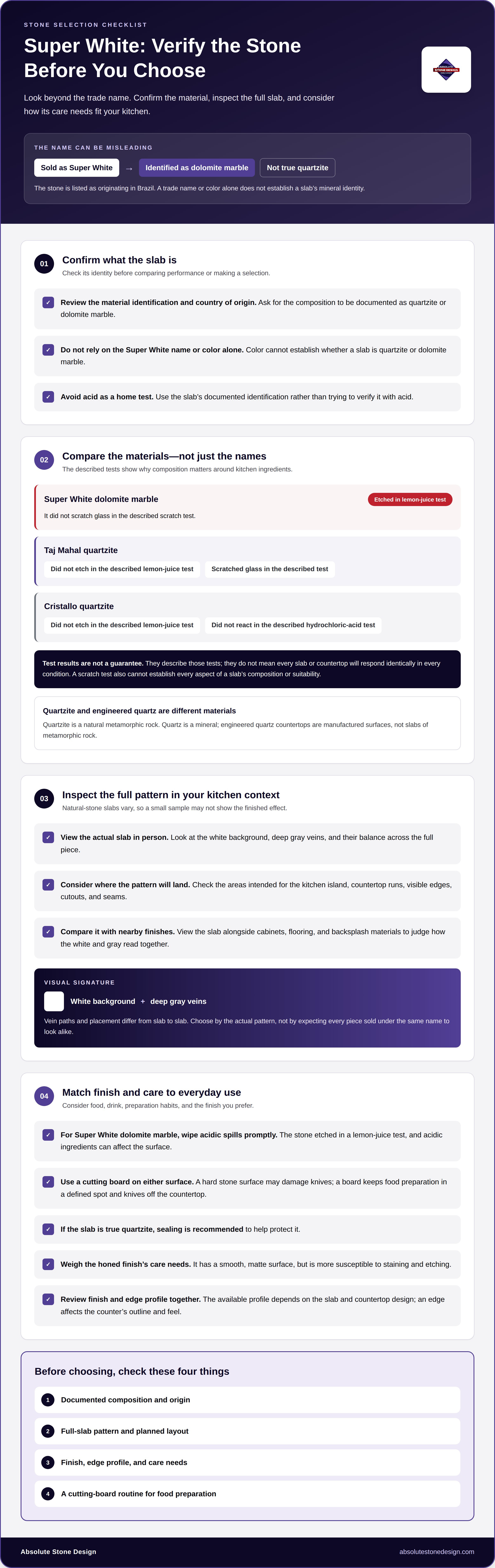
Stone marketed as Super White can be used for a kitchen countertop, but its trade name needs careful attention. It is identified as dolomite marble, not true quartzite, and listed as originating in Brazil.

Countertop Suitability

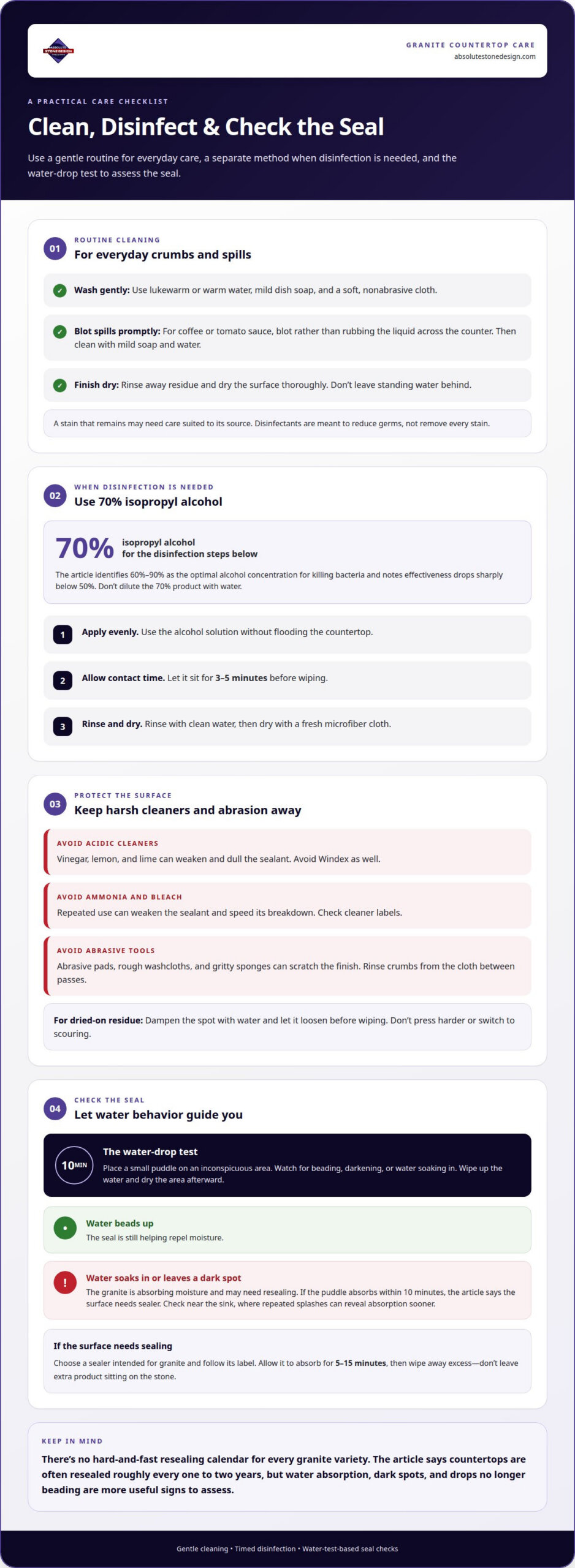
Quartzite is commonly used for kitchen countertops, and stone sold as Super White is also used for this purpose. The distinction matters: Super White dolomite marble etched in a lemon-juice test. Acidic ingredients can therefore affect the surface, so wipe spills promptly and use a cutting board for food preparation. If the slab is true quartzite, sealing is recommended to help protect it.

Available Finishes and Edge Profiles

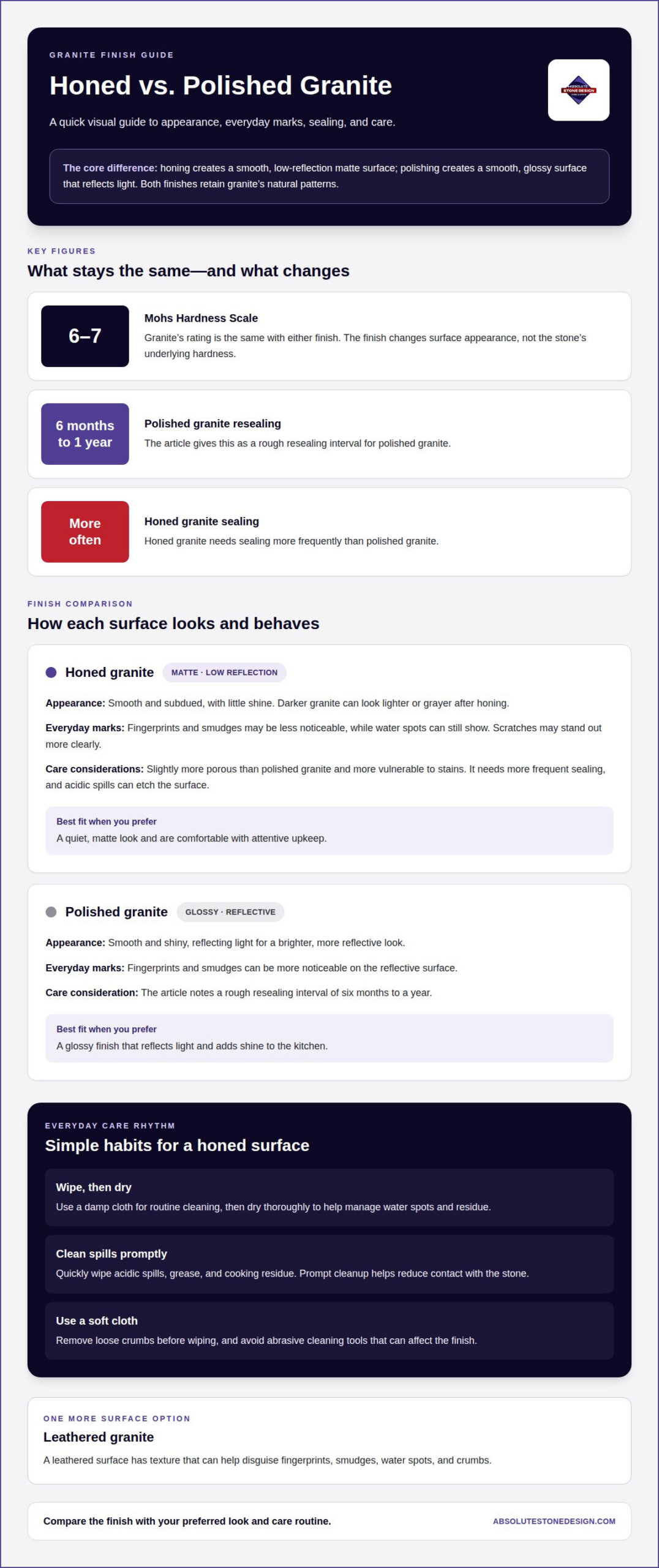
A honed finish has a smooth, matte surface, but it is more susceptible to staining and etching. That matters for a kitchen counter exposed to food and drink. The finish and edge profile are design and fabrication choices, and the available profile depends on the slab and countertop design. Review these details together, since an edge affects the counter’s outline and feel.

Verifying Slab Authenticity and Suitability

Color alone can’t establish whether a slab is quartzite or dolomite marble. Before choosing, review its material identification and country of origin, then view the actual slab to assess its white background, deep gray veins, and natural variations. Ask for its composition to be documented as quartzite or dolomite marble, rather than relying on the Super White trade name alone. Avoid using acid as a home test.

Super White quartzite’s color and veining

The stone’s signature look pairs a white background with deep gray veins. Because natural-stone slabs are unique, the balance and placement of these features vary from piece to piece.

Color Appearance

White forms the main field, while deep gray veining adds contrast. This combination can suit kitchens where you want a light stone with a distinct pattern rather than an uninterrupted solid color. The overall impression depends on the slab, so a small sample may not show the full visual effect.

View the slab alongside your kitchen’s cabinets, flooring, and backsplash materials. Compare how the white background reads against cabinet colors, then consider whether the gray marks feel balanced with nearby surfaces. This helps you judge the stone within your design, rather than by its trade name alone.

Veining Patterns

Deep gray veins are a defining feature, but their paths and placement differ from slab to slab. Some quartzite is present in the veining, even though stone sold under the Super White name is identified as dolomite marble. That distinction matters when discussing both appearance and composition.

View the full slab in person to see how its veins run across the surface. Pay attention to areas that may become the kitchen island, countertop runs, or visible edges. A vein near a cutout or seam can affect the finished layout, so consider the slab’s overall pattern rather than a small, isolated section.

The clearest takeaway: choose based on the actual slab’s white-and-gray balance and vein placement. Natural variation means two pieces may not create the same look, even when sold under the same name. Seeing the full pattern helps you picture how it will read across your kitchen, including the island and adjoining counter sections.

Comparison with Taj Mahal and Cristallo quartzites

The name “Super White quartzite” can obscure a key difference: the stone sold as Super White is identified as dolomite marble, not quartzite. Taj Mahal and Cristallo are described as quartzites, so comparing their performance means looking beyond color names and considering composition. A slab’s trade name alone does not establish its mineral identity.

In the described lemon-juice tests, Taj Mahal and Cristallo quartzite did not etch, while Super White dolomite marble did. Cristallo also did not react in the described hydrochloric-acid test. These results show why identifying the actual stone matters around acidic kitchen ingredients. They describe those tests, not a guarantee that every slab or countertop will respond identically in every condition.

The glass scratch tests offer another comparison. Taj Mahal quartzite scratched glass, while Super White dolomite marble did not. Quartzite is harder than glass and should scratch a glass surface; the Super White result is consistent with its identification as dolomite marble. Don’t treat a scratch test as a complete material assessment, since it cannot establish every aspect of a slab’s composition or suitability.

Quartzite and quartz are different materials. Quartzite is a natural metamorphic rock. Quartz is a mineral; engineered quartz countertops are manufactured surfaces, not slabs of metamorphic rock. This difference matters when describing and comparing the materials, even though their names sound similar.

For a kitchen, confirm whether the slab is quartzite or dolomite marble, then weigh the relevant etch and scratch-test information alongside its appearance and care needs. The practical takeaway is simple: choose based on the stone’s composition and your kitchen’s needs, not the word “quartzite” in a sales name.
Super White Quartzite for Kitchen Countertops

Cutting directly on quartzite

Use a cutting board rather than chopping directly on a quartzite countertop. A hard stone surface may damage knives, so cutting directly on it can dull or harm the blade. For everyday tasks such as slicing vegetables, trimming herbs, or cutting bread, place a board between the knife and countertop. It gives you a separate work area while helping protect your kitchen tools.

Make the board part of your regular prep routine. Set it on the counter before cutting, and prepare food on it rather than moving the knife across the stone. If you use an island for several tasks, keep a board nearby so it’s ready when you switch from serving or setting down groceries to chopping.

Material identity also matters for stone sold under the Super White name. Super White is identified as dolomite marble, not quartzite, so the label alone doesn’t tell you exactly what stone is in your kitchen. A cutting board is the sensible choice for either surface: it keeps knives off the countertop and food preparation in one defined spot.

Consider your kitchen countertop layout when choosing where to keep a board. One near the sink can suit washing and trimming produce, while one near the range keeps chopping close to cooking. Keep the board stable as you work, and move it rather than cutting over seams, edges, or openings. These habits help protect your knives and finished stone during everyday food preparation.

Quartzite can be selected for kitchen counters, but its hardness isn’t a reason to use it as a chopping surface. The practical rule is simple: prepare food on a cutting board, not directly on the stone. This helps protect your knives while reserving the countertop for the tasks it was designed to handle.

Planning a Super White Quartzite Countertop

Plan around the actual slab, not its label. The trade name Super White quartzite can refer to dolomite marble, so material identification should guide care expectations and project decisions. Review the slab’s white ground and gray veining, then decide how its pattern should appear across the main counter and kitchen island. This helps the layout feel intentional rather than pieced together.

Next, establish the kitchen countertop layout. Precision measuring and templating capture counter runs, corners, sink and cooktop openings, and planned seams. The countertop’s support structure matters too, since cabinets carry the finished stone. Measurements account for the room as it stands, so the template reflects the actual space rather than estimates or a generic cabinet plan.

Fabrication turns the approved layout into a fitted surface. Before fabrication begins, approve the selected slab and design details, including edge choices and visible seam placement. In-house fabrication lets the measurements and agreed layout guide the work directly. Planning where prominent veining falls helps coordinate separate countertop sections and any island surface.

Countertop installation follows fabrication and delivery. Before installation, clear the work area and ensure the cabinets are ready to support the new surface. The installation team fits the pieces to the templated kitchen, aligning seams and openings with the approved plan. Coordinating the process from measuring through fitting helps each stage reflect the same design decisions.

Keep the central decision clear: identify the stone correctly, choose the slab for its pattern, and plan the layout around your kitchen. This approach supports a countertop that suits the room and reflects the natural variation of the selected material.

As you shape your kitchen, let the stone support the atmosphere you want to create, from a quiet, light-filled gathering place to a room with a more pronounced natural pattern. A Super White dolomite marble countertop can be part of that vision, while the right choice also depends on how you want the finished space to feel and function.

Absolute Stone Design works with countertop projects and offers granite and marble as other natural-stone options. The team’s measuring, in-house fabrication, and installation services carry the selected material from planning through to the finished kitchen.

Ready to take the next step? Plan your countertop project with Absolute Stone Design, and start shaping a kitchen that feels like yours.

Frequently Asked Questions

What are the appearance, colors, and natural variations of Super White quartzite slabs?

If a slab is marketed as super white quartzite, assess its pattern at full scale before deciding where it belongs in your kitchen. Compare the slab with cabinet and flooring samples under the room’s planned lighting. This helps you judge whether the stone’s overall movement feels balanced with nearby finishes, instead of relying on a small sample or screen image.

How hard, durable, and heat-resistant is Super White quartzite?

Hardness and heat resistance are separate considerations, so one doesn’t establish the other. For everyday kitchen use, place hot cookware on a trivet and avoid dropping heavy pots on the counter. These habits help limit sudden heat exposure and impact. The stone’s name alone isn’t a practical guide to how it will respond.

Does Super White quartzite stain, etch, or scratch easily?

Stains, etching, and scratches are different kinds of surface change. A stain affects the stone’s appearance after a substance penetrates or leaves residue; etching can alter the finish, while a scratch is a physical mark. If you notice a change, view it in good light and identify its appearance before choosing a cleaning or repair approach.

How often does Super White quartzite need sealing, and what maintenance does it require?

Follow care guidance for the specific stone and sealer rather than relying on a schedule attached to a trade name. For routine upkeep, use a stone-safe cleaner and a soft cloth, and follow the sealer maker’s application directions. Keep the product information with your kitchen records so you can refer to the right care instructions later.

What are the pros and cons of using Super White quartzite for kitchen countertops and backsplashes?

A kitchen design using super white quartzite can carry the same material across the countertop and backsplash for a coordinated look. Plan the horizontal and vertical pieces together, considering vein direction, seams, outlets, and cutouts. Careful coordination helps the finished surfaces feel connected rather than like separate choices.
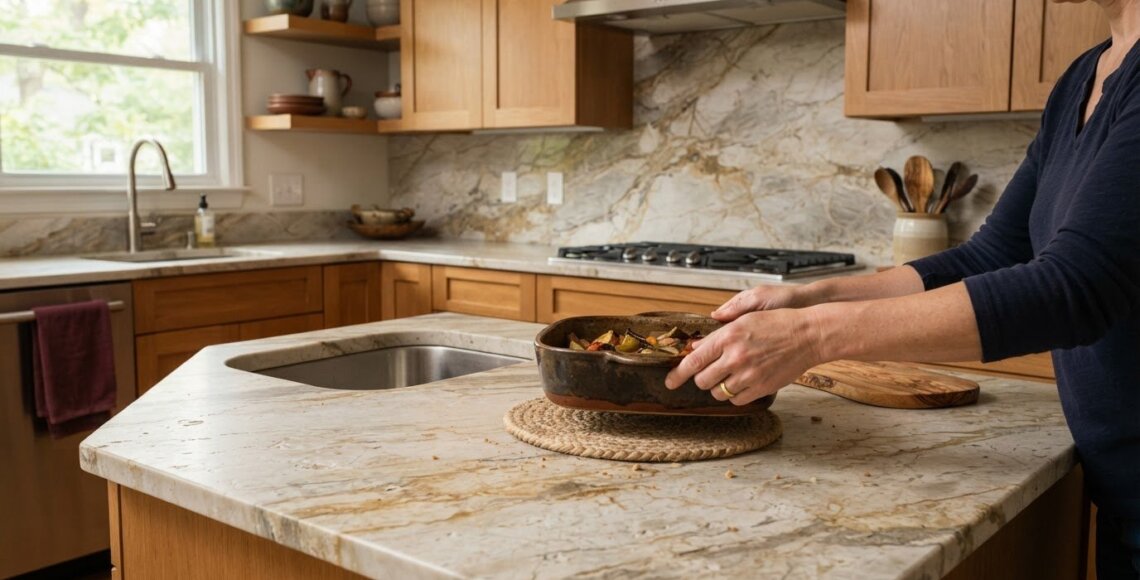
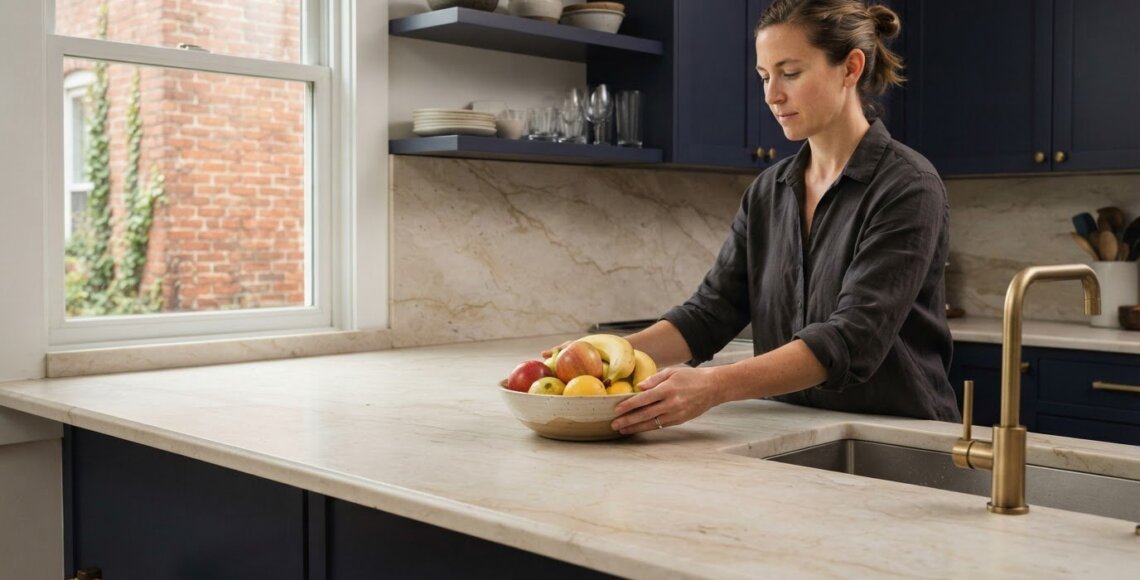
Homeowner using a Taj Mahal quartzite counter and full-height backsplash in a Richmond-area kitchen

Taj Mahal Quartzite Counters for Kitchen Durability and Style

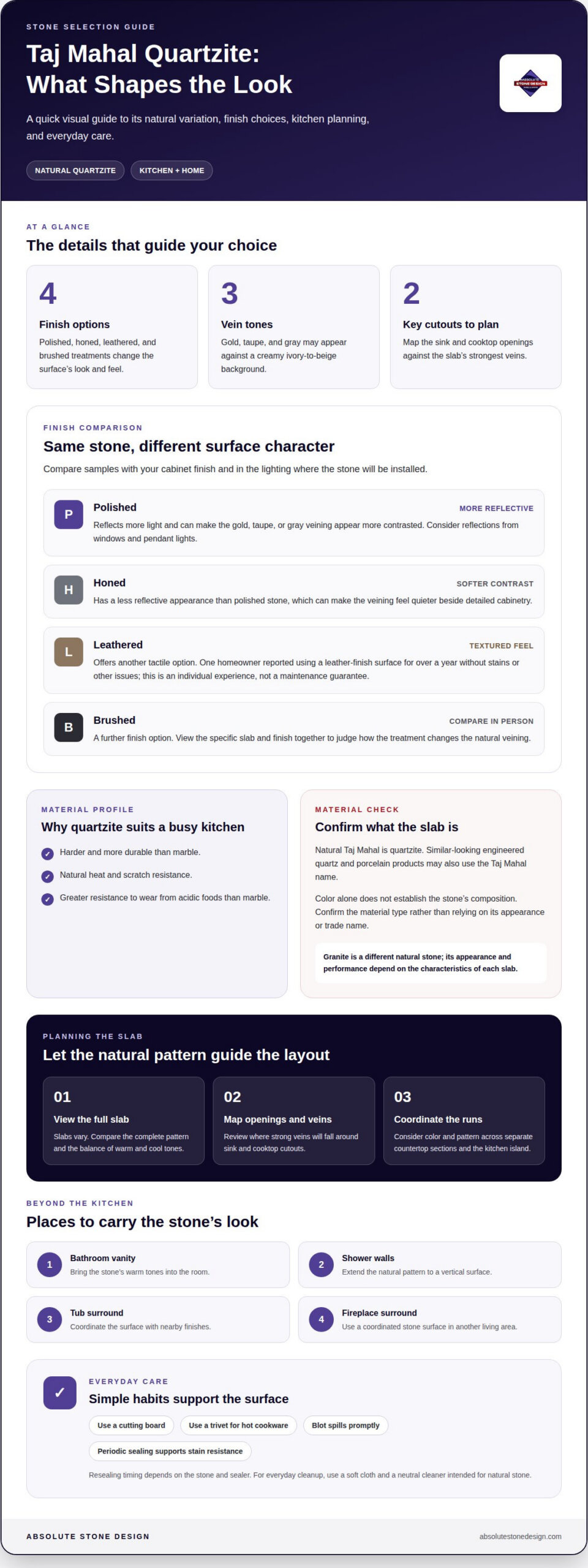
Taj Mahal quartzite counters offer a durable kitchen surface with natural heat and scratch resistance, and greater hardness than marble. Their warm ivory-to-beige coloring and gold, taupe, or gray veining vary from slab to slab, while polished, honed, and brushed finishes create different looks. Learn how this stone performs in everyday kitchen use, what to consider when choosing a slab and finish, and how it can bring a coordinated look to bathrooms and other spaces in your home.

Key Takeaways

  • Plan the slab layout around sink and cooktop openings so the natural veining falls where you want it.
  • View the actual slab before selecting it, since each piece has its own pattern and balance of warm tones.
  • Compare surface finishes in your room’s lighting to find the look and feel that suit your kitchen.
  • Consider this stone beyond the kitchen, including for bathroom vanities, shower walls, tub surrounds, and fireplace surrounds.

Is Taj Mahal Quartzite Durable Enough for a Kitchen?

Taj Mahal quartzite counters can suit a busy kitchen because quartzite is harder and more durable than marble. The stone also has natural heat and scratch resistance, while fabrication planning helps position prominent veins around sink and cooktop cutouts.

Thickness and Prefabricated Sizes

Thickness and prefabricated dimensions shape the edge profile and fit. A homeowner used 2-centimeter stone with an ogee-to-square edge; another selected a 2 1/4-inch mitered edge. These examples show how edge design changes the finished appearance, not universal specifications. A countertop professional considers the countertop support structure, island overhang, and openings when planning dimensions. Prefabricated pieces need to suit the measured countertop runs, so compare their dimensions with the kitchen layout before choosing.

Slab availability varies by lot, and every slab has its own usable pattern. During fabrication planning, map sink and cooktop cutouts against the strongest veins to avoid placing a striking vein awkwardly across an opening. Reviewing the full slab also helps coordinate color and pattern across separate countertop runs.

Comparing Countertop Materials

Compared with marble, Taj Mahal quartzite offers greater hardness and durability, including resistance to wear from acidic foods. Granite is another natural stone, but its appearance and performance depend on the characteristics of each slab. Quartz is engineered, unlike natural quartzite, and some engineered quartz and porcelain products use the Taj Mahal name for a similar look. When choosing Taj Mahal quartzite counters, consider the material identity and natural pattern alongside your kitchen’s needs.

Use a cutting board and trivet for hot cookware, and blot spills promptly. Periodic sealing supports stain resistance, though resealing timing depends on the stone and sealer.

Ask the fabricator where a chosen vein will fall around sink or cooktop cutouts; one homeowner expected fabrication and installation to take 8 weeks.

Taj Mahal quartzite appearance and color variations

Taj Mahal quartzite is a natural stone with a warm, light-colored palette. Its background ranges from creamy ivory to beige, with beige and taupe accents. Some slabs have an ivory background crossed by soft gold veining. Gray may appear alongside gold or taupe, adding a cooler note while keeping the overall look light. Perla Venata is another industry name for this stone.

Each slab looks distinct, so the balance of background and veining changes from piece to piece. One slab may read as mostly creamy ivory, while another has more visible taupe, gray, or gold. This variation can shape how the surface relates to cabinet color, flooring, and a stone backsplash. View the complete slab in person, then compare its tones with your project’s finish samples.

A countertop professional identifies real Taj Mahal quartzite by confirming the slab’s stone type, rather than relying on color or its trade name alone. Light beige and gold tones can resemble dolomite or other stones, so appearance alone doesn’t establish composition. The Taj Mahal name can also describe engineered quartz or porcelain with a similar look. Natural Taj Mahal is quartzite, while granite is a different stone.

When selecting a slab, consider where the strongest veining will fall across the kitchen countertop layout. A bold section may draw attention on an island, while quieter areas can suit surrounding work surfaces. If the slab includes both warm gold and cooler gray, see how those tones relate to nearby finishes. Viewing the full piece helps you judge pattern continuity and choose a visual balance that suits the room.

Its warm, light-colored base ranges from creamy ivory to beige, with beige and taupe accents. Veining may appear gold, taupe, or gray.

Polished, honed, and leathered finishes

A finish changes how Taj Mahal quartzite looks under kitchen lighting. Common options include polished, honed, and brushed surfaces; leathered finishes also appear in homeowner projects. Each treatment gives the same natural stone a different visual and tactile character, so compare samples with your cabinet finish and room lighting.

Polished quartzite reflects more light, which can make its veining appear more contrasted than honed stone. This finish can emphasize gold, taupe, or gray lines against an ivory background. Before choosing a polished surface, consider how reflections from windows and pendant lights will fall across the kitchen island.

Honed quartzite has a less reflective appearance than polished stone. Its softer contrast can suit a kitchen where you want the veining to feel quieter beside detailed cabinet fronts. Compare both finishes under similar lighting, since a showroom sample may look different from the slab in your home.

Leathered Taj Mahal quartzite offers another finish option for a more textured look and feel. One homeowner reported using a leather-finish surface for over a year without stains or other issues. That experience is an example, not a maintenance guarantee, so consider your kitchen’s daily use and care routine.

Brushed, honed, and polished finishes are also available for this stone. Look at the specific slab and finish together, since surface treatment can change how its natural veining appears. For example, a polished sample may make gold lines stand out, while a honed sample may present them more softly.

To choose a finish, compare samples beside a cabinet door in both daylight and evening lighting. Pay attention to reflections, visible veining, and surface feel. For everyday cleanup, use a soft cloth and a neutral cleaner intended for natural stone.

Taj Mahal Quartzite Counters for Kitchen Durability and Style

Quartzite countertop and home applications

Taj Mahal quartzite counters can connect a kitchen’s work surfaces with nearby living spaces. On an island, the stone’s light background can make a broad surface feel calm. A waterfall edge carries the pattern down the island sides, while a full-height backsplash can continue the veining behind a range or sink.

For an island or waterfall design, the fabricator plans how slab sections meet, accounting for edges, seams, and the pattern across the top and sides. A coordinated layout helps the veining appear intentional rather than interrupted. The kitchen countertop plan also guides where openings and joints fall across separate runs.

Bathrooms offer several ways to extend the stone’s look. A vanity can bring its warm tones into the room, while a tub surround creates a distinct focal point. Large-format slabs on shower walls can create a refined finish with fewer grout lines. Consider how the pattern will read across the vanity, shower, and nearby wall surfaces.

A fireplace surround can carry the stone’s soft ivory, beige, or gold tones into a living room. Taj Mahal quartzite can also be considered for outdoor kitchens and entertainment areas when the design and construction are carefully planned. Outdoor seating and dining surfaces require planning the entire installation, not just selecting a visually appealing slab.

Choose applications according to the room’s layout and the role you want the stone to play. A striking vein might anchor an island, while a quieter section suits a vanity. Planning Taj Mahal quartzite counters alongside a backsplash or fireplace surround lets the fabricator consider pattern placement across the project. Reviewing the intended pieces together helps you understand how the natural variation will carry through your home.

Absolute Stone Design: Quartz

Absolute Stone Design helps you turn a Taj Mahal quartzite selection into a countertop plan suited to your home. For a project in Richmond, Henrico, Glen Allen, Midlothian, or Chesterfield, the team can guide decisions about how the material will fit your room, cabinetry, and design priorities.

With a preferred slab and kitchen plan in place, the project moves from visual choices to precise decisions. Measurements and templates establish dimensions, while in-house fabrication turns those dimensions into the finished piece. Discuss edge shape, seam placement, and how the stone should relate to nearby surfaces before fabrication begins.

Absolute Stone Design works with natural and engineered surfaces, including quartzite, quartz, and granite countertops. If Taj Mahal quartzite is your preference, share what matters most: a quiet pattern, a particular edge, or continuity across connected surfaces. This gives the team a clear design direction while respecting that each homeowner’s priorities differ.

For a kitchen update, the team coordinates measuring, fabrication, delivery, and installation as connected stages. This keeps design choices tied to the actual room rather than an isolated slab image. Bring cabinetry selections and room plans into the discussion so surface decisions work with existing finishes and your intended layout.

This is a practical next step for homeowners planning countertop work in Richmond, Henrico, Glen Allen, Midlothian, or Chesterfield, as well as designers and contractors coordinating a local project. The team handles residential and commercial countertop projects, shaping material selection around each project’s design and installation needs.

Contact Absolute Stone Design to discuss your countertop project.

Frequently Asked Questions

Which project details shape a Taj Mahal quartzite installation?

The planned scope shapes the work involved. A project may cover existing countertop runs or include connected surfaces, such as a backsplash. Changes to the kitchen footprint also affect the sequence of measuring, templating, fabrication, delivery, and installation. Clarifying which surfaces are part of the renovation helps coordinate design decisions and gives the installation team a clear picture of the finished space.

What Are Taj Mahal Countertops Made Of?

Taj Mahal countertops can refer to different materials, so the name alone doesn’t identify the surface. Natural Taj Mahal is quartzite; engineered quartz or porcelain products may use the name to evoke a similar appearance. Check the material description on the slab or product documentation. This distinction helps you understand whether you’re choosing natural stone or a manufactured surface.

What does countertop installation for Taj Mahal quartzite involve?

Countertop installation follows preparation of the measured and fabricated pieces. The installation team positions and fits each section, aligning joints and finished edges with the approved design. Before work begins, the room needs to be ready for the pieces, and the existing cabinets must provide a suitable base. The planned sequence connects the finished surface to the kitchen’s actual layout.

What should you decide before a Taj Mahal quartzite project begins?

Decide which surfaces belong in the project and how they should relate visually. For example, you might want the countertop to coordinate with a stone backsplash or remain the room’s main focal point. Cabinetry and surrounding finishes can guide those choices. Clear design decisions help the measuring and fabrication stages reflect the result you want, rather than leaving key details unsettled.

Is Taj Mahal quartzite a suitable kitchen surface?

Yes. Its natural heat and scratch resistance make it suitable for kitchen use, and it is harder than marble. These qualities describe the stone’s general performance, not a guarantee that every slab or finish will respond identically to daily use. Your surface treatment and the way you use the kitchen can shape the experience over time.

Does Taj Mahal quartzite need sealing, and how often should it be sealed?

Natural Taj Mahal quartzite needs periodic sealing, but no single schedule applies to every installation. Keep the product information for the sealer used on your surface and follow its care directions. If you don’t know which sealer was applied, the stone’s finish and treatment history can help identify appropriate maintenance guidance. Avoid assuming one calendar interval fits every slab.

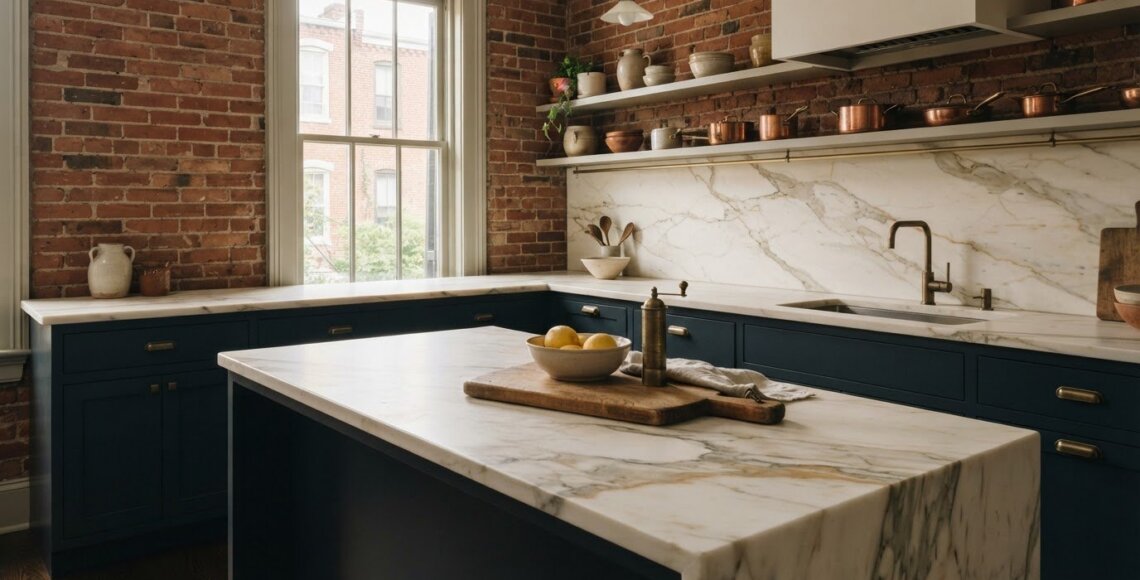
Taj Mahal quartzite island and full-height backsplash in a Richmond rowhouse kitchen

Taj Mahal Countertops for Homes and Commercial Spaces

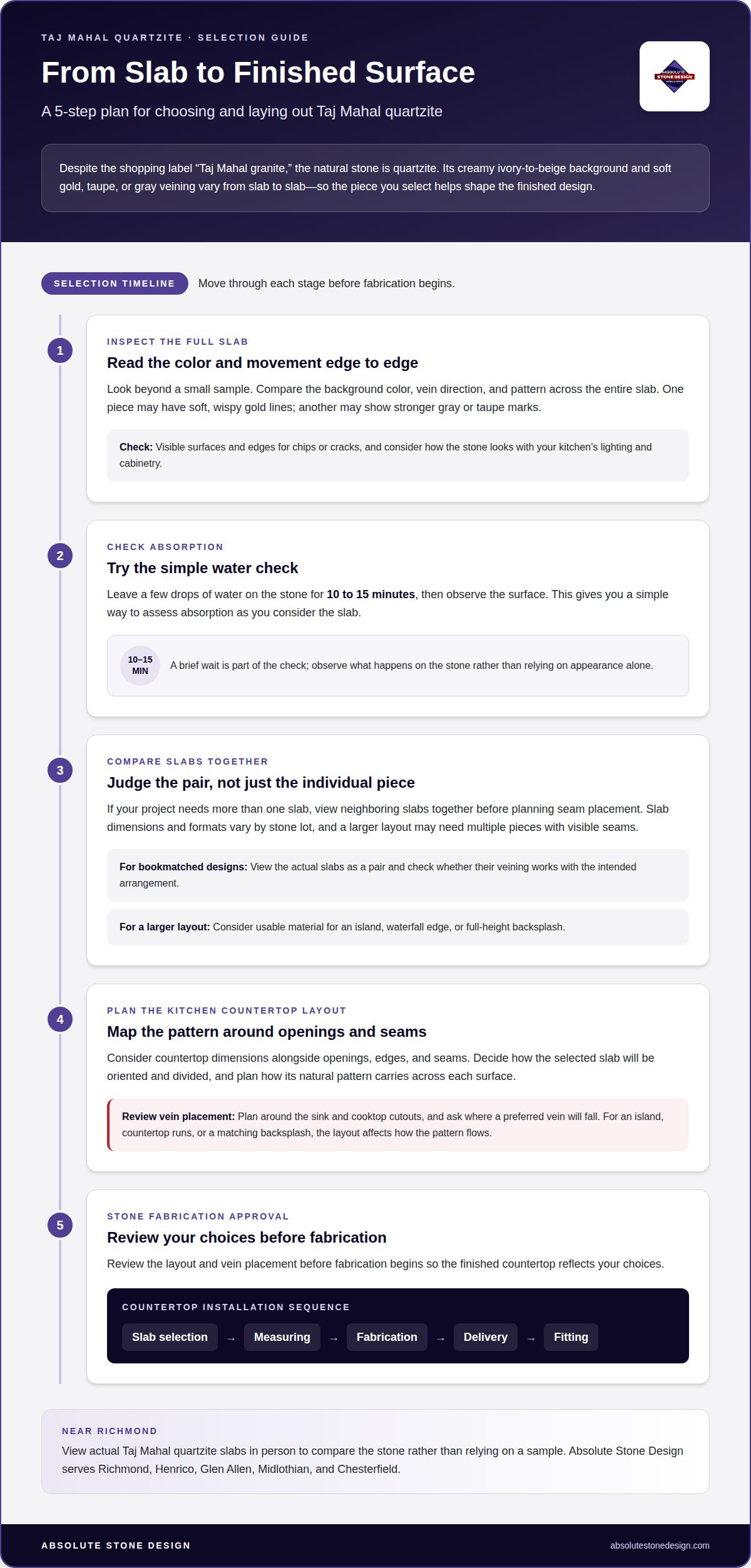
The stone sold as Taj Mahal granite is actually natural quartzite, formed when sandstone changes under heat and pressure. Its creamy ivory-to-beige background and soft gold, taupe, or gray veining create a warm, understated look. Because slabs vary in color and movement, the specific piece you choose shapes the finished design.

That natural variation matters when planning a kitchen island, countertop runs, or a full-height backsplash, especially if you want the veining to flow across seams or around a sink opening. It also helps to understand how quartzite compares with granite and engineered surfaces, since materials with a similar appearance can have different compositions and care needs.

This guide explains what Taj Mahal quartzite is made of, what to look for when selecting slabs, and how its appearance and durability compare with other surfaces. You’ll also learn when stone sealing may be appropriate. Taj Mahal quartzite is commonly sealed about once a year, depending on kitchen use, to help improve stain resistance.

Key Takeaways

  • Plan slab selection around your island, backsplash, and cutouts so the stone’s natural movement works with the finished layout.
  • Learn how natural quartzite differs from granite and engineered surfaces before choosing the look and material for your project.
  • Consider how the surface will function in a home or commercial setting, including kitchens, bathrooms, and other design applications.
  • Weigh the visual appeal and care needs of quartzite to decide whether it suits your everyday routines.

Slab variation and in-person selection

Taj Mahal quartzite ranges from creamy ivory to beige, with gold, taupe, or gray veining. For a kitchen, view the actual slabs before planning an island, seams, or a matching backsplash.

Assessing Slab Quality

Look across the full slab, not just a small sample. Compare the background color, vein direction, and pattern from edge to edge. One slab may have soft, wispy gold lines, while another shows stronger gray or taupe marks. Check visible surfaces and edges for chips or cracks, and consider how the pattern will look with your kitchen’s lighting and cabinetry.

A simple water check can help you assess absorption: leave a few drops on the stone for 10 to 15 minutes and observe the surface. Before deciding, view neighboring slabs together if your project needs more than one. This helps you compare their color and movement before planning seam placement.

Slab Sizes and Formats

Slab dimensions and formats vary by stone lot, so don’t assume one piece will cover every kitchen run or island. Consider the planned countertop dimensions alongside openings, edges, and seams. A large island, waterfall edge, or full-height backsplash may require more usable material, and the layout affects how the natural pattern carries across each surface.

Ask how the selected slab will be oriented and divided for your design. One slab may suit a smaller run, while a larger layout may need multiple pieces and visible seams. For bookmatched applications, view the actual slabs as a pair and check that their veining works with the intended arrangement.

Finding Slabs and Planning Installation

Near Richmond, view actual Taj Mahal quartzite slabs in person to compare the stone rather than relying on a sample. Absolute Stone Design serves Richmond, Henrico, Glen Allen, Midlothian, and Chesterfield, with a large stone viewing selection. For a waterfall island or bookmatched design, assess the chosen slabs together before settling on the layout.

Before fabrication, plan the kitchen countertop layout around the sink, cooktop, edges, and seams. The fabricator can show where a preferred vein will fall around sink or cooktop cutouts. Countertop installation involves slab selection and measuring, followed by fabrication, delivery, and fitting. Review the layout and vein placement before fabrication begins so the finished countertop reflects your choices.

Taj Mahal quartzite versus granite and engineered surfaces

Despite the shopping label “Taj Mahal granite,” natural Taj Mahal stone is quartzite, not granite. Quartzite forms when sandstone changes under heat and pressure over millions of years. It has a distinct geological origin from granite, even though both materials are considered for kitchen countertops.

Hardness offers one point of comparison. True Taj Mahal quartzite has a Mohs hardness of around 7, while granite typically measures between 6 and 6.5. Marble is softer, with a Mohs hardness range of 3-4. These figures describe scratch resistance, not every aspect of performance, so surface care and project needs matter too.

Engineered quartz and porcelain may use the Taj Mahal name to suggest a similar creamy, veined appearance. A quartzite countertop, however, is natural stone, and its pattern varies from slab to slab. Engineered surfaces are manufactured products, with different compositions and patterns. Compare the material itself, not just a label or photograph, before deciding.

Cabinet color can make the stone feel subtle or more defined. White or cream cabinetry echoes a pale quartzite background for a quiet, blended kitchen. Natural wood adds warmth, while dark cabinets create stronger contrast with ivory stone and gold veining. View cabinet samples beside the actual slab to judge how the combination looks.

Choose based on the look and care considerations that suit your space, rather than assuming every material performs the same way. For example, marble’s lower hardness differs from quartzite’s, while granite is a separate natural stone category. If you’re weighing natural and engineered options, explore quartzite countertops alongside granite, marble, and quartz to compare materials for your kitchen.

Taj Mahal Countertops for Homes and Commercial Spaces

Residential and commercial applications

In a home, Taj Mahal quartzite can bring a consistent stone look to kitchen countertops, bathroom vanities, and fireplace surrounds. Each setting gives the natural pattern a different role. A kitchen surface is part of daily food preparation, while a vanity or fireplace surround may serve as a quieter design feature.

For a residential kitchen, consider how the countertop connects with nearby finishes. A pale surface can complement light cabinetry, while wood or darker cabinets create contrast. On a bathroom vanity, the same stone can coordinate with nearby tile. A fireplace surround can carry the stone’s soft movement into a living room.

Commercial spaces can also use quartzite for visible surfaces, such as reception counters, office kitchenette tops, or hospitality service counters. Because routines vary, assess how the surface will be used and cleaned. A reception desk may prioritize a polished appearance, while a shared kitchenette needs a layout that supports everyday tasks.

Scale changes the design decisions. A broad reception counter may call for a calm, continuous pattern, while a smaller vanity can accommodate more noticeable veining. For a commercial project with several counters, planning stone selection and placement together can help create a consistent appearance across separate rooms.

Finish affects how the stone looks in each space. Polished Taj Mahal quartzite reflects more light and can make its veining appear more pronounced. That quality may suit a residential kitchen or reception area where a brighter look is desired. A honed finish has a matte appearance and creates a softer visual effect.

Consider the full setting before choosing. Note where the stone will sit, the cabinetry or tile beside it, and the surface’s daily role. A kitchen, bathroom vanity, fireplace surround, and commercial counter each call for a different balance of appearance and function. Matching the application to the design helps you choose with purpose.

What are the pros and cons of Taj Mahal quartzite for kitchens and bathrooms?

Taj Mahal quartzite pairs a creamy background with subtle veining, giving kitchens and bathrooms a natural stone surface with a soft, refined look. Its Mohs hardness rating is 7+, which makes it a hard surface, though hardness alone doesn’t prevent stains or damage.

In a kitchen, polished quartzite reflects more light and can make its veining look stronger. That finish may suit an island or countertop where you want the pattern to stand out. Honed quartzite has a matte appearance, while satin offers a gentler sheen than polished stone. Consider nearby lighting and cabinetry when choosing.

Bathrooms offer another application, from vanity tops to coordinated surfaces. The stone’s pale color can pair with tile to create a light, cohesive room. Its natural pattern varies, so the look across a vanity may differ from a small sample. For kitchens and bathrooms alike, viewing the slab helps you understand the finished appearance.

Care is one consideration. Sealing stone can improve stain resistance, and Taj Mahal quartzite is commonly sealed about once a year, depending on kitchen use. For everyday cleanup, use a soft cloth and a neutral cleaner intended for natural stone. Don’t assume quartzite is maintenance-free just because it is hard.

Natural stone varies, while engineered surfaces can offer a more consistent manufactured pattern. Quartzite also requires professional fabrication. Silica-containing material calls for careful handling during fabrication. That work calls for appropriate shop practices, not a do-it-yourself cutting approach.

For your project, weigh the natural variation, finish, and care routine against the look you want. If quartzite fits your kitchen or bathroom plans, plan a quartzite surface that suits the space.

Absolute Stone Design: Granite

Absolute Stone Design can help you move from comparing stone names to planning countertops for your space. If a slab labeled “Taj Mahal granite” caught your eye, remember that natural Taj Mahal stone is quartzite, not granite. For a different material direction, compare granite, marble, and quartz by appearance and how each suits your kitchen or bathroom.

For countertop projects, the team provides precise measurements and templates, in-house fabrication, and installation. This coordinated process connects your chosen surface with its dimensions, edges, and openings, helping turn material decisions into a finished countertop. Whether you’re updating a kitchen or planning a bathroom, clear design choices can guide the next steps.

Contact Absolute Stone Design to discuss your countertop project.

Shape a Surface Plan That Feels Like Yours

Your next step is to turn inspiration into a clear design direction. Think about the feeling you want the room to create, from a calm, softly blended kitchen to a reception area with a more defined focal point. If the label “Taj Mahal granite” started your search, use what you’ve learned to describe the look and material you have in mind.

Absolute Stone Design’s team can help you consider how countertops, granite, and marble fit your project’s design. Bring your ideas together around the room, the surrounding finishes, and how you want the surface to feel in everyday use. A thoughtful starting point makes the design conversation more focused, whether you’re planning a home or commercial project.

Start planning your countertop project with Absolute Stone Design, and take the next step toward a space that feels distinctly yours.

Frequently Asked Questions

What Are Taj Mahal Countertops Made Of?

Natural Taj Mahal countertops are made from quartzite, not granite. When purchasing, treat the name as a style label until the material is identified in the slab documentation. That distinction matters before you approve fabrication: the label alone cannot tell you whether the surface is natural stone or an engineered product made to resemble it.

What is Taj Mahal granite, and is it actually granite or quartzite?

The phrase “Taj Mahal granite” is a market label, not a reliable geological description. Natural stone sold under that name is classified as quartzite, while look-alike engineered surfaces may use similar wording. Before approving a slab, match its written material description to the surface you selected. This helps prevent an ambiguous label from carrying into fabrication decisions or project records.

What colors, patterns, and natural variations does Taj Mahal stone have?

Taj Mahal stone may show creamy ivory, beige, gold, taupe, or gray, with each slab offering its own balance of color and veining. If the room has adjacent surfaces, bring cabinet, flooring, or backsplash samples when viewing slabs. Compare the stone with those finishes in natural and interior lighting, then note which areas of the slab should remain visible in the final design.

How does Taj Mahal quartzite compare with granite, marble, and engineered quartz?

Compare samples side by side under the same lighting, then assess how the pattern works with your cabinet and backsplash choices. Natural quartzite, granite, and marble each have a distinct character, while engineered quartz is manufactured. For a large counter run, consider whether you prefer visible natural variation or a more controlled, repeatable look across the design.

Is Taj Mahal quartzite durable, heat-resistant, and scratch-resistant?

Quartzite is a hard surface, but a hardness rating alone can’t tell you how an installed countertop will handle every impact or heat exposure. In kitchens, protect the edges during use and don’t treat a stone top as a cutting board. Practical performance depends on the material, installation details, and daily habits. Keep those factors in mind when reviewing surface claims.

Does Taj Mahal quartzite need sealing, and how often?

Yes. Taj Mahal quartzite is commonly sealed about once a year, depending on kitchen use. Keep a note of the last application and follow the sealant label for preparation, application, and curing instructions. This interval is a maintenance guide, not a reason to apply another coat automatically. Assess the surface and its care history before repeating the treatment.

Calacatta Gold marble island and full-height backsplash in a Richmond rowhouse kitchen

Calacatta Gold Marble Countertops for Kitchens and Baths

Calacatta Gold marble countertops make a striking focal point, pairing a warm, buttery-white background with veining that ranges from deep gray to honey-toned gold. This natural pattern brings character to kitchens and bathroom vanities. But appearance is only part of the decision: marble can scratch and etch with everyday use, so the right fit depends on how you use the surface, the care you’re comfortable giving it, and the selected slab’s color and veining. This guide covers Calacatta Gold’s appearance and what to consider for a kitchen or bath, plus how to view slabs at Absolute Stone Design in Richmond. Seeing the stone in person helps you compare its pattern with your cabinets, fixtures, and overall design.

Key Takeaways

  • Match marble to how you use your kitchen or bath, and consider the care its surface needs in daily life.
  • Look at the full slab to understand how its natural pattern may flow across your countertop.
  • Plan the countertop layout, edges, and seams together so the finished surface feels cohesive.
  • Learn how measuring, in-house fabrication, and installation support a more coordinated countertop project.

Marble countertop suitability and applications

Calacatta Gold marble may suit kitchen counters, islands, and bathroom vanities when its care needs fit your routine. Consider daily use, exposure, and the surface’s role.

Countertop and Island Uses

In a kitchen, Calacatta Gold creates a distinctive surface for perimeter counters or an island. Whether it suits your kitchen depends on how you use the surface and care for it. Marble is not scratch resistant, so consider how you prepare food, handle cookware, and use the island before choosing it for a busy work area. In a bathroom, marble may be considered for a vanity, depending on the intended use and care requirements.

Stain, Etch, Scratch, and Crack Concerns

Calacatta Gold marble can stain or etch, and it can scratch because marble is not scratch resistant. Honed marble has a smooth, matte finish, but is more susceptible to staining and etching. Marble does not necessarily crack easily, though impacts and an uneven countertop support structure can damage a slab. Professional stone sealing is recommended annually, with surface restoration and protection specialists like Sealwerx highlighting the importance of regular protective treatments to guard porous natural stone against deep staining.

For a residential kitchen, weigh the visual appeal against the care involved in cooking and cleanup. A bathroom vanity may face different demands than a kitchen island, so choose the application with your daily routine in mind. A honed finish also affects how the surface responds to stains and etching, making finish selection part of the decision.

Commercial settings call for the same practical assessment. A marble reception counter may see different use from a restaurant work surface, while marble flooring requires consideration of foot traffic and maintenance. Match the stone to the setting rather than assuming one application suits every project. This helps you decide whether Calacatta Gold belongs on counters, floors, or selected feature surfaces.

Slab inventory and showroom viewing

Viewing a full slab lets you assess its color, veining, and pattern before fabrication. Calacatta Gold varies between natural stone blocks, so inspect the actual piece.

Slab Inventory and Thickness Options

Calacatta Gold slabs are available in 2 cm and 3 cm thicknesses. Thickness affects the slab profile and planned edge details. Compare the selected thickness with the countertop support structure and intended edge treatment. A fabricator can review the kitchen countertop layout and explain how the slab may be planned for counters, an island, and seams.

Listed examples include a Calacatta Gold Borghini polished slab measuring 117 by 78 inches and a Calacatta Gold Caldia polished slab measuring 128 by 74 inches. Slab dimensions help inform layout planning, but pattern placement also matters. Review how the fabricator plans to position the stone across countertop runs.

Natural Stone Variation and Slab Selection

How can a stone fabricator help you choose and inspect Calacatta Gold marble slabs? The fabricator can guide you through the slab, point out vein direction and color shifts, and discuss how those features may align with your countertop plan. Seeing the full stone helps you assess its character beyond a small sample.

Natural stone blocks can vary in appearance, and gold-vein intensity differs between quarry blocks. One slab may look warmer or more dramatic than another. Examine the entire face and consider where prominent veins will fall across long countertop runs.

Inventory details can complement a full-slab inspection. A New Jersey Calacatta Gold A1 Select marble slab is 1-1/4 inches thick, measures 70X128, and has 62.22 square feet available. A Texas Calacatta Gold A1 Select marble slab measuring 70 by 135 inches is 1-1/4 inches thick and has 65.63 square feet available. Another New Jersey Calacatta Gold A1 Select marble slab measures 79 by 129 inches and has 70.4 square feet available.

Other listed Calacatta Gold A1 Select slabs include one measuring 69 by 138 inches with 66.13 square feet available, and one measuring 74 by 121 inches with 62.18 square feet available. Comparing available area and dimensions with the countertop plan can help narrow the slabs to inspect, while viewing the actual stone lets you consider its color and vein placement.

Calacatta Gold Marble Countertops for Kitchens and Baths

Calacatta Gold marble appearance and characteristics

Calacatta Gold’s visual character depends on the scale and direction of its veining. Broad, sweeping lines can create a dramatic focal point, while finer movement may feel quieter across a long counter. Consider how the pattern will sit beside cabinet colors, hardware, and flooring. Warm cabinet finishes can echo the gold tones; cooler finishes can bring the gray veins forward.

Calacatta Gold marble is quarried natural stone, while Calacatta Gold quartz is an engineered surface inspired by marble’s appearance. Marble’s individual pattern comes from the stone itself, so the finished surface has natural variation. Other marble countertops also differ in background color and vein character. Compare the actual material with nearby finishes to decide which overall effect suits your room.

Edge profiles, surface finishes, and backsplash choices shape the design as a whole. A more decorative edge can add detail, while a restrained profile keeps attention on the stone’s pattern. For the backsplash, consider whether you want a coordinated stone surface or a contrasting material. Lighting matters, too: it can change how a polished surface reflects and how its veining reads.

Professional measurement captures the countertop’s dimensions, wall contours, overhangs, and sink or cooktop openings. A template then guides fabrication, including cutout placement. Before installation, the room and countertop support structure are prepared for fitting. Installers position the fabricated sections, join planned seams, and assess how the finished edges meet adjoining walls and cabinets.

These choices work together. A broad-veined slab, for example, may call for a simpler edge and a quieter backsplash, while a subtler pattern leaves room for more decorative details. Consider the whole room, not just a small sample, when shaping the final design.

Planning a Calacatta Gold Marble Countertop Project

Start with how the room needs to work, not just how it should look. In a family kitchen, you may want a clear prep zone separate from the area where guests gather. For a bathroom vanity, consider who shares the space and how much counter area supports your morning routine. These priorities help shape the project brief.

Next, coordinate the countertop project with the wider renovation. Cabinet changes, flooring work, and wall finishes can affect the room’s readiness and how design choices fit together. If you’re keeping existing cabinets, include that in the plan early. A new build may offer more freedom to coordinate the room’s finishes from the start.

Think through how the space will function during the work. A kitchen renovation may temporarily limit access to cooking and cleanup areas, while a bathroom project may affect a shared daily-use space. Discuss the project schedule and household needs with the team so the work can be planned around the room’s role.

For a commercial project, consider how staff and visitors use the space. A reception counter has different demands from a food-service work area, and the surrounding operation may affect access during the project. Share the intended use, cleaning routine, and any site constraints with the project team. Those details keep the design discussion grounded in the setting.

Finally, choose a clear point of contact for decisions. When homeowners, designers, and contractors are involved, shared priorities help keep selections consistent. Agreeing on the preferred balance between a striking focal point and a quieter overall room, for example, makes later choices easier to evaluate. A well-defined brief gives the team a practical direction from the outset.

Absolute Stone Design: Countertops

Absolute Stone Design manages marble countertop projects from material selection through installation. Its countertop services include precision measuring, templates, in-house stone fabrication, delivery, and installation. This connected process helps account for the slab’s natural pattern alongside the room’s dimensions and planned edges.

For a Calacatta Gold project, visit Absolute Stone Design’s Richmond showroom to view marble and discuss how its veining may suit your kitchen or bathroom. Measurements and a template translate the selected material into countertop pieces, including sink openings and an island. Reviewing the layout and design details before fabrication helps align the finished surface with your plans.

Absolute Stone Design also offers granite and quartz countertops. Each material offers a different way to coordinate your room’s surfaces, so your choice can reflect the appearance and everyday use you have in mind. If you’re comparing marble with another option, the team can discuss the materials and how each may fit your project, without treating them as interchangeable.

Whether you’re renovating a bathroom vanity or planning kitchen counters and an island, begin with the room and the decisions that shape its finished look. Absolute Stone Design manages the process from measurements through delivery and installation, with in-house fabrication keeping the stone work within one workflow. Share your design priorities with the team to discuss the next steps for your project.

Contact Absolute Stone Design to discuss your countertop project.

Frequently Asked Questions

What is Calacatta Gold marble and what does it look like?

Calacatta Gold is marble quarried in Italy, known for expressive natural patterning. Its appearance can shift from slab to slab, so the stone’s name alone does not tell you exactly what a particular piece will look like. If your room has several finishes, compare the selected stone with cabinet and flooring samples under the planned lighting.

Is Calacatta Gold marble durable and suitable for kitchens and bathrooms?

Calacatta Gold can work in either room if you’re comfortable caring for marble as a natural surface. In a kitchen, consider whether you regularly prepare food directly on counters or can use cutting boards and trivets. In a bathroom, think about how the vanity is used and cleaned. The right application depends on your routine, not just the room’s appearance.

How do you seal, clean, and maintain Calacatta Gold marble countertops?

Build a simple care routine around gentle daily use: place a cutting board under food, use trivets for hot cookware, and choose nonabrasive cleaning tools. Keep cosmetics and toiletries on trays where practical, especially near a bathroom sink. Ask the fabricator which care products suit the selected finish, then follow its guidance for maintenance and resealing.

Where can you buy Calacatta Gold marble slabs near me, and what should you ask a stone fabricator?

For homeowners in Richmond, Henrico, Glen Allen, Midlothian, and Chesterfield, Absolute Stone Design’s Richmond showroom offers a place to view slabs in person. For a large project, consider whether slabs from the same lot would help maintain a consistent look, since gold-vein intensity can vary between quarry blocks. Discuss how the team can help assess the selected stone’s overall pattern for your project.

What countertop edge profiles, finishes, and backsplash options work with Calacatta Gold marble?

A decorative edge adds detail, while a restrained profile keeps attention on the veining. A honed finish is smooth and matte, but more susceptible to staining and etching. For the backsplash, choose coordinated stone or a contrasting material; broad veining can pair well with a quieter backsplash.

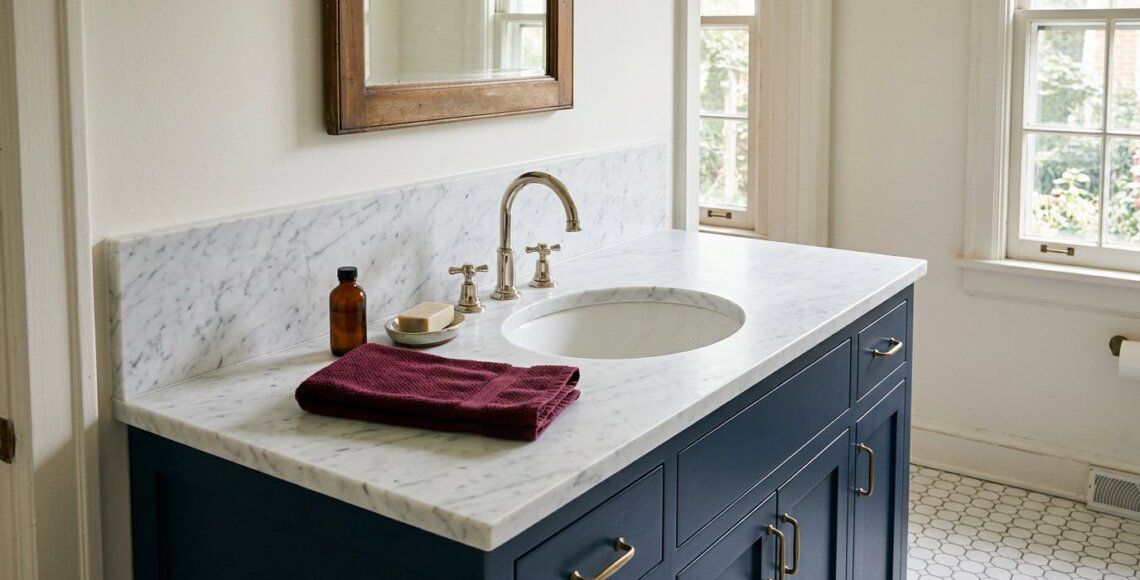
Carrara marble bathroom countertop with natural gray veining in a Richmond bungalow vanity

Marble Bathroom Countertops: Slab Costs and Design Examples

Marble bathroom countertops bring natural veining and a refined feel to a vanity, while offering heat resistance that can be useful around shower steam and styling tools. Their beauty does come with care considerations: marble can be susceptible to staining, etching, and moisture intrusion, so choosing the right design also means thinking about how the surface will be used and maintained. If you’re drawn to marble, you’re likely weighing its timeless look against everyday practicality; this guide explores bathroom design ideas, the factors that shape slab selection, and how marble’s heat resistance fits into a real home, so you can make a more confident choice for your space.

Key Takeaways

  • Compare marble colors, veining, and finishes to find a vanity surface that suits your bathroom’s style and everyday care needs.
  • Explore design choices such as pairing a stone countertop with coordinated bathroom tile for a more unified look.
  • Marble offers heat resistance, but its porous surface can be vulnerable to staining, etching, and moisture, so plan for thoughtful care.
  • Weigh marble’s natural character against quartz and granite to choose a countertop material that fits your priorities.

Marble Slab Options for Bathroom Countertops

Carrara, Calacatta, and Statuario are familiar marble choices for bathroom vanities. Each slab has its own natural pattern, from subtle movement to pronounced veining. For a quiet, cohesive design, pair a softly patterned slab with simple cabinetry. To make the vanity a focal point, choose stronger veining and keep surrounding finishes restrained.

Finish affects both appearance and how minor wear shows. Polished marble has a smooth, reflective surface that can brighten a vanity area. Honed marble has a softer, matte look and can help conceal minor scratches and etching. In a busy shared bathroom, for example, a honed finish can make small marks less noticeable. It changes the look, but marble still needs care.

Color and layout work together. Light marble can complement pale tile for a calm, continuous palette, while contrasting cabinetry can define the vanity. Before fabrication, plan how the veining will run across the countertop and around the sink opening. This helps the finished surface look intentional, rather than leaving a prominent vein awkwardly cut at an edge.

Marble is porous, so moisture and staining are considerations in a bathroom. Sealing can help guard against stains, and marble bathroom countertops need regular resealing.

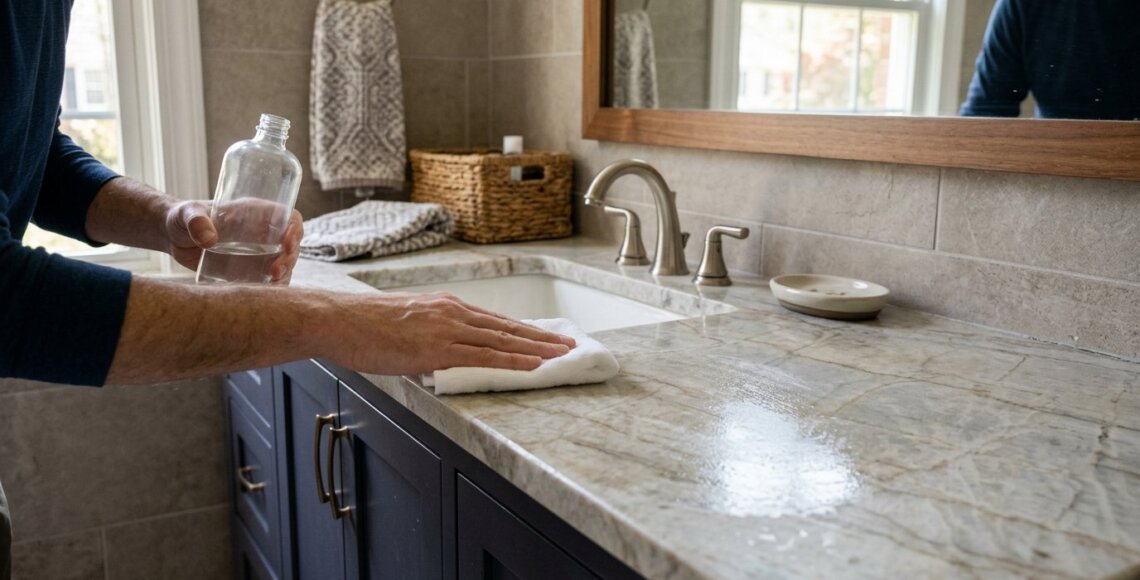
Marble can stain or etch, and its softer surface may scratch if objects scrape or fall on it. Avoid harsh abrasive or chemical cleansers. Wipe spills promptly and use gentle cleaning methods, since bathroom products can affect the surface.

Before buying, ask the countertop installer how the slab will be measured, how its veining will align around the sink, and what finish and sealing care it needs. Those details connect your design choice to fabrication and everyday maintenance.

Bathroom design inspiration featuring marble countertops

Marble brings natural pattern and a refined focal point to a bathroom. Its distinctive veining and heat resistance are advantages; susceptibility to staining, etching, moisture, and scratches are drawbacks to consider. In a calm, light-toned bathroom, for example, a marble vanity can add movement while simple surrounding finishes keep the space balanced.

For a cohesive look, coordinate the slab’s veining with the room’s other finishes. In a compact bathroom, a pale marble top paired with understated cabinetry can keep the vanity from feeling visually heavy. In a larger room, a more strongly veined slab can anchor the design. Simpler tile and fixtures allow the stone to stand out.

Care matters after installation. Marble is porous, so regular sealing can help guard against stains. A professional can renew the protective seal as part of ongoing maintenance; timing depends on the surface’s condition and exposure to moisture. For daily cleaning, wipe spills promptly and avoid harsh abrasive or chemical cleansers.

For installation, a professional measures the vanity and creates a template that accounts for the sink opening, edges, and fit. The stone is fabricated to those measurements, then delivered and installed. This process helps align the finished countertop with the vanity and planned plumbing openings. For homeowners undertaking a broader renovation, working with an experienced team like Black Bear Construction can help coordinate the vanity, plumbing, and surrounding finishes into a cohesive space.

Before fabrication, review the slab’s pattern and planned cuts together. If a prominent vein crosses the sink area, for instance, adjusting the layout may create a more intentional focal point. This connects material selection to the finished room.

Marble Bathroom Countertops: Slab Costs and Design Examples

Heat resistance

Marble’s heat resistance can be useful around shower steam and heat-styling tools. After a warm shower, for example, steam may linger near the vanity, making marble a suitable surface for this setting. Heat resistance does not make the countertop immune to damage, so thoughtful placement and care still matter.

Consider a morning routine that includes a curling iron or hair dryer. Set styling tools on a protective mat or stand rather than directly on the stone. This gives hot tools a dedicated resting place and keeps them off the vanity surface. Clearing space near the mirror can also make getting ready easier.

Heat is only one part of bathroom performance. Marble is porous and can be susceptible to staining, etching, and moisture intrusion, so pay attention to regular exposure to water and personal-care products. If a bottle leaks beside the faucet, wipe it up promptly and use gentle cleaners. These habits help protect the surface without changing its natural appearance.

During design planning, consider where heat sources and wet areas sit in relation to the countertop. If styling tools are kept beside the sink, include a safe resting spot in the vanity arrangement. If steam gathers around a mirror, consider how the countertop finish and surrounding materials work together. A well-planned layout reflects your routine as well as the slab’s appearance.

Marble’s heat resistance can make it a fitting option for a bathroom exposed to steam and styling tools. Pair that advantage with sensible care, especially around moisture and personal-care products. This balance lets you enjoy the stone’s distinctive look while accounting for everyday use.

How does marble compare with quartz and granite for bathroom countertops?

One difference you’ll notice first is marble’s natural veining, which gives each slab individual movement. Granite is also natural stone, while quartz countertops offer an engineered surface option. Marble can add distinctive pattern to a calm bathroom palette. If you prefer a more consistent look, compare quartz slabs alongside marble before choosing.

Marble’s beauty comes with care considerations. It is porous and may be susceptible to staining, etching, and moisture intrusion. Its softer surface can also scratch if an object drops or scrapes across it. In a busy family bathroom, for example, frequent spills and daily grooming may make maintenance an important part of your material decision.

Compare materials according to your priorities rather than assuming one always performs best. If natural variation matters to your design, review marble and granite slabs for their patterns. If you want to consider an engineered option, view quartz samples beside your tile and cabinetry. Seeing the materials together shows how each choice may shape the room.

Use a simple selection process: decide how much natural pattern you want, consider the care you’re comfortable providing, then compare samples in your bathroom’s lighting. Honed marble, for instance, can help conceal minor scratches and etching, but it still needs care. Choose a surface that balances appearance with how the vanity will be used.

For marble bathroom countertops, plan on regular resealing and avoid harsh abrasive or chemical cleansers. Granite and quartz have different material characteristics, so discuss the specific slab and finish during selection. Reviewing marble, granite, and quartz side by side can clarify which surface best suits your bathroom’s design and daily routine.

Marble can scratch when objects are dropped or scraped across it, so consider how the vanity is used when comparing it with granite or quartz. A countertop choice is about more than appearance: the possibility of surface marks may affect how comfortable you feel using the space. Weigh that concern against marble’s distinctive veining and the care routine you’re prepared to maintain.

Absolute Stone Design: Countertops

Absolute Stone Design helps you move from comparing marble and quartz to planning a bathroom countertop that fits your space. Its countertop work includes precision measuring, templating, in-house stone fabrication, delivery, and installation. That process is useful when you’ve chosen a marble look and need the slab shaped for your vanity and sink.

For a marble design, the slab’s veining and finish guide the visual plan. Measurements and a template shape the countertop to the vanity, while fabrication turns the selected stone into a fitted surface. Granite is another natural-stone option. Comparing both materials with your bathroom’s tile and cabinetry can help you choose a cohesive pattern.

Bathroom tile work can coordinate the surfaces around the vanity. A quieter tile, for example, lets expressive marble veining take the lead, while more detailed tile creates a layered look. Considering these finishes together helps clarify the room’s design direction.

Absolute Stone Design handles residential and commercial countertop projects. If you’re considering a marble or granite countertop, share your material preferences and project needs to plan a surface suited to your bathroom. The team’s process covers measurements, fabrication, delivery, and installation, with the details shaped around your space.

To discuss your bathroom countertop project, contact Absolute Stone Design.

Frequently Asked Questions

What types of marble are best for bathroom countertops?

Carrara, Calacatta, and Statuario are popular choices for marble bathroom countertops, each with distinctive natural veining. The right fit depends on the look you want and how much variation suits your room. Compare slab samples with your vanity cabinet and tile to see whether the stone’s pattern complements your planned finishes.

What project details shape a marble vanity installation?

The installation plan depends on the vanity’s dimensions, selected slab, edge design, sink opening, and site conditions. These details determine how the stone is measured, fabricated, and fitted. A vanity with an unusual shape, for example, needs a template that captures its full outline. Reviewing the layout before fabrication helps align the finished surface with the room.

What edge profiles and finishes are available for marble vanity tops?

Common marble edge choices include eased, rounded, and beveled profiles; finishes often include polished and honed. For marble bathroom countertops, a rounded edge can soften a vanity’s outline, while a crisp eased edge suits a simpler design. Review the profile alongside the slab and cabinet style before fabrication, since the edge affects the finished appearance and how the countertop thickness looks.

Can a marble vanity top be repaired if chipped or stained?

Some chips and stains can be treated, but the right approach depends on the damage and marble’s condition. A small edge chip, for example, differs from a stain that has penetrated the stone. Avoid abrasive cleaners and improvised repair products, which may worsen the surface. A stone professional can assess the affected area and recommend a suitable repair or cleaning approach.

A homeowner applies sealer to a naturally veined quartzite bathroom vanity in a Glen Allen home.

Quartzite Colors, Durability, Care and Sealing Needs

Yes, quartzite generally needs periodic sealing to help protect its porous surface from stains. Wipe spills promptly and avoid harsh or acidic cleaners. To understand what quartzite is, start with its geology: heat and pressure transform quartz-rich sandstone into a dense natural stone. This differs from engineered quartz, which combines mined quartz with resin and pigments. Quartzite’s minerals create natural colors and veining, so slabs range from calm, pale backgrounds to more expressive patterns. It can bring a refined look to a kitchen or bath and offer strong everyday durability, but no natural surface is maintenance-free. This article explains how quartzite’s composition shapes its appearance and performance, how it compares with quartz, and what routine care and sealing involve, helping you decide whether its character and upkeep suit your home.

Key Takeaways

  • Learn how mineral traces influence a slab’s color and pattern, and what to look for when choosing a finish that suits your space.
  • Understand how natural stone formation differs from engineered quartz, so you can compare the materials with greater confidence.
  • Get practical guidance on everyday care and the habits that help protect a stone countertop from stains and surface damage.
  • Consider how each material’s characteristics fit your home’s style, daily use, and maintenance preferences.

Natural quartzite colors and mineral impurities

Natural quartzite often appears white, cream, or gray, with veins and patches that add movement across a slab. Iron-bearing minerals can create pink, red, or rust-colored areas, while other mineral impurities may contribute green or darker markings. The mix and distribution of minerals shape each stone’s colors, so even slabs from the same collection can have distinct patterns.

Veining can appear as soft, cloudy bands or sharper lines across the surface. A pale background with gray veining may feel quiet, while brown or gold streaks create stronger contrast. Cutting also affects how these patterns appear: the slab’s direction and the placement of cut pieces determine which veins continue across a countertop. Reviewing the full slab helps you see how its grains and markings will look in your space.

The finish also changes the look. A polished surface reflects light and can make colors seem more pronounced; honed stone has a softer, less reflective appearance. A leathered finish adds tactile texture and highlights variation in the stone. These finishes change how light meets the surface, not the minerals that give the rock its color.

Natural quartz crystals show a broader range of colors than the mostly pale appearance associated with many quartzite slabs. Clear, white, smoky, pink, and purple crystals are examples; trace elements and formation conditions influence their color. Quartzite’s appearance reflects the rock as a whole and its mineral impurities, rather than a single crystal.

Some quartzite, including Cristallo varieties, can transmit light and suit backlit designs. Transparency depends on the particular stone and its structure. In gemstone-quality material, cutting can reveal translucence or emphasize color, while a countertop slab may show cloudy areas, visible grains, or veining. Viewing the actual piece in different lighting helps reveal its colors, clarity, and pattern before you choose it.

What is Difference Between Quartz and Quartzite?

Quartzite and quartz share a mineral name but describe different materials. Their formation and composition explain key differences between the countertop options.

Composition and Metamorphic Formation

Quartzite is a natural metamorphic rock composed mainly of interlocking quartz grains. Its name describes the rock; quartz names a mineral found within it. This distinction matters when comparing quarried stone with engineered quartz. Natural quartzite forms in the earth, while engineered quartz combines mined quartz with resin and pigments. The materials therefore differ in composition and how they are made.

Geological Origins

Quartzite begins as quartz-rich sandstone buried and exposed to intense heat and pressure. During metamorphism, its original grains recrystallize and fuse, forming dense stone. This process can change the rock’s texture without making it a manufactured surface. For countertop decisions, that origin explains why quartzite is natural stone and why individual slabs can differ.

Formation from Sandstone

Quartz-rich sandstone contains 90% to 99% quartz grains. As heat and pressure act on the buried rock, the grains recrystallize and bind together, creating quartzite. The sandstone’s original structure changes, but quartz remains central to the resulting stone. This formation process helps explain quartzite’s hardness and why its natural surface can be resistant to everyday wear.

Engineered quartz follows a different path: manufacturers combine crushed, mined quartz with resin and pigments. It is about 93% quartz, while quartzite is a natural stone formed underground. That difference affects the material’s character and care. Quartzite can withstand high temperatures, while resin in engineered quartz can be damaged by excessive heat. A cutting board and prompt spill cleanup help protect either surface during daily use.

Quartzite Colors, Durability, Care and Sealing Needs

Quartzite countertop durability and maintenance

Quartzite has a Mohs hardness of around 7, making it resistant to everyday scratches. Is quartzite harder than granite? Quartzite generally ranks higher in hardness, while both natural stones resist heat and everyday wear. Formed under heat and pressure, quartzite is dense, but countertops can still chip or dent from impact. Use a cutting board, and avoid striking exposed edges with cookware.

What are the pros and cons of quartzite countertops? Their strengths include natural patterns, high heat tolerance, and hardness. The tradeoffs are periodic sealing and care to limit stains, chips, and dents. Quartzite’s porous surface can absorb spills, so wipe them promptly. Sealing helps protect against staining, but it does not make the countertop immune to damage.

Quartz countertops have different care needs because they contain resin. They’re often more stain-resistant than quartzite, but less heat-resistant; repeated exposure to temperatures over 500 degrees Fahrenheit may cause heat damage. Excessive heat can damage quartz countertops. A cutting board also helps prevent knife scratches. For routine cleaning, wipe quartz with a damp cloth. These differences matter if you regularly set hot cookware or prepare food directly on the counter.

Quartzite can suit countertops, kitchen islands, bathroom vanities, and bar tops, but each application brings different exposure to spills, heat, and daily wear. A busy kitchen island, for example, needs prompt spill cleanup and attention to its seal. An outdoor kitchen requires a separate evaluation based on the stone’s performance, local climate, and intended use. If your outdoor living plans also encompass an adjacent swimming area, industry specialists like Rod Cameron Pools provide helpful guidance on what to expect during surface restoration and maintenance. Gem-quality quartzite and countertop slabs serve different purposes: a translucent gemstone cut for light is not automatically suited to a work surface. Choose according to how you’ll use the surface, the appearance you want, and the care it requires.

Quartz and quartzite composition

Quartz is a mineral; quartzite is a metamorphic rock made mostly from quartz. That difference explains why a quartz crystal and a quartzite slab have distinct textures, even though both contain the same mineral. Quartzite is composed of more than 90% quartz, while the remaining minerals can vary. Those differences influence the stone’s color, veining, and other visible characteristics.

Heat and pressure transform quartz-rich sandstone into quartzite. Its grains recrystallize and become tightly interlocked, creating the stone’s crystalline texture. Mineral impurities, such as iron oxide, can add color, while a purer quartz-rich composition may look more uniform. The mineral mix varies from piece to piece, helping explain why natural stone slabs rarely have identical patterns.

Quartz has a crystalline structure and a chemical composition distinct from the full rock. In quartzite, quartz crystals are part of a larger mineral arrangement rather than a single specimen. This matters when comparing a crystal’s clarity with a slab’s overall appearance: other minerals and the arrangement of grains affect the stone’s color and texture.

For gem-quality quartzite, measured characteristics include a density of 2.64 to 2.69, a refractive index of 1.544 to 1.553, and birefringence of 0.009. These values describe how gemstone material behaves with light and measurement. They don’t explain every countertop’s appearance, since mineral variety and grain structure also shape each slab.

Composition can help explain what you’re seeing: a pale field with darker veins may reflect differences in mineral content, not a surface coating. Compare the whole slab under consistent lighting, then consider how its pattern will fall across your planned countertop. This gives you a clearer sense of the stone’s natural characteristics before choosing a particular piece.

Absolute Stone Design: Quartz

Absolute Stone Design can help you compare quartzite and quartz when planning countertops in Richmond, Henrico, Glen Allen, Midlothian, or Chesterfield. When weighing natural stone’s distinctive patterns against engineered quartz’s composition, start with how you use the space, the look you want, and the care each surface needs.

The team handles the process from measuring through delivery and installation, with stone fabrication completed in-house. This connected approach carries your material choice through to the finished countertop. Granite is also available if you’re considering another natural stone for your project.

Contact Absolute Stone Design to discuss your countertop plans.

Choose a Surface That Fits Your Home

Understanding what quartzite is gives you a helpful starting point. Next, picture how the surface will work with the room’s lighting, cabinetry, and daily routines. A striking slab may look different beside your existing finishes, so consider the whole space as you shape your plans.

Absolute Stone Design offers quartzite, quartz, granite, and marble countertops for projects in Richmond, Henrico, Glen Allen, Midlothian, and Chesterfield. The team can help you think through your design direction and which material suits your needs. Bring your priorities, from the look you want to how you use the room, into the conversation.

Ready to take the next step? Contact Absolute Stone Design to discuss your countertop plans and move your project forward with confidence.

Frequently Asked Questions

Does quartzite need to be sealed?

Yes. Sealing is part of caring for a quartzite surface, but it should not be treated as a one-time finish. Before applying sealer, make sure the countertop is clean and dry, and choose a product intended for natural stone. Follow its label directions, including guidance on application and curing, to avoid affecting the finish.

Where Does Quartzite Come From?

Quartzite is quarried from natural deposits found in several countries, including the United States. In the U.S., deposits occur in the Appalachian Mountains, which extend through 13 states. That broad geological region means domestic quartzite can come from different locations, with natural variation from deposit to deposit. The origin may help explain why slabs vary in appearance, even within a similar color family.

What is quartzite and how does it form?

Quartzite is a natural metamorphic rock formed from quartz-rich sandstone. One useful way to understand its classification is through the British Geological Survey’s standard: a metamorphic rock is quartzite when it contains at least 80% quartz by volume. This threshold distinguishes quartzite from some quartz-rich rocks that may look similar but have a different geological identity.

How can you tell quartzite from marble or quartz?

Color and veining alone cannot reliably identify a slab, since quartzite and marble can look alike. For a renovation, use the material identification provided with the stone rather than relying only on a sample’s appearance. Compare the full slab with the selected sample, too, since natural patterns can vary. Clear material identification helps you match care expectations to the surface you choose.

Is quartzite heat-resistant and scratch-resistant?

Yes, quartzite resists heat and everyday scratching, but it is not immune to every kitchen hazard. Avoid sliding gritty cookware or small appliances across the surface, since trapped particles can abrade the finish. Place hot cookware carefully rather than dropping it onto the countertop. These habits help preserve the polished appearance without treating the stone as damage-proof.

Does quartzite need to be sealed, and how often?

Yes, but no single calendar interval suits every quartzite countertop. Follow the sealer’s care directions and note the product and application date so you can plan maintenance consistently. A sink area may encounter water more often than a lightly used counter section. Differences in use can affect when resealing is needed.

A homeowner compares engineered quartz and naturally veined quartzite countertop samples in a Richmond showroom.

Quartz vs Quartzite: Which Countertop Should You Choose

The most natural-looking countertop isn’t always the one that asks the most of your care routine. In the quartz vs quartzite decision, quartz is an engineered surface that generally doesn’t need sealing, while natural quartzite needs periodic sealing to help resist stains.

Both can bring lasting beauty to a kitchen or bathroom. The right fit depends on what matters most in your home: a more consistent appearance and simpler upkeep, or the natural veining and variation of stone. Weigh everyday care alongside the look you want, especially for a busy kitchen.

Learn how the materials are made, how their appearance and everyday care differ, and what quartzite sealing involves, including how to tell when it may be time to reseal. These practical details can help you choose a countertop that suits your space and routine.

Key Takeaways

  • Choose based on the look and upkeep you prefer: engineered quartz has a more consistent appearance, while natural quartzite has distinctive veining and variation.
  • Understand how each surface responds to heat so you can build practical habits around cooking and countertop care.
  • Quartzite needs periodic sealing, and a simple water test can help indicate when it’s time to reseal.
  • Learn how each material is made to better understand the differences you’ll see in your finished countertop.

Quartz vs Quartzite: What’s the Difference and Which Should You Choose?

Quartz is an engineered countertop material made with crushed quartz, resin, and pigments; quartzite is natural stone formed from sandstone. That difference affects appearance and care: quartz usually has more consistent patterns and generally doesn’t need sealing, while quartzite has natural variation and needs periodic sealing to help resist stains. Both can suit a kitchen, but their upkeep differs.

What are the pros and cons of quartz versus quartzite countertops? Quartz offers a consistent look and simpler care, but hot cookware can damage its resin, so use a trivet. Quartzite offers natural veining and greater heat tolerance, but its porous surface needs sealing and prompt spill cleanup.

Which countertop is easier to maintain and repair? Quartz is usually simpler to maintain because it generally doesn’t need sealing. Repair depends on the type and location of damage. Matching a repair to quartzite’s natural veining can be challenging, while quartz’s more consistent patterns may make visual coordination easier.

How can you tell genuine quartzite from mislabeled or soft quartzite? Apply lemon juice to a sample or offcut for several minutes; true quartzite shouldn’t develop an etched, dull spot from acid. Don’t test an installed countertop, since another material could be damaged.

Countertop Appearance Care Kitchen consideration
Quartz More consistent engineered patterns Generally no sealing Protect from hot pans with a trivet
Quartzite Natural veining and variation Periodic sealing; clean spills promptly More heat-tolerant, but porous

Choose quartz if consistent patterns and simpler maintenance fit your priorities. Choose quartzite if you prefer natural variation and are comfortable with sealing and prompt cleanup. Before deciding, consider where the countertop will go, how you use that area, and which surface’s care needs feel manageable for your household.

Quartzite vs Quartz: What are Quartzite Countertops?

Quartzite begins as sandstone, then forms under heat and pressure over millions of years. Its natural colors and veining vary from slab to slab, unlike the more consistent patterns often found in engineered quartz. That natural character is part of its appeal, but the surface also needs care suited to natural stone.

Which is harder and more durable, quartz or quartzite? Quartzite generally ranks between 7 and 8 on the Mohs hardness scale, while quartz rates around 7. Both resist everyday scratches, but quartzite is harder; granite also stands up well to scratches, heat, and general wear. Marble is softer than quartzite and more likely to scratch.

How resistant are quartz and quartzite to stains, scratches, heat, and UV light? Quartz resists stains without sealing and handles everyday scratches, but its resin can be damaged by high heat. Porous quartzite can stain if spills penetrate, yet it offers strong scratch and heat resistance. Some quartzite contains resin that may fade in UV exposure, so resin-containing slabs aren’t suited to outdoor use.

Heat tolerance matters beside a range or on a kitchen island. Quartzite tolerates heat better than engineered quartz, whose resin can be damaged by hot cookware. Granite also resists heat, but using a protective trivet is sensible with any countertop. According to Cambria, use a closed-weave hot pad or solid trivet to protect quartz and quartzite surfaces.

Quartzite’s hardness doesn’t make it immune to damage. A sharp impact can still chip a countertop edge, and acidic foods can affect some natural stones. Wipe up lemon juice promptly, for example, and use a cutting board instead of cutting directly on either surface.

For a material choice that balances natural veining with everyday kitchen routines, explore quartzite countertop options and consider how heat, spills, and sunlight affect your space.

Quartz vs Quartzite: Which Countertop Should You Choose

Does quartzite require sealing and how often?

Yes. Quartzite is porous, so liquids can enter the stone and leave stains; sealing adds protection but doesn’t make the countertop stain-proof. Sandstone transforms under heat and pressure to form quartzite, and differences between slabs and finishes affect how readily each surface absorbs moisture. That’s why sealing needs can vary, even for a premium countertop material.

Resealing guidance varies: quartzite countertops generally need resealing one to two times per year, while another typical interval is once every one to three years, depending on the stone and its use. These are different recommendations, not one schedule for every slab. A polished finish, daily cooking, and frequent spills can all affect maintenance needs.

Use a water test to judge whether the sealer is still working. Place a few drops of water on the countertop and watch what happens. If the water absorbs within a few minutes instead of beading, resealing is needed. If it beads, the seal remains effective at that spot; repeat the test elsewhere, since wear may differ across the counter.

For daily cleaning, wipe spills promptly and choose a natural-stone-safe or pH-balanced cleaner. Lemon juice and vinegar can etch some stone surfaces, so clean them up quickly rather than letting them sit. For a fresh spill, start with water and mild dish detergent, then rinse and dry the area.

Sealing helps reduce staining, but routine care still matters. Coffee left on a porous section can penetrate despite a sealer, while a promptly wiped spill is less likely to linger. Avoid harsh, acidic cleaners, which can affect the surface or sealer. Follow the care directions for your countertop, and repeat the water test if absorption suggests protection has weakened.

How engineered quartz and natural quartzite are made

Engineered quartz countertops are made by combining ground natural quartz aggregate with resin and pigments, then forming the mixture into slabs. Many engineered surfaces contain about 90 to 95 percent quartz aggregate; the rest includes resin and colorants. This process lets manufacturers create patterns with a more consistent appearance than natural stone. For example, repeated slabs can offer similar color and veining across a kitchen.

Natural quartzite forms when sandstone undergoes heat and pressure over millions of years. The pressure transforms the original rock into a hard, quartz-rich natural stone. Its composition and color depend on the minerals present as the sandstone forms. Quartzite slabs are typically more than 90 percent quartzite, and some can reach 99 percent. Each slab develops its own pattern rather than following a manufactured design.

The distinction between quartz and quartzite is clear in their patterns. Engineered quartz can offer repeatable colors and visual movement, which helps when coordinating multiple countertop areas. Natural quartzite has veins and color variation shaped by its geological formation. Even slabs sold under the same stone name can look different, so a large kitchen may show noticeable variation between pieces or seams.

Production also influences everyday care. The resin in engineered quartz helps create a nonporous surface that resists stains without sealing, while quartzite’s natural pores can absorb spills and benefit from stone sealing. Pigments and resins give engineered surfaces their selected appearance, but high heat can damage the resin. Quartzite’s natural composition tolerates heat better, though its veining and slab-to-slab differences call for thoughtful layout planning. To compare how these materials may look across your kitchen, explore quartz and quartzite countertop options before choosing a surface.

Absolute Stone Design: Quartz

Absolute Stone Design serves homeowners in Richmond and nearby communities with quartz and quartzite countertops, helping you choose between a consistent engineered pattern and the natural variation of stone. The team can help you consider how each material’s appearance and care needs fit your kitchen. Granite is another option to compare if you’re considering natural stone.

Once you’ve chosen a direction, Absolute Stone Design handles measuring, fabrication, delivery, and countertop installation for homes in the Richmond area. The team can help translate your material choice into a surface tailored to your space, including the kitchen layout and details that shape the finished look.

For help planning a quartz or quartzite countertop in Richmond or a nearby community, contact Absolute Stone Design.

Plan a countertop that fits your home

In the quartz vs. quartzite decision, picture the surface in its finished setting. Consider how its colors will work with your cabinets, backsplash, flooring, and natural light. Viewing a sample beside those elements can help you decide whether the overall look feels calm, coordinated, or more expressive.

Think, too, about the routines around the counter. A busy cooking area, a frequently used island, or a bathroom vanity may each call for different priorities. The Absolute Stone Design team can help connect your design goals with a practical countertop selection. If you’re also weighing natural-stone alternatives, the company offers granite and marble countertops.

Give yourself room to consider the full design, not just the slab on its own. The right choice should feel at home in your space and suit the way you use it. Contact Absolute Stone Design to talk through your countertop plans and explore service for your Richmond-area project, then take the next step with confidence.

Frequently Asked Questions

What does quartzite look like compared to quartz?

Quartzite’s appearance can shift noticeably from one slab to another, while quartz offers more predictable patterning. If you’re planning several countertop runs, look at the actual slabs and consider how their visual movement will carry across the room. A small sample may not show the full pattern, so assess the larger surface before deciding how it fits your design.

How do you plan quartzite seams in a large kitchen?

Plan seam locations as part of the kitchen layout, especially where long runs meet an island or turn a corner. Natural veining may not line up across separate pieces, so seam placement can affect how continuous the surface appears. Considering the overall pattern before fabrication helps you decide which areas should draw attention.

Is Quartz or Quartzite Better for Your Kitchen?

Choose according to the kitchen’s design priorities and your care preferences. If you want a coordinated look across separate work areas, consider how closely the selected surface can match from one run to another. If the countertop is a focal point, decide whether you prefer a uniform pattern or the distinct character of natural stone. Your routine matters, too.

What should you compare when viewing countertop samples?

Look at color, pattern, and how the surface relates to fixed elements such as cabinet fronts and flooring. For a kitchen with perimeter counters and an island, consider whether you want the surfaces to coordinate closely or create contrast. Reviewing the material in the context of your design can make the choice more intentional.

Quartz vs. Quartzite vs. Granite: Which is Best?

There isn’t one best surface for every kitchen. Think about whether you prefer engineered consistency or natural variation, then weigh the care each material requires. Granite adds another natural-stone option to compare. Narrow your choices by considering the look you want across the full countertop layout, rather than judging a small section in isolation.

What is the difference between quartz and quartzite countertops?

The key distinction is how each countertop material is made: quartz is engineered, while quartzite forms naturally. That difference can guide design decisions, particularly when matching surfaces across several areas. For instance, a homeowner coordinating a long counter and an island may prioritize a predictable pattern, while someone seeking a one-of-a-kind focal surface may prefer natural variation.

A homeowner applies alcohol to disinfect a speckled granite kitchen countertop in Glen Allen.

How to Clean Granite Countertops Safely and Disinfect Them

For everyday cleaning granite countertops, use lukewarm water, mild dish soap, and a soft cloth, then dry the surface thoroughly; to disinfect, apply 70% isopropyl alcohol, let it sit for 3 to 5 minutes, rinse with water, and dry with a clean microfiber cloth. Routine cleaning and disinfection are different tasks, and choosing gentle products helps protect the granite’s sealant: acidic cleaners such as vinegar and lemon, products containing ammonia or bleach, and abrasive sponges can dull or damage the surface over time. You’ll learn how to clean up spills, choose a suitable cleaner, disinfect when needed, and spot signs that your countertop may need attention, so daily care feels straightforward and your stone stays ready for the next meal, gathering, or quiet morning at home.

Key Takeaways

  • Use a water-drop test to see whether your granite may need resealing, and watch for signs that moisture is soaking in.
  • For disinfection, choose an appropriate alcohol solution and follow the recommended contact time before rinsing and drying.
  • Protect the sealant by avoiding acidic or harsh cleaners and choosing soft cloths over abrasive sponges.
  • Clean spills promptly, use mild dish soap for routine care, and dry the surface instead of leaving standing water.

Should You Use a Special Granite-Safe Cleaner?

  1. Start by testing the seal, because cleaner choice alone can’t protect stone that absorbs spills. Place a small puddle of water on an inconspicuous part of the granite surface. Watch for darkening or water soaking in. If the stone absorbs the puddle within 10 minutes, it needs sealer. Unsealed granite can absorb spills, oils, and stains, so wipe up the test water and dry the area afterward.
  2. Use water’s behavior as a sign of whether the surface is sealed. If drops bead up, the seal is still helping repel moisture. If water soaks in or leaves a dark spot, the granite is absorbing moisture and may need resealing. Check near the sink, where repeated splashes can reveal absorption sooner. Granite is less porous than marble, but its seal still needs attention.
  3. Let the test guide your timing instead of relying on a fixed calendar. Granite countertops are often resealed roughly every one to two years, but there’s no hard-and-fast rule for every variety. If a water puddle hasn’t soaked in after 10 minutes, the stone may need only a mild sealer or none. Recheck when water stops beading or dark spots appear.
  4. If the surface needs sealing, choose a sealer intended for granite and follow its label. Allow the sealer to absorb for 5 to 15 minutes before wiping away excess. Don’t leave extra product sitting on the stone. Once the surface is sealed, routine cleaning usually calls for a mild approach rather than a specialized cleaner. A granite-safe cleaner can be useful, but a suitable product won’t replace sealing when water absorbs into the stone.

Use the water-drop test as a practical guide rather than relying on a fixed calendar interval: water that soaks into the surface indicates the granite may need sealing. If drops no longer bead up, assess the countertop for resealing. These signs help you evaluate the surface instead of assuming every stone behaves alike.

Dark spots around a granite countertop sink can indicate that the granite is absorbing water and needs resealing. There is no hard-and-fast rule that every variety of granite must be resealed every 1-3 years, so the visible response to water is more useful than a universal schedule. Consider the test results together with changes in beading and any darkening, then base sealing decisions on those signs.

Disinfecting granite countertops

  1. For a fresh stain, blot the spill promptly with a soft cloth rather than scrubbing. Clean the area with warm water and mild dish soap, then dry it thoroughly. Tomato sauce and coffee can stain granite. Disinfectants are intended to reduce germs, not remove every stain. A mark that remains may need care suited to its source.
  2. Choose 70% isopropyl alcohol when you need to disinfect a granite surface. Apply it evenly, without flooding the counter, and let it sit for 3 to 5 minutes before wiping. Rinse the surface with clean water, then dry it with a fresh microfiber cloth. This sequence limits lingering residue while giving the solution time to work.
  3. Check the concentration before applying alcohol. According to the Centers for Disease Control and Prevention, alcohol’s effectiveness at killing germs drops sharply below 50% concentration. The Centers for Disease Control and Prevention identifies 60% to 90% as the optimal alcohol concentration for killing bacteria. A 70% isopropyl alcohol product falls within that range; don’t dilute it with water.
  4. Keep vinegar and other acidic cleaners away from granite, even if they seem useful for stains. They can weaken the sealant, while abrasive scrubbing may damage the finish. Granite is less porous than marble, but its seal still matters: moisture can enter through an unsealed or worn area. If a mark remains after gentle cleaning, don’t switch to harsher chemicals.
  5. Use disinfection when the counter needs more than routine washing, such as after handling raw ingredients. For everyday crumbs or spills, mild soap and water are often the gentler choice. If you’re planning a new surface, explore granite countertop options as part of your kitchen design.

How to Clean Granite Countertops Safely and Disinfect Them

Avoiding harsh and abrasive cleaners

  1. Prevent damage by using a soft cloth and a gentle cleaner for routine care. Abrasive pads and rough washcloths can scratch granite, especially if grit gets trapped beneath them. For dried-on residue, dampen the spot with water and let it loosen before wiping. Don’t press harder or use a scouring pad to remove stubborn marks.
  2. Keep acidic cleaners, including vinegar, lemon, and lime, away from the countertop. Frequent use can weaken and dull the sealant, leaving the surface less protected. Avoid Windex as well. For a tomato sauce spill, blot first, then clean with mild dish soap and water.
  3. Read cleaner labels and avoid products containing ammonia or bleach. Repeated use can weaken the sealant and speed its breakdown. A product that removes grease from another household surface may be too harsh for granite. Choose a mild cleaner instead, and wipe away residue rather than letting it dry on the surface.
  4. Use a clean, nonabrasive cloth for each pass, especially after food preparation. A gritty sponge can drag particles across the surface and leave scratches. Rinse the cloth as it collects crumbs, then wipe again with clean water. This helps prevent debris from turning routine cleaning into abrasive scrubbing.
  5. Clean spills promptly, particularly coffee and tomato sauce, which can stain granite. Blot instead of rubbing liquid across a wider area, then wash with mild dish soap and water. If a mark remains, don’t reach for vinegar, bleach, or abrasive powder. Harsh liquids can dull the sealant, while scrubbing can scratch the finish.

Keep the cleaning approach consistent: use a gentle cloth rather than an abrasive sponge or washcloth, since these materials can potentially scratch granite countertops. Even when wiping away residue, avoid letting the cleaning tool itself add abrasion to the surface.

Choose cleaning products carefully. Harsh liquids can weaken and dull the sealant, and repeated use can speed its breakdown. Avoid acidic cleaners such as vinegar, lemon, and lime, as well as Windex and products containing ammonia or bleach. A mild cleaner is a gentler choice for granite.

Granite countertop cleaning do’s and don’ts

  1. For routine cleaning, mix lukewarm water with mild dish detergent, then wipe with a soft washcloth. Work in small sections to pick up crumbs and residue instead of spreading them across the counter. Don’t flood the granite with water. Standing moisture can enter areas where the seal has worn, so use a damp cloth rather than pouring water onto the surface.
  2. Dry each cleaned section thoroughly with a soft, clean cloth. This removes moisture and soap film that can leave a polished surface streaky. Pay extra attention around the sink, where splashes can collect. If the cloth becomes wet or gritty, rinse it before wiping again so debris doesn’t drag across the stone.
  3. Blot acidic food spills promptly, including tomato sauce and coffee. These spills can stain granite, especially if they sit on an area with a weakened seal. Lift the liquid with a clean cloth, then wash the spot with mild dish detergent and water. Avoid scrubbing hard with a sponge; abrasive surfaces can scratch the finish.
  4. Keep acidic cleaners such as vinegar and lemon away from granite, along with products containing bleach or ammonia. Frequent use can weaken and dull the sealant. Use a mild cleaner for everyday messes instead. If a spill leaves a mark, don’t assume a harsher chemical will remove it safely; avoid abrasive powders and pads.
  5. Protect the counter while cooking by placing hot cookware on a trivet or wire rack, not directly on granite. Direct contact with hot items can leave marks or cause damage. Use a protective coaster for glasses, particularly near the sink or other spots where moisture often gathers. These habits help reduce avoidable wear between cleanings.
  6. For a kitchen update, explore granite countertop options that suit your space and daily routine.

Absolute Stone Design: Countertops

For Richmond-area homeowners planning a kitchen update or choosing a new countertop, Absolute Stone Design provides precision measuring, in-house stone fabrication, delivery, and countertop installation. The team helps connect material selection with the finished surface in your home.

If you’re considering granite, marble, or quartz, the right choice depends on the look you want and how you use your kitchen. Discuss your layout and material preferences with Absolute Stone Design to explore a countertop suited to your space.

Have a countertop project in mind? Contact Absolute Stone Design to start planning.

Keep Your Countertop Ready for Everyday Life

A thoughtful routine for cleaning granite countertops helps keep your kitchen ready for everything from quick breakfasts to shared meals. When you’re ready for a kitchen refresh, material and design choices can be tailored to your space. Absolute Stone Design offers granite and marble countertops among its natural stone options. The team handles material selection, fabrication, and installation, connecting your chosen design with the finished surface in your home.

You don’t need to plan every detail at once. Start with the change that matters most, whether updating a worn counter or choosing a stone for a new kitchen. A conversation with Absolute Stone Design can help you explore the next step at your pace.

Contact Absolute Stone Design to discuss your countertop plans and begin shaping a space that feels right for you.

Frequently Asked Questions

Is Granite Capable of Harboring Bacteria?

Yes, bacteria can remain on granite if food residue or other contamination is left on the surface. A sealed finish doesn’t replace regular cleaning after food preparation, especially after handling raw ingredients. Remove residue with an appropriate cleaner and a clean cloth, then disinfect when needed. Keeping the counter free of crumbs and spills helps prevent food debris from lingering between meals.

A homeowner wipes a water spot from a honed granite island beside a glossy sample of the same stone.

Honed or Polished Granite: Which Finish Fits Your Kitchen

Honed granite countertops have a smooth, matte surface rather than the glossy shine of polished granite. That understated look comes with a practical consideration: honed stone may be slightly more porous and vulnerable to staining. Both finishes showcase natural stone character, so the right choice depends on your preferred look and how you approach everyday care.

A nonreflective finish can make fingerprints less conspicuous, but water spots and smudges may still show. Regular wiping and thorough drying matter. Honed granite also needs attentive sealing, while acidic spills can etch the surface. Polished granite’s shine creates a different look and maintenance experience.

This guide compares the finishes for appearance, fingerprints, upkeep, stains, and etching, helping you picture how each could work in your kitchen and choose with confidence.

Key Takeaways

  • Compare the soft, matte look of honed granite with polished granite’s reflective finish to see which better suits your kitchen’s style.
  • Consider your cleaning routine: a muted surface may disguise some fingerprints, but water spots and smudges can still call for regular wiping.
  • Learn how sealing, quick spill cleanup, and care around acidic foods can help manage honed granite’s vulnerability to stains and etching.
  • Use your kitchen’s look and everyday demands to guide your finish choice, then explore how granite countertop design and installation can bring the plan together.

What Is Honed Granite?

Honed granite is natural stone ground with coarse abrasives, stopping before the surface is polished. Colors and patterns vary by slab, and darker granite can look lighter or grayer with a honed finish.

Smooth Matte Appearance

The surface feels smooth, with little shine or reflection. This matte appearance sets honed granite apart from polished granite, whose glossy finish reflects light. Across a large countertop, honed granite looks subdued, while polished granite can appear brighter and more reflective. Both finishes retain the stone’s natural patterns.

Decor Compatibility

Honed granite suits decor built around understated surfaces, such as kitchens with wood cabinets, simple hardware, or soft, muted colors. Its low-sheen appearance lets the stone’s natural pattern add interest without a glossy focal point. Polished granite may better suit a kitchen designed around shine and contrast. Since darker granite can look grayer after honing, consider how the finish will look beside your cabinets and backsplash.

Granite’s natural variety means each slab has its own color and pattern. A honed finish changes the surface appearance, not the underlying pattern, so veins, flecks, and color variation remain part of the stone’s character. Compare the slab with nearby kitchen materials to see how the pattern and finish work together.

Finish Appearance Surface
Honed Matte, subdued Smooth, low reflection
Polished Glossy, reflective Smooth, shiny

Choose honed for a quieter, matte look; choose polished if you prefer a glossy, light-reflecting surface.

Choosing a finish based on lifestyle and maintenance

Your kitchen routine can help settle the choice. Honed granite suits homeowners who prefer a low-sheen surface and are comfortable with regular care. Polished granite has a glossy finish, but its reflective surface can make fingerprints and smudges more noticeable.

Honed granite’s advantages include a muted look and fingerprints that may be less apparent. Trade-offs include more frequent sealing than polished granite and greater vulnerability to staining and etching. Clean up acidic spills promptly, and remember that scratches may show more clearly on a honed surface.

Before choosing honed granite for a kitchen countertop, consider whether you’ll maintain the sealant and wipe spills promptly. Polished granite should be resealed roughly every six months to a year; honed granite needs sealing more frequently. The right care routine depends on how you use the kitchen and maintain the surface.

Think about a typical day: cooking with citrus, setting down a glass, or wiping the counter after breakfast. Acidic substances can etch honed granite, and water spots or fingerprints may still show. A protective coaster and prompt cleanup can limit contact with spills, but they don’t replace regular sealing.

Granite’s Mohs Hardness Scale rating is six to seven, regardless of finish; the finish changes the surface appearance, not the stone’s underlying hardness. Compare your preferred look with the care you’re comfortable giving it. If you’re weighing finishes for your kitchen, explore granite countertop options as part of your decision.

Honed granite’s nonreflective finish may make fingerprints and scratches less noticeable than on polished granite. A leathered surface’s texture can help disguise fingerprints, smudges, water spots, and crumbs.

Honed or Polished Granite: Which Finish Fits Your Kitchen

Fingerprints, grease, and dust on honed surfaces

Honed granite may disguise fingerprints better than polished granite, but water spots and everyday residue can still show. For routine cleaning, wipe with a damp cloth, then dry the surface thoroughly.

Fingerprints and Surface Imperfections

Because a honed finish reflects less light, fingerprints and smudges may be less noticeable than on glossy polished granite. But not every mark disappears: scratches can show more clearly on honed stone. A drag mark near a frequently used cutting area, for example, may stand out against the matte surface. Consider how visible wear will look beside your backsplash and its finish.

Water Spots

Water spots may be more visible on honed granite than you expect, even if fingerprints seem less prominent. Drops around a sink or a damp glass left on the counter can leave marks as water dries. Wipe the area with a damp cloth, then dry it thoroughly. This simple step helps remove visible spots and prevent residue from lingering.

Clean up grease and cooking residue promptly, too. After preparing a meal, wipe splashes near the stove and kitchen island with warm water and a soft cloth. Avoid abrasive cleaning tools, which can affect the stone’s finish. A quick wipe after cooking helps prevent ordinary buildup around food-preparation areas.

Dust and crumbs can collect along counter edges, beside appliances, or where the counter meets a backsplash. Remove loose debris with a soft cloth before wiping, so particles aren’t dragged across the stone. Dry the cleaned area rather than letting water evaporate. This routine is especially useful on a matte surface, where dried spots may catch your eye.

In short, honed granite can make fingerprints less conspicuous, but water spots and scratches may remain visible. Consistent wiping and thorough drying help manage everyday marks.

Honed granite’s susceptibility to stains and etching

Honed granite is slightly more porous than polished granite, so spills may stain it more easily. Knowing the difference between stains and etching helps you respond appropriately.

Stain Susceptibility

A stain occurs when a spill absorbs into stone, and honed granite may be more vulnerable than polished granite. Spilled cooking oil, for example, can leave a mark if it sits on an unsealed surface. Wipe spills promptly and maintain the sealant to help reduce absorption. A leathered finish has texture, but granite still needs protection from spills.

Etching Susceptibility

Etching differs from staining: acidic substances can affect the stone’s surface rather than simply leaving absorbed color. Lemon juice or vinegar, for example, should be wiped up promptly instead of left to sit. Honed granite can etch, so even durable stone needs care around acidic ingredients. Sealing helps guard against stains, but it doesn’t prevent etching.

Sealing Frequency

Honed granite countertops should be resealed at least annually, or even every few months, to help prevent spills and water from absorbing into the stone. Honed granite may need more frequent sealing than polished granite. Regular sealing supports stain protection, while prompt cleanup addresses spills between applications. Include both steps in your care routine.

Choosing granite for a kitchen means weighing its natural character against the care its finish calls for. Explore granite countertop options as you plan a surface that fits your kitchen and everyday routine.

Respond consistently: clean up spills quickly and maintain the sealant, since both steps help prevent stains on honed granite countertops. Treat them as parts of routine surface care rather than relying on either one alone. The goal is to reduce the chance of spills leaving stains.

Absolute Stone Design: Countertops

Absolute Stone Design helps turn your finish preference into a kitchen countertop plan. For homeowners in Richmond, Henrico, Glen Allen, Midlothian, Chesterfield, and Charlottesville, its design services connect visual goals with practical material selection. Bring cabinet tones, lighting, and backsplash ideas into the conversation, along with the care routine you prefer. These details help shape a considered surface choice that suits your kitchen.

After you choose a material and direction, Absolute Stone Design handles countertop measuring, templating, in-house fabrication, delivery, and installation. Precise measurements and templates account for the kitchen’s dimensions, countertop runs, and openings. This process carries your design choices through fabrication and fitting, planning the finished surface for its intended space.

Granite is one option; quartz and quartzite offer other material choices for your project. The right fit depends on the appearance you want and how you use your kitchen. If you’re drawn to granite, consider the finish alongside the stone’s color and pattern. Your preference for a matte or glossy look, and the upkeep you’re comfortable with, can guide your decision.

As your plans take shape, Absolute Stone Design can help bring the material and countertop details together. Discuss how your preferred finish suits the room and project layout before fabrication begins.

If you’re ready to discuss your kitchen countertop project, contact Absolute Stone Design.

Plan a Finish That Feels Like Yours

Your kitchen should feel considered, from the first impression to everyday details. As you decide whether honed granite countertops suit your plans, think about how the finish will work with your lighting, cabinet colors, and daily routine. Taking the whole room into account can help your selection feel cohesive.

The Absolute Stone Design team brings practical knowledge of stone selection and custom countertop projects, helping you shape a design around your preferences. A conversation can be a useful next step as you refine the direction for your kitchen.

Ready to keep planning? Contact Absolute Stone Design to talk through your ideas. Your kitchen can begin with one thoughtful choice.

Frequently Asked Questions

Can stone sealing change honed granite’s color?

It can affect the appearance. One reported experience described a lighter gray honed slab becoming darker after sealing. If preserving the stone’s original tone matters to your design, consider how a sealed sample looks beside your cabinet and backsplash colors before settling on the finished palette.

Can every granite color be honed?

No. Some granite colors may not suit a honed finish because their mineral content can compromise the slab’s integrity during finishing. Your preferred color and finish may not always be available together. Keep your overall design in mind and consider other granite options if a particular slab cannot take the finish.

Which cleaner is suitable for honed granite?

Use gentle, nonabrasive soap and warm water, or a specialty stone cleanser. Choose a cleaner made for natural stone rather than a harsh household product. Apply it with a soft cloth and follow the product directions to clean everyday kitchen residue without abrasive products.

What colors and patterns are available in honed granite countertops?

Colors and patterns vary by slab, and veins, flecks, and natural color variation remain. Darker granite may look lighter or grayer when honed.

A fabricator checks granite slab thickness beside charcoal, gray, and gold-brown granite offcuts.

Types of Granite Compared by Color, Grade, and Slab Thickness

No granite color is automatically the most durable. The right choice depends on the specific stone and how its slab will suit the countertop. Types of granite are often grouped by appearance, including black, red, green, gold, yellow, pink, gray, and blue. Geologically, granite is defined by its mineral composition: feldspar, quartz, mica, and hornblende. Color can guide the look of your kitchen or bathroom, but it does not tell you everything about performance. Grade labels and slab thickness offer additional points of comparison, but neither is a stand-alone measure of durability. This guide explains how color, grade, thickness, and granite’s geological meaning fit together to help you make an informed selection. Viewing the full slab matters too: natural veining and tone can vary, and the stone may look different across a large surface than in a small sample.

Key Takeaways

  • Learn why a commercial grade label and a geological classification describe different things about a slab.
  • Compare slab thickness thoughtfully, instead of assuming a thicker option or higher grade automatically means greater durability.
  • See how regional names can help you make sense of granite varieties and narrow your material choices.
  • Explore popular kitchen selections and weigh appearance alongside practical factors such as porosity and intended use.

Does the granite’s strength differ between granite colors?

Color alone doesn’t determine how durable a granite countertop will be. Black, red, green, gold, yellow, pink, gray, and blue describe appearance, while a stone’s porosity and condition affect its care and suitability. For an outdoor kitchen, low-porosity granite is generally a better fit. Compare the available colors with the room’s needs and the stone’s care requirements.

Cabinet color can help narrow your choices. Black or gray granite can contrast with white cabinets, while gold or red tones can complement warm wood. Green, pink, and blue varieties add distinctive color, so consider how their patterns will work with cabinet finishes and other surfaces. Granite colors and textures can vary between batches. View the full slab, because a small sample may not show its complete veining or tone.

Granite, quartzite, and engineered quartz are different materials: granite and quartzite are natural stones, while engineered quartz is manufactured. Granite’s geological makeup includes feldspar, quartz, mica, and hornblende, but a stone’s name or color doesn’t reveal its porosity. For a natural-stone project, assess the specific slab rather than assuming every dark or light variety performs alike.

Polished granite has a glossy surface and is often chosen for easier cleaning, though streaks and smudges can show. Honed granite has a matte look, while leathered granite has a textured, more rustic appearance. Matte finishes can help disguise fingerprints and watermarks, making them worth considering for busy countertops.

For maintenance, clean granite with a pH-neutral stone cleaner and use a penetrating sealer as needed. Granite countertops are commonly resealed every 1-2 years; lighter varieties may need particular attention. A water drop that soaks in and leaves a darker area can indicate that the surface needs sealing. Dense black granite may turn cloudy if sealed.

Natural granite comes in varied colors, veining, and textures, giving each slab its own look. Its porosity is an important care consideration, and sealing may be part of upkeep. Compare the slab’s appearance, finish, and care needs together. That gives you a more useful basis for choosing than color alone.

Commercial and geological definitions of granite

“Granite” can mean different things in a geology book and a countertop showroom. Geologically, granite is a natural igneous rock identified by its mineral composition and coarse-grained structure. In commercial stone, the label may describe a broader category of durable, polishable natural stone. So a slab marketed as granite may not fit the narrow geological definition.

For geological classification, mineral content matters more than a slab’s color or trade name. Granite includes feldspar, quartz, mica, and hornblende, and its visible crystals contribute to its natural texture. A geologist evaluates composition and structure, while homeowners typically encounter commercial labels that help distinguish materials during selection.

That difference matters when you compare samples. A product tag reading “granite” is useful when shopping, but it doesn’t tell you every detail about mineral proportions, porosity, or appearance. Looking closely at the slab can reveal crystal size, veining, and color variation that a category name alone can’t convey.

Commercial names also help organize choices by appearance. Two slabs sold as granite may have very different patterns and tones, even though both are natural stone. In a bathroom, one homeowner might prefer a quiet, consistent look, while another might choose pronounced movement as a focal point. The geological label can’t decide which appearance suits the room.

Use each definition for its purpose: geological classification describes what the rock is, while commercial terminology helps identify materials for a project. When reviewing a slab, consider its actual appearance and intended use alongside its sales label. That distinction can make conversations about natural stone clearer and help you compare options with confidence. For a closer look at granite material options, focus on the slab’s visible character and how it will work in your space.

Types of Granite Compared by Color, Grade, and Slab Thickness

What are the main types of granite?

Granite is often grouped by color or variety name, rather than by one universal classification. Common color groups include black, red, green, gold, yellow, pink, gray, and blue. These labels help you start comparing appearance, but they don’t capture every detail of an individual slab. Patterns, crystal distribution, and tone can differ even within one color group.

Variety names offer another way to describe granite. They identify specific commercial options, often with names that suggest a color or visual character. Examples include Absolute Black, Black Galaxy, New Kashmir White, Vizag Blue, Steel Grey, and Imperial Gold. Names can help organize your choices, but they don’t replace seeing the stone itself.

Other named varieties include:

  • New Imperial Red and Jhansi Red
  • Crystal Yellow and Alaska White
  • Blue Dunes, Platinum White, and Rajasthan Black

These labels provide a starting point for narrowing your selection by broad appearance. For example, Steel Grey suggests a different color direction from Imperial Gold, while Blue Dunes points to another palette. The names alone don’t establish how much veining, contrast, or variation a particular slab will have. Natural stone can differ from slab to slab.

Use color groups and variety names to organize your options, then compare actual slabs for tone, pattern, and how each will look in your room. If you’re considering a kitchen countertop, view the stone alongside your cabinets and other finishes. Types of granite may be described by color or by a specific variety name. Understanding both labels helps you compare appearance without treating a name as a ranking of quality or durability.

There isn’t one universal ranking that makes a granite variety right for every kitchen. The useful question is how a candidate will work with your room’s shape and planned countertop details. A long peninsula, compact work area, and broad kitchen island each present the stone differently. Consider where you want the surface to draw attention before settling on a selection.

Countertop planning also affects how a slab becomes a finished surface. Sink and cooktop openings interrupt the stone, while seams divide longer runs into sections. A bold feature near an opening may be partly removed during fabrication, so planned cuts matter as much as the slab’s overall appearance. Mapping those details early helps you understand what will remain visible after fabrication.

  • For a long run: Consider how the visual movement carries across the usable counter area.
  • For a sink zone: Think about which parts of the pattern will remain around the opening.
  • For a kitchen island: Decide whether the surface should anchor the room or complement other design elements.

Edge selection is another design decision. A simple edge keeps attention on the stone’s surface, while a more defined profile adds detail along the counter’s perimeter. The choice can change how the countertop relates to cabinet doors, nearby trim, and the room’s overall style. Consider the edge alongside the planned shape of each countertop section.

Rather than choosing solely by a variety’s reputation, consider how the planned pieces will look after fabrication. A coordinated selection accounts for visible areas, cutouts, edges, and transitions as one design. This gives you a practical way to compare popular options based on the finished kitchen, not just a catalog label.

Ready to plan your kitchen surface? Plan your granite countertop selection around the details of your project.

Absolute Stone Design: Granite

Absolute Stone Design helps Richmond-area homeowners turn a granite selection into a countertop planned for their space. If you’re comparing colors, patterns, or slab details, the team can guide material selection and coordinate precision measuring, in-house fabrication, and installation. This is especially useful when you want the finished surface to fit your kitchen layout and complement your cabinets.

Granite is one option alongside marble and quartz, and each material brings a different look to your project. Consider your priorities, such as natural variation or a more consistent appearance, to clarify which surface suits your plans.

Contact Absolute Stone Design to discuss your countertop project.

Shape a Granite Choice Around Your Home

Your next step is to turn your preferences into a clear design direction. Decide whether the surface should feel quiet or expressive, and how it should support the room’s everyday use. This makes comparisons between types of granite more purposeful, because you’re judging each option against your space rather than an abstract ranking.

Absolute Stone Design offers granite and marble countertops, with a team that can connect material selection to your project’s design. Bring your priorities for color, pattern, and the overall feel of your kitchen or bath into the conversation. The team’s stone expertise can help shape a considered, personal direction.

Whether you’re planning a new surface or refining a renovation plan in Richmond or the surrounding area, make the choice around your home, not a passing trend. Contact Absolute Stone Design to talk through your project and take the next step with confidence.

Frequently Asked Questions

What is the most durable type of granite?

No variety name by itself establishes which slab will be most durable. Start with how you use the surface: a kitchen used frequently for food preparation has different demands from a guest bathroom vanity. Then consider how much routine care you’re comfortable providing. These practical priorities help you compare options without treating a color, label, or grade as a guarantee of performance.

Granite: What’s In a Name?

A variety name helps distinguish one marketed granite selection from another, but it shouldn’t be the only identifier in your project notes. Record the exact name alongside the slab you selected and its intended location. This can keep design discussions clear when coordinating a kitchen countertop, island, and other surfaces. The physical slab remains the reference for its particular appearance.

Which granite is best for outdoor use?

Choose a slab with the outdoor setting in mind, including the surface’s exposure and the look you want alongside nearby materials. For example, an outdoor kitchen beside stone paving may call for a different visual balance from a covered entertaining area next to wood cabinetry. Consider the whole setting and intended use together, rather than choosing based on a granite name alone.

What are the different granite colors and patterns?

Granite ranges from pale, relatively quiet appearances to darker stones with stronger visual movement. For a practical comparison, look at how a pattern reads across the full surface, then picture it around a sink or cooktop opening. Cutouts can change which parts of the design remain visible. This helps you judge the finished countertop, not just an isolated patch of stone.

How do granite types differ in hardness, durability, and porosity?

These properties represent different considerations, so don’t treat one as a substitute for another. A surface may suit your preferred appearance yet require care that doesn’t fit your routine. Think about daily use, likely spills, and how you clean your counters. These habits help you assess what performance means for your household, beyond a broad label or a single material characteristic.

Which granite types are best for indoor and outdoor use?

A slab marketed for a bathroom countertop may also work in a kitchen, but suitability depends on the specific slab and its intended use. For outdoor spaces, consider the setting and the surface’s exposure as part of your selection. Matching the slab to its location means looking beyond the room name and considering how the surface will be used and experienced there.