
Quartz vs Quartzite: Which Countertop Should You Choose
The most natural-looking countertop isn’t always the one that asks the most of your care routine. In the quartz vs quartzite decision, quartz is an engineered surface that generally doesn’t need sealing, while natural quartzite needs periodic sealing to help resist stains.
Both can bring lasting beauty to a kitchen or bathroom. The right fit depends on what matters most in your home: a more consistent appearance and simpler upkeep, or the natural veining and variation of stone. Weigh everyday care alongside the look you want, especially for a busy kitchen.
Learn how the materials are made, how their appearance and everyday care differ, and what quartzite sealing involves, including how to tell when it may be time to reseal. These practical details can help you choose a countertop that suits your space and routine.
Key Takeaways
- Choose based on the look and upkeep you prefer: engineered quartz has a more consistent appearance, while natural quartzite has distinctive veining and variation.
- Understand how each surface responds to heat so you can build practical habits around cooking and countertop care.
- Quartzite needs periodic sealing, and a simple water test can help indicate when it’s time to reseal.
- Learn how each material is made to better understand the differences you’ll see in your finished countertop.
Quartz vs Quartzite: What’s the Difference and Which Should You Choose?
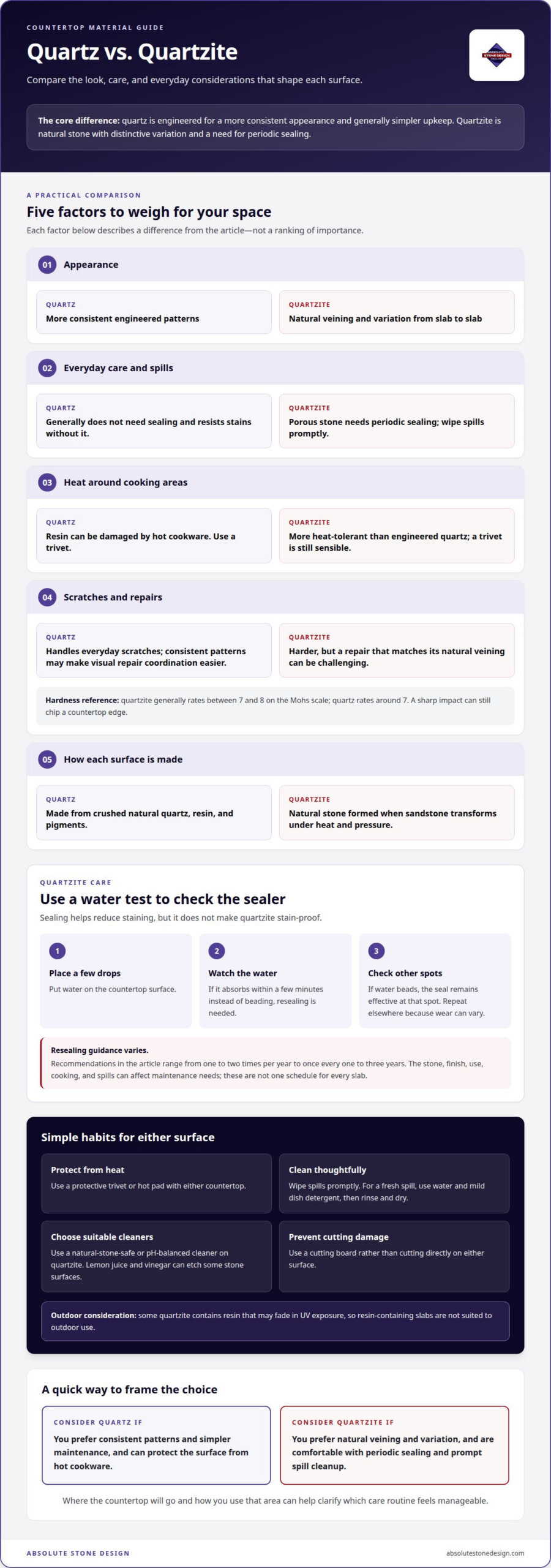
Quartz is an engineered countertop material made with crushed quartz, resin, and pigments; quartzite is natural stone formed from sandstone. That difference affects appearance and care: quartz usually has more consistent patterns and generally doesn’t need sealing, while quartzite has natural variation and needs periodic sealing to help resist stains. Both can suit a kitchen, but their upkeep differs.
What are the pros and cons of quartz versus quartzite countertops? Quartz offers a consistent look and simpler care, but hot cookware can damage its resin, so use a trivet. Quartzite offers natural veining and greater heat tolerance, but its porous surface needs sealing and prompt spill cleanup.
Which countertop is easier to maintain and repair? Quartz is usually simpler to maintain because it generally doesn’t need sealing. Repair depends on the type and location of damage. Matching a repair to quartzite’s natural veining can be challenging, while quartz’s more consistent patterns may make visual coordination easier.
How can you tell genuine quartzite from mislabeled or soft quartzite? Apply lemon juice to a sample or offcut for several minutes; true quartzite shouldn’t develop an etched, dull spot from acid. Don’t test an installed countertop, since another material could be damaged.
| Countertop | Appearance | Care | Kitchen consideration |
|---|---|---|---|
| Quartz | More consistent engineered patterns | Generally no sealing | Protect from hot pans with a trivet |
| Quartzite | Natural veining and variation | Periodic sealing; clean spills promptly | More heat-tolerant, but porous |
Choose quartz if consistent patterns and simpler maintenance fit your priorities. Choose quartzite if you prefer natural variation and are comfortable with sealing and prompt cleanup. Before deciding, consider where the countertop will go, how you use that area, and which surface’s care needs feel manageable for your household.
Quartzite vs Quartz: What are Quartzite Countertops?
Quartzite begins as sandstone, then forms under heat and pressure over millions of years. Its natural colors and veining vary from slab to slab, unlike the more consistent patterns often found in engineered quartz. That natural character is part of its appeal, but the surface also needs care suited to natural stone.
Which is harder and more durable, quartz or quartzite? Quartzite generally ranks between 7 and 8 on the Mohs hardness scale, while quartz rates around 7. Both resist everyday scratches, but quartzite is harder; granite also stands up well to scratches, heat, and general wear. Marble is softer than quartzite and more likely to scratch.
How resistant are quartz and quartzite to stains, scratches, heat, and UV light? Quartz resists stains without sealing and handles everyday scratches, but its resin can be damaged by high heat. Porous quartzite can stain if spills penetrate, yet it offers strong scratch and heat resistance. Some quartzite contains resin that may fade in UV exposure, so resin-containing slabs aren’t suited to outdoor use.
Heat tolerance matters beside a range or on a kitchen island. Quartzite tolerates heat better than engineered quartz, whose resin can be damaged by hot cookware. Granite also resists heat, but using a protective trivet is sensible with any countertop. According to Cambria, use a closed-weave hot pad or solid trivet to protect quartz and quartzite surfaces.
Quartzite’s hardness doesn’t make it immune to damage. A sharp impact can still chip a countertop edge, and acidic foods can affect some natural stones. Wipe up lemon juice promptly, for example, and use a cutting board instead of cutting directly on either surface.
For a material choice that balances natural veining with everyday kitchen routines, explore quartzite countertop options and consider how heat, spills, and sunlight affect your space.
Does quartzite require sealing and how often?
Yes. Quartzite is porous, so liquids can enter the stone and leave stains; sealing adds protection but doesn’t make the countertop stain-proof. Sandstone transforms under heat and pressure to form quartzite, and differences between slabs and finishes affect how readily each surface absorbs moisture. That’s why sealing needs can vary, even for a premium countertop material.
Resealing guidance varies: quartzite countertops generally need resealing one to two times per year, while another typical interval is once every one to three years, depending on the stone and its use. These are different recommendations, not one schedule for every slab. A polished finish, daily cooking, and frequent spills can all affect maintenance needs.
Use a water test to judge whether the sealer is still working. Place a few drops of water on the countertop and watch what happens. If the water absorbs within a few minutes instead of beading, resealing is needed. If it beads, the seal remains effective at that spot; repeat the test elsewhere, since wear may differ across the counter.
For daily cleaning, wipe spills promptly and choose a natural-stone-safe or pH-balanced cleaner. Lemon juice and vinegar can etch some stone surfaces, so clean them up quickly rather than letting them sit. For a fresh spill, start with water and mild dish detergent, then rinse and dry the area.
Sealing helps reduce staining, but routine care still matters. Coffee left on a porous section can penetrate despite a sealer, while a promptly wiped spill is less likely to linger. Avoid harsh, acidic cleaners, which can affect the surface or sealer. Follow the care directions for your countertop, and repeat the water test if absorption suggests protection has weakened.
How engineered quartz and natural quartzite are made
Engineered quartz countertops are made by combining ground natural quartz aggregate with resin and pigments, then forming the mixture into slabs. Many engineered surfaces contain about 90 to 95 percent quartz aggregate; the rest includes resin and colorants. This process lets manufacturers create patterns with a more consistent appearance than natural stone. For example, repeated slabs can offer similar color and veining across a kitchen.
Natural quartzite forms when sandstone undergoes heat and pressure over millions of years. The pressure transforms the original rock into a hard, quartz-rich natural stone. Its composition and color depend on the minerals present as the sandstone forms. Quartzite slabs are typically more than 90 percent quartzite, and some can reach 99 percent. Each slab develops its own pattern rather than following a manufactured design.
The distinction between quartz and quartzite is clear in their patterns. Engineered quartz can offer repeatable colors and visual movement, which helps when coordinating multiple countertop areas. Natural quartzite has veins and color variation shaped by its geological formation. Even slabs sold under the same stone name can look different, so a large kitchen may show noticeable variation between pieces or seams.
Production also influences everyday care. The resin in engineered quartz helps create a nonporous surface that resists stains without sealing, while quartzite’s natural pores can absorb spills and benefit from stone sealing. Pigments and resins give engineered surfaces their selected appearance, but high heat can damage the resin. Quartzite’s natural composition tolerates heat better, though its veining and slab-to-slab differences call for thoughtful layout planning. To compare how these materials may look across your kitchen, explore quartz and quartzite countertop options before choosing a surface.
Absolute Stone Design: Quartz
Absolute Stone Design serves homeowners in Richmond and nearby communities with quartz and quartzite countertops, helping you choose between a consistent engineered pattern and the natural variation of stone. The team can help you consider how each material’s appearance and care needs fit your kitchen. Granite is another option to compare if you’re considering natural stone.
Once you’ve chosen a direction, Absolute Stone Design handles measuring, fabrication, delivery, and countertop installation for homes in the Richmond area. The team can help translate your material choice into a surface tailored to your space, including the kitchen layout and details that shape the finished look.
For help planning a quartz or quartzite countertop in Richmond or a nearby community, contact Absolute Stone Design.
Plan a countertop that fits your home
In the quartz vs. quartzite decision, picture the surface in its finished setting. Consider how its colors will work with your cabinets, backsplash, flooring, and natural light. Viewing a sample beside those elements can help you decide whether the overall look feels calm, coordinated, or more expressive.
Think, too, about the routines around the counter. A busy cooking area, a frequently used island, or a bathroom vanity may each call for different priorities. The Absolute Stone Design team can help connect your design goals with a practical countertop selection. If you’re also weighing natural-stone alternatives, the company offers granite and marble countertops.
Give yourself room to consider the full design, not just the slab on its own. The right choice should feel at home in your space and suit the way you use it. Contact Absolute Stone Design to talk through your countertop plans and explore service for your Richmond-area project, then take the next step with confidence.
Frequently Asked Questions
What does quartzite look like compared to quartz?
Quartzite’s appearance can shift noticeably from one slab to another, while quartz offers more predictable patterning. If you’re planning several countertop runs, look at the actual slabs and consider how their visual movement will carry across the room. A small sample may not show the full pattern, so assess the larger surface before deciding how it fits your design.
How do you plan quartzite seams in a large kitchen?
Plan seam locations as part of the kitchen layout, especially where long runs meet an island or turn a corner. Natural veining may not line up across separate pieces, so seam placement can affect how continuous the surface appears. Considering the overall pattern before fabrication helps you decide which areas should draw attention.
Is Quartz or Quartzite Better for Your Kitchen?
Choose according to the kitchen’s design priorities and your care preferences. If you want a coordinated look across separate work areas, consider how closely the selected surface can match from one run to another. If the countertop is a focal point, decide whether you prefer a uniform pattern or the distinct character of natural stone. Your routine matters, too.
What should you compare when viewing countertop samples?
Look at color, pattern, and how the surface relates to fixed elements such as cabinet fronts and flooring. For a kitchen with perimeter counters and an island, consider whether you want the surfaces to coordinate closely or create contrast. Reviewing the material in the context of your design can make the choice more intentional.
Quartz vs. Quartzite vs. Granite: Which is Best?
There isn’t one best surface for every kitchen. Think about whether you prefer engineered consistency or natural variation, then weigh the care each material requires. Granite adds another natural-stone option to compare. Narrow your choices by considering the look you want across the full countertop layout, rather than judging a small section in isolation.
What is the difference between quartz and quartzite countertops?
The key distinction is how each countertop material is made: quartz is engineered, while quartzite forms naturally. That difference can guide design decisions, particularly when matching surfaces across several areas. For instance, a homeowner coordinating a long counter and an island may prioritize a predictable pattern, while someone seeking a one-of-a-kind focal surface may prefer natural variation.