Articles by: chrisRibeiro

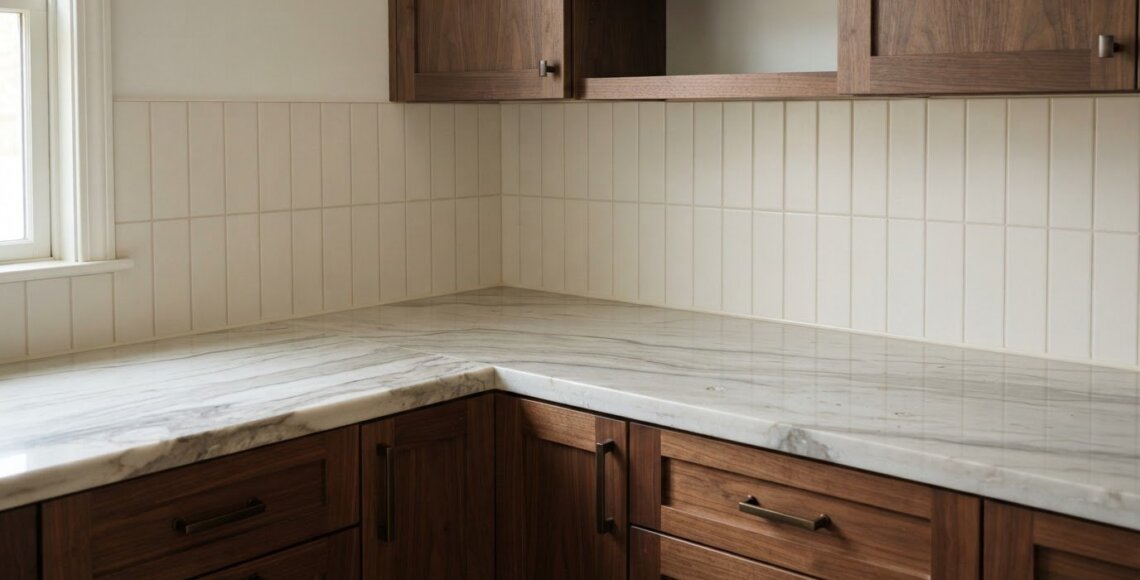
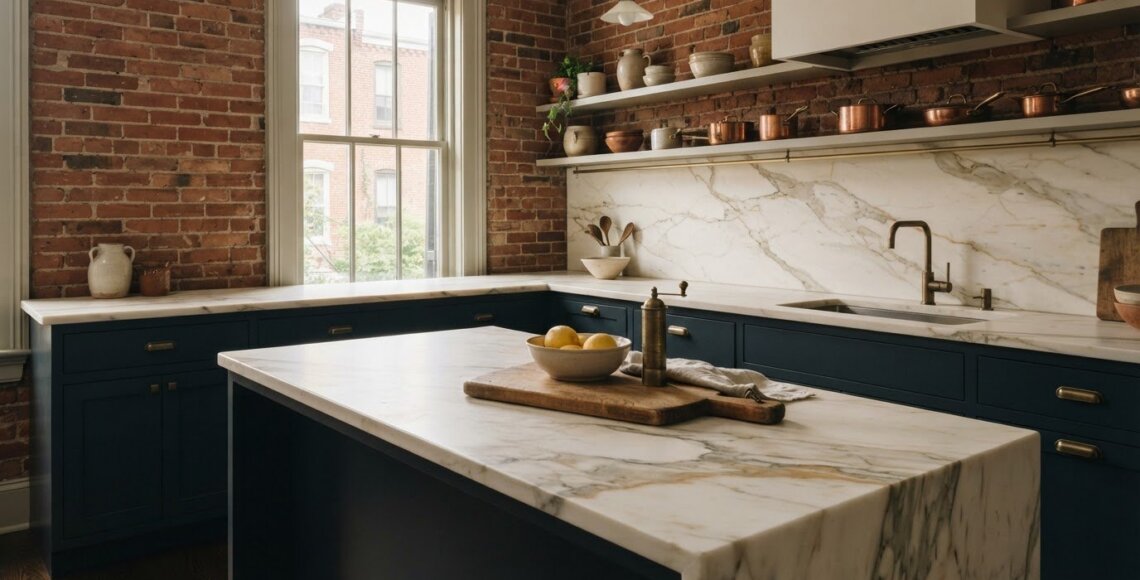
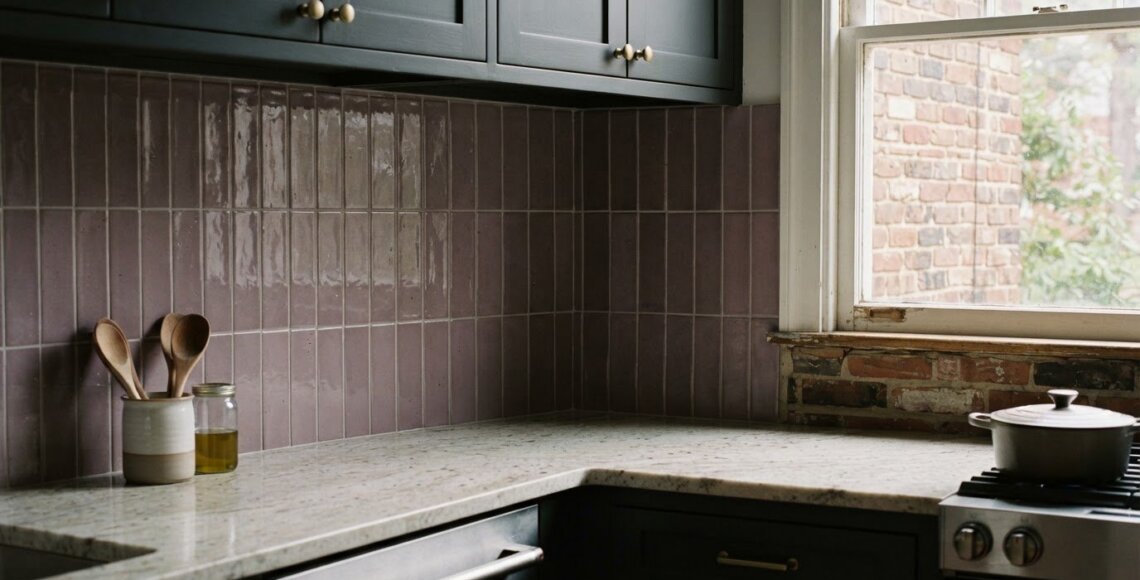
Full-height aubergine ceramic backsplash above a granite counter in a Richmond brick Colonial kitchen

Best Tile Richmond: Explore Tile Styles, Types and Selection Help

The best tile in Richmond is the tile that suits your room, daily needs, and style. Before choosing a material or finish, consider how you’ll use the surface, whether it’s a kitchen floor, bathroom wall, or backsplash.

Tile color, pattern, finish, and material all shape a room. Compare these details and narrow your choices to options that complement your home or project.

From porcelain options to tile coordinated with stone surfaces, you’ll learn what to consider, what selection assistance is available, and where to find the Richmond showroom as you decide what belongs in your space.

Key Takeaways

  • Compare tile materials and styles by considering the room, the look you want, and how the space is used.
  • Learn how selection guidance can help you narrow options and coordinate tile with nearby stone surfaces.
  • Find out what to look for in customer reviews and ratings when comparing Richmond tile companies.
  • Explore bathroom tile work from Absolute Stone Design and see how a showroom visit can support your selection process.

Product selection assistance

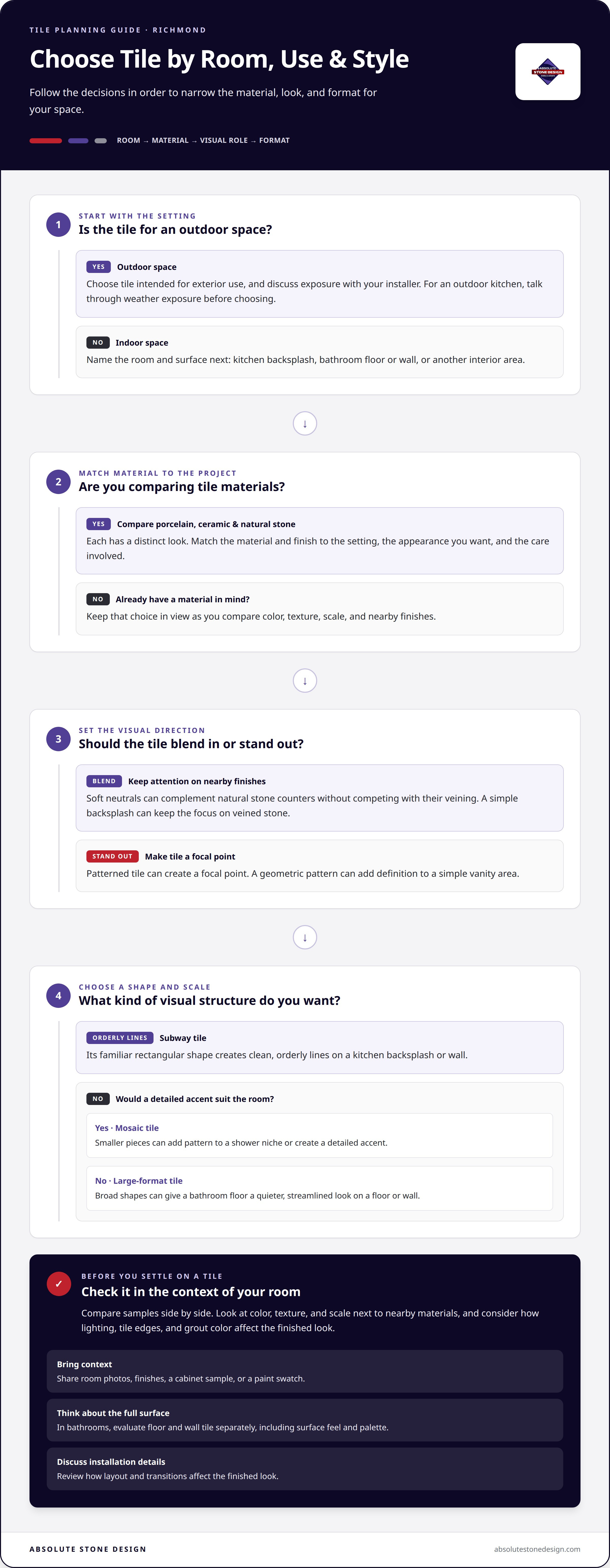
Start with the room, then narrow your options by use, appearance, and care. A kitchen backsplash, bathroom floor, and covered porch face different conditions. Share those details with a design professional to guide your choice of material and finish. Bring a cabinet sample or paint swatch to see how the tile may coordinate.

When comparing Richmond tile stores, consider selection, design guidance, and installation services. Look for clear explanations of how materials and finishes suit different rooms, and whether the provider can coordinate tile with nearby surfaces. These details show how a business can support your project beyond displaying samples.

For kitchens, consider how tile will work with the cooking area, cabinetry, and counters. A simple backsplash can keep attention on veined stone, while patterned tile can create a focal point. In bathrooms, evaluate floor and wall tile separately, including the surface feel and overall palette. For outdoor spaces, choose tile intended for exterior use and discuss exposure with your installer.

The best tile for a kitchen, bathroom, or outdoor space in Richmond depends on the room and its conditions. Porcelain, ceramic, and natural stone each offer a distinct look. Match the material and finish to the setting, your preferred appearance, and the care involved. For an outdoor kitchen, discuss weather exposure before choosing.

  • Bring context: Share room photos, finishes, and project priorities.
  • Compare samples: View color, texture, and scale beside nearby materials.
  • Discuss installation: Review how layout and transitions affect the finished look.

Choosing the best tile in Richmond starts with a clear picture of the room and its finishes. Discussing these details helps turn inspiration into a practical selection.

Tile showroom location

For an in-person showroom visit, keep Richmond, Virginia, in mind. A conversation about your project can help connect tile choices with the wider design. Before you visit, note the room, surface, preferred look, and nearby finishes. For example, a bathroom floor planned alongside a stone vanity needs a coordinated palette.

The showroom is at the Richmond location, while the business is based in Glen Allen. That gives local homeowners a nearby place to discuss material choices and project goals. If you’re coming from another part of the Richmond area, plan your visit around the decisions you need to make. A focused discussion about a shower wall differs from one about a kitchen backsplash.

Bring useful references, such as a cabinet sample, paint swatch, or room photo. These make it easier to discuss color and how finishes relate. For a bathroom, note whether the project includes walls, floors, or both. For a kitchen, identify the backsplash area and the countertop colors it will meet.

  • Set the scope: Name the room and surfaces involved.
  • Gather references: Bring photos or samples of existing finishes.
  • List priorities: Note the look, use, and care expectations.
  • Discuss coordination: Connect tile choices with nearby cabinetry or stone.

Preparing these details makes a showroom visit more useful, even before you make final selections. If your plans cover multiple rooms, keep separate notes for each space. A bathroom floor and kitchen backsplash may call for different colors, formats, and visual emphasis. Consider each room separately while keeping the home’s finishes in mind.
Best Tile Richmond: Explore Tile Styles, Types and Selection Help

Tile styles and collections

Tile style depends on more than color. Shape, size, surface, and grout all affect the finished look. Classic subway tile creates orderly lines on a kitchen backsplash. A small mosaic adds pattern to a shower niche, while large-format tile gives a bathroom floor a quieter look. Start with the room’s main surface, then decide whether the tile should blend in or draw attention.

Collections often group related colors, shapes, and finishes, making it easier to compare options with a similar design direction. View samples side by side rather than judging one tile alone. Warm white tile may look different beside cool gray grout or dark cabinetry. In a bathroom, compare wall and floor samples together to see whether the contrast feels balanced.

  • Subway tile: Use its familiar rectangular shape for a clean backsplash or wall.
  • Mosaic tile: Consider smaller pieces for a detailed accent or niche.
  • Large-format tile: Explore broad shapes for a streamlined floor or wall.

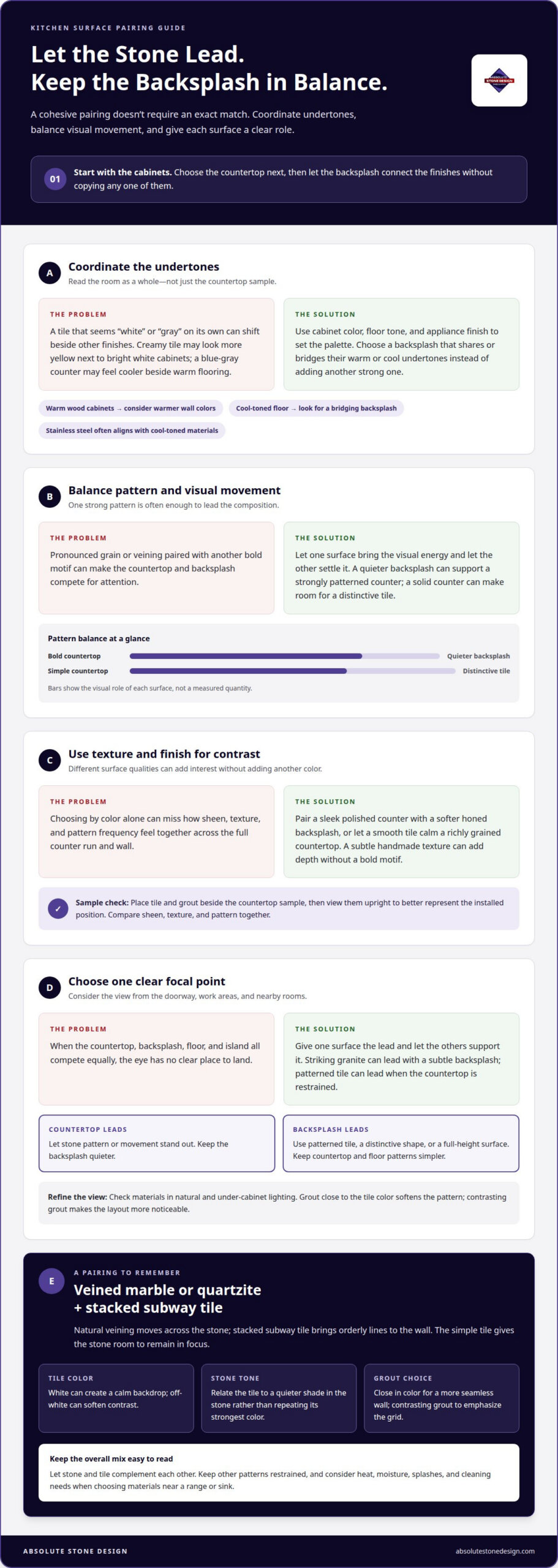
Color and pattern set a room’s mood. Soft neutrals can complement natural stone counters without competing with their veining. A geometric pattern can add definition to a simple vanity area. For a cohesive kitchen, connect the backsplash color to the cabinets, then decide whether the countertop should stand out or remain the focal point.

Before choosing, compare the sample with the room’s lighting and nearby finishes. Notice how the tile’s edge, texture, and grout color affect its appearance. A polished surface looks different from a matte one, and a strong pattern can feel busy across a large wall. These comparisons help you choose a style that suits the room, not just the sample.

Which Richmond tile companies have the best customer reviews and ratings?

When reading reviews of a Richmond tile company, look for comments about the service your project needs. A high rating alone won’t show whether customers mention careful bathroom tile work, clear communication, or installation quality. Read the written feedback alongside the rating and look for details relevant to your room and project scope.

A review of a kitchen backsplash, for example, may say little about a company’s floor installation. Look for comments that identify the room, tile work, and customer experience. Specific observations about communication, measurements, grout lines, and finished edges provide more context than a brief statement that the result looks great.

Patterns across reviews are more useful than a single glowing or critical comment. Notice whether customers describe similar strengths across different projects. Several mentions of clear updates may indicate a consistent communication experience. A review that describes a problem and the company’s response can also show how concerns were handled. Keep the project type in mind as you read.

  • Match the work: Compare bathroom, backsplash, or flooring reviews with your project.
  • Read the details: Look for examples of workmanship and communication.
  • Check context: Note the project scope and when the review was posted.
  • Look for patterns: See whether similar feedback appears across multiple comments.

Richmond reviews are most useful when they help you understand the customer experience. Use recurring themes to guide questions about tile selection, installation planning, and communication. Detailed feedback about a relevant project may tell you more than the average score alone. For a bathroom, prioritize reviews that describe bathroom tile installation rather than relying only on comments about countertops or cabinets.

Absolute Stone Design: Bathroom Tile Work

Absolute Stone Design provides bathroom tile work, including shower tile, for updates and renovations. Design services can help coordinate tile with nearby surfaces. This is useful when a vanity top and shower tile share a palette.

Begin by defining the bathroom’s scope: floor, shower walls, or both. A floor-and-wall plan can connect tile colors without making every surface identical. For example, a quiet floor can balance a patterned shower wall. Consider the vanity area too. Decide which surface should draw attention, then coordinate the other finishes around it.

Granite and marble countertops bring distinct natural patterns into a bathroom. Tile can echo a countertop’s warm beige or cool gray undertones. A restrained tile choice lets pronounced stone veining remain the focal point, while patterned tile can add detail beside a quieter stone surface. Comparing these relationships helps the room feel connected without matching every finish exactly.

Before settling on a combination, consider the view from the doorway. Note where the floor meets the wall and where tile ends beside a vanity. These transitions affect how colors and patterns work together. Repeated tones can create continuity in a small bathroom, while a defined accent area can provide a focal point in a larger room.

Absolute Stone Design’s bathroom tile work suits projects where you want tile considered alongside stone surfaces. The team brings experience in tile work and coordinating stone finishes. Share the room’s scope and the finishes you’re keeping, such as a marble countertop or existing cabinetry. That context can guide design decisions and help shape a coordinated direction. Your selections can reflect the look you want and how you use the bathroom each day.

Contact Absolute Stone Design to discuss your bathroom tile project.

Frequently Asked Questions

What are the best tile stores and showrooms in Richmond, Virginia?

For tile and surface projects around Richmond, Absolute Stone Design offers bathroom tile work, porcelain, and design services. Consider whether your project would benefit from coordinating tile with nearby finishes, such as a vanity countertop. The right fit depends on your materials and project scope, not simply a store’s product selection.

Where can I find ceramic and porcelain tile in Richmond?

Absolute Stone Design offers porcelain for Richmond-area projects, while ceramic tile selections depend on the specific retailer and project. When choosing porcelain, consider the full project scope, including the area being covered, finish, and installation needs. You can also weigh how the tile coordinates with existing cabinets or countertops before settling on a selection.

Where can I buy natural stone, mosaic, and specialty tile in Richmond?

For natural stone surfaces in Richmond, Absolute Stone Design offers granite and marble, as well as bathroom tile work. Granite and marble bring distinctive veining and color variation to a room. If you’re considering mosaic or specialty tile, think about where it will appear, such as a shower accent or vanity detail, and how its pattern will relate to the surrounding surfaces.
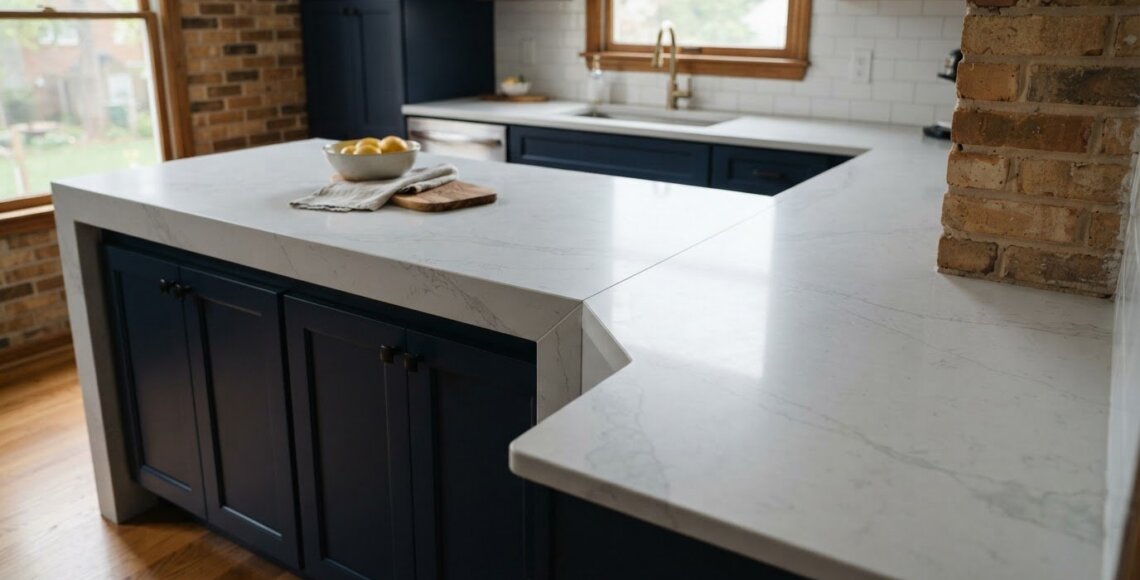
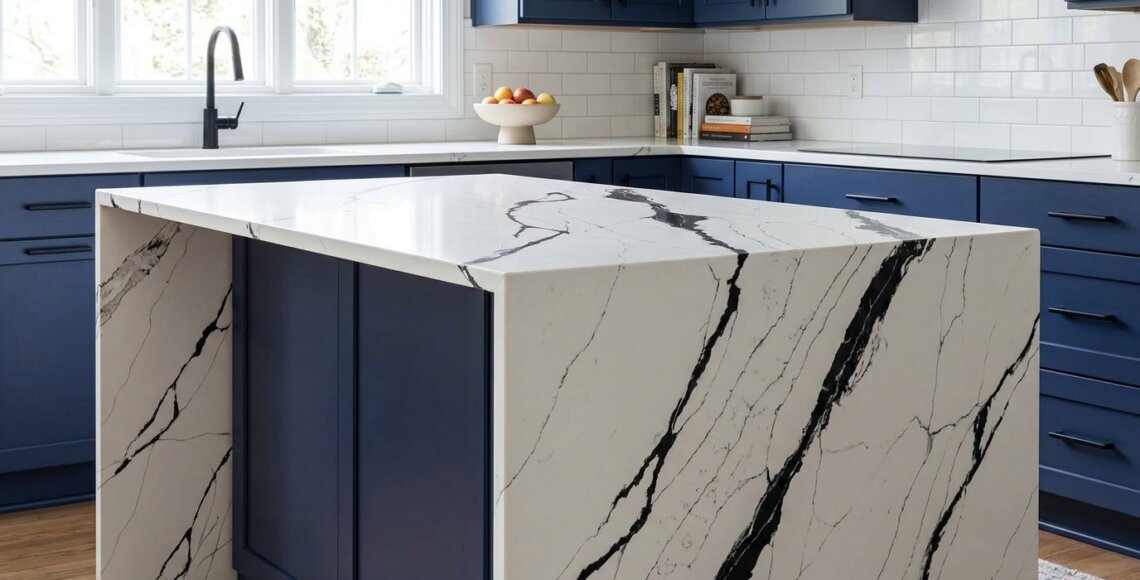
Mitered quartz island edge compared with a standard eased countertop edge in a Midlothian kitchen

Choose a Mitered or Standard Countertop Edge

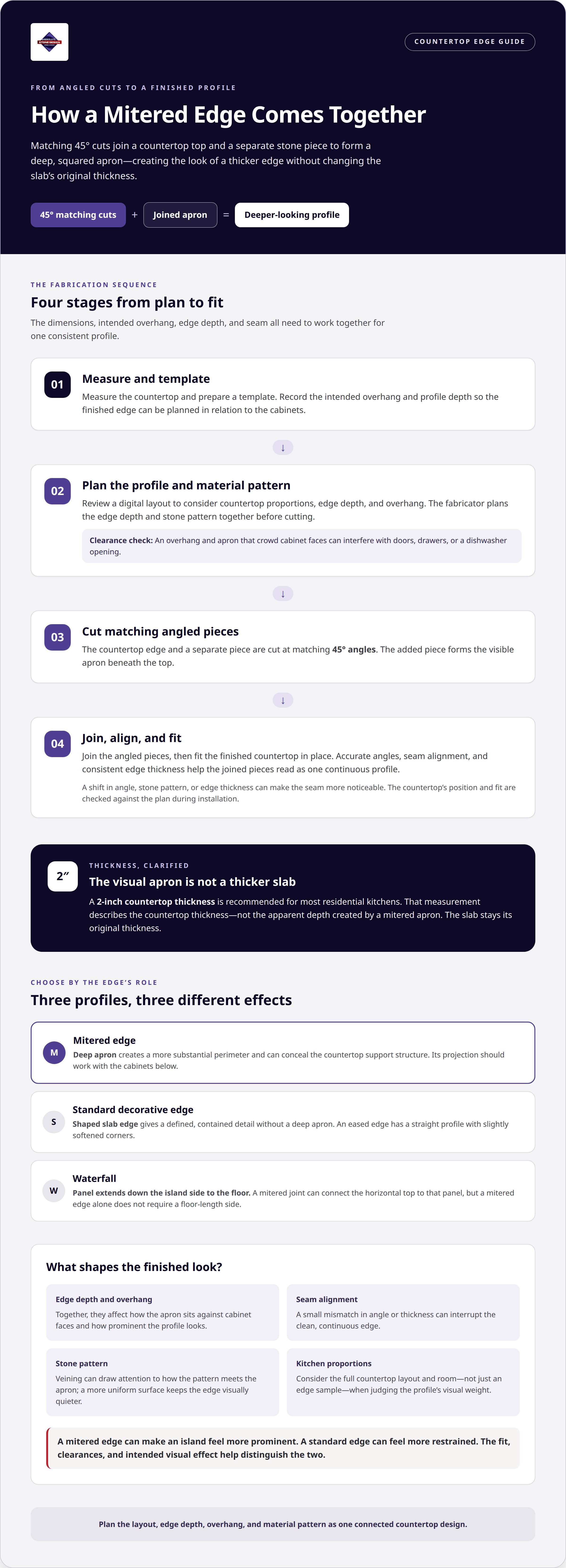
A mitered edge countertop is formed by joining two stone pieces cut at a 45-degree angle, creating a deep, squared profile that can make the surface look thicker without changing the slab’s original thickness. Unlike a standard decorative edge, which shapes the edge of a single slab, a mitered edge uses an angled piece to create the deeper apron, so precise alignment and a clean seam matter to the finished look.

If you’re weighing countertop edge styles, the right choice depends on the look you want and how the edge works with your kitchen cabinets and overall design. A mitered edge countertop uses angled pieces to create a deeper-looking profile. Here’s how the pieces come together, what shapes the finished appearance, and how to decide whether a mitered or standard edge suits your countertop.

Key Takeaways

  • Compare a mitered edge with a standard profile to decide which better fits your kitchen’s design and daily use.
  • See how mitered edges relate to waterfall countertops and the visual effect each creates.
  • Learn which fabrication details help create a clean, consistent seam and edge profile.
  • Consider how an extended edge can add visual depth, then weigh that look against your countertop layout.

What is a mitered edge?

A mitered edge joins angled pieces to create a deeper-looking countertop profile. Its vertical apron can conceal the substrate beneath the surface, giving the counter a more substantial appearance. The design differs from an edge shaped directly into a slab, and it can be paired with quartz or natural stone.

Mitered and Standard Decorative Edges

A standard decorative edge shapes the exposed countertop perimeter without creating a deep apron. An eased edge, for example, has a straight profile with slightly softened corners. A mitered profile creates a stronger visual band beneath the surface, which can make an island feel more prominent. Choose according to whether you want the edge to blend in or contribute visibly to the room’s design.

Mitered and Regular Edge Benefits

A mitered edge’s deeper apron can conceal the countertop support structure and create a tailored look. Its projection needs to work with the cabinets below: an overhang across cabinet faces may interfere with doors, drawers, or a dishwasher if it is not properly built up. A standard edge is typically a practical choice when you prefer a simpler profile and want to limit exposure to everyday wear.

A waterfall countertop extends a panel down the side of an island to the floor. A mitered joint can connect the horizontal top to that vertical panel, but a mitered edge alone does not require a floor-length side. With quartz, granite, marble, or quartzite, the stone pattern may appear to continue around the corner, depending on how the pieces meet.

Option Profile Visual effect Useful distinction
Mitered edge Deep apron More substantial perimeter Can conceal the substrate
Standard decorative edge Shaped slab edge Defined, contained detail No deep apron
Waterfall Panel down to floor Wrapped island side May include a mitered joint

Choose based on the edge’s visual role, cabinet clearances, and how you want the island to meet the floor.

Countertop fabrication and angled edge pieces

A precise miter depends on more than the angle: the pieces, seam, and finished depth must align to create one consistent profile.

Mitered Edge Fabrication

To make a mitered edge, a fabricator cuts the countertop edge and a separate piece at matching 45-degree angles. The pieces are joined to form the visible apron beneath the top. This differs from shaping a standard edge directly into one slab, because the mitered profile depends on an added piece and a joined seam. The fabricator plans the edge depth and material pattern together.

Fabrication and installation involve measuring the countertop, preparing a template, cutting and joining the angled pieces, then fitting the finished top in place. Each step depends on the dimensions and intended overhang.

Fabrication and Installation Precision

Accurate angles, seam alignment, and consistent edge thickness help the joined pieces read as one continuous profile. A small mismatch can make the apron look uneven or interrupt the material pattern. Before fabrication, a digital layout can help review countertop proportions, overhangs, and edge depth. During installation, the countertop’s position and fit are checked against the plan.

For example, an island overhang affects how the apron sits in relation to the cabinets. Planning this relationship helps prevent a profile from crowding cabinet doors, drawers, or a dishwasher opening.

Seam Visibility

The seam is where the angled pieces meet, so it remains part of the edge’s construction. Careful alignment can make the joint less noticeable, while a visible shift in angle, pattern, or edge thickness can draw attention to it. Natural stone patterns may continue across the join, but the result depends on the selected slab and how its pattern meets the apron.

Before fabrication, reviewing a digital layout gives you a chance to consider the edge depth and overhang as part of the full countertop design. For a project-specific discussion, explore countertop design options with the planned layout in mind.

Choose a Mitered or Standard Countertop Edge

Creating the appearance of a thicker countertop

A mitered profile adds visual depth without changing the slab’s original thickness. Its deeper apron can make a countertop feel more substantial, especially across a long run or kitchen island.

Thick-Look Profile

The profile pairs the countertop surface with a vertical apron to create a broad, squared edge. The apron gives the eye a thicker band of stone, while the slab itself stays its original thickness. On a long countertop run, that added visual depth can make the surface feel more proportionate rather than flat or underscaled.

Material pattern also shapes the appearance. Veining, for example, can draw attention to how the pattern meets the apron, while a more uniform surface keeps the edge visually quieter.

Recommended Countertop Thickness

A 2-inch countertop thickness is recommended for most residential kitchens. That measurement describes the countertop thickness, not the apparent depth a mitered apron creates. The distinction helps you compare a standard slab with a thick-look profile without assuming the entire countertop is made from a thicker piece.

For a kitchen island, consider how the edge depth relates to the cabinet faces and room proportions. A digital layout can help you review the overhang and profile together before fabrication, so the edge looks intentional within the overall design.

A mitered profile can create a strong visual line without using a thicker slab. The added apron changes the edge’s appearance, while the original slab thickness remains unchanged. This distinction matters on long runs, where extra depth can make the counter feel more grounded in the room.

Consider the full view, not just an edge sample. A deep apron may stand out against simple cabinetry, while a standard profile can feel more restrained. Reviewing the countertop layout, material pattern, and edge depth together helps you choose a profile suited to the kitchen’s proportions.

How angled countertop pieces form a mitered edge

A mitered edge forms when two pieces of the same countertop material meet along matching angled cuts. For a typical miter, each piece is cut at 45 degrees, creating a corner that can read as one continuous, thicker-looking edge.

The fabrication sequence connects the design to the finished profile:

  1. A professional measures the countertop area and prepares a template showing the planned dimensions and edges.
  2. The layout establishes the countertop’s overhang, apron depth, and relationship to cabinets and appliances.
  3. The fabricator cuts the top and edge pieces at matching 45-degree angles.
  4. The angled faces are joined, with attention to seam alignment, edge thickness, and the material pattern.
  5. During installation, the assembled countertop is positioned to match the planned layout.

Each step affects the next. If the apron depth changes, the edge piece must match that profile; if the angle or alignment varies, the seam may look uneven. With veined stone, the fabricator also considers how the pattern meets across the top and apron. A well-planned mitered edge countertop depends on consistent-looking joined pieces, not simply on cutting both at an angle.

Digital layouts can help review proportions, overhangs, and edge depth before fabrication. They also help account for cabinet doors, drawers, and a dishwasher. If the miter extends over the cabinet face without enough build-up, it can interfere with opening them. The countertop support structure and intended apron position should therefore be part of the same plan.

During fitting, the professional aligns the countertop with the prepared space and checks how the edge sits against the cabinets. The seam remains a joint between separate pieces, but accurate cuts and alignment help it follow the edge cleanly. Discussing the desired apron depth and layout with a countertop professional can help bring the design together. Plan your countertop edge.

Absolute Stone Design: Countertops

Absolute Stone Design can help turn your preferred edge profile into a countertop plan. For projects in Richmond, Henrico, Glen Allen, Midlothian, and Chesterfield, the team’s measuring, in-house fabrication, and installation carry the design details from template through fitting.

Material selection is part of that conversation. Granite, quartz, and quartzite each have distinct patterns and surface characteristics that can shape how an angled seam and apron appear. Reviewing the material alongside the edge depth and countertop layout helps you make a coordinated choice for your kitchen. Contact Absolute Stone Design to discuss your countertop design and material preferences.

Shape the Countertop Around Your Design

As you refine your kitchen, think about how the countertop edge will feel alongside cabinet fronts, hardware, and the room’s overall character. A mitered edge countertop can make a deliberate design statement, while a simpler profile may let other details take the lead. Consider which element you want people to notice first, and how the surface will look from across the room as well as up close. That design decision can help guide material and finish choices. Absolute Stone Design offers countertops in granite and marble, and its team can help you consider how each material works with your preferred edge and kitchen style.

You don’t need every selection finalized before starting a conversation. Bring your ideas, inspiration, or questions about the look you’re creating, and take the next step at your own pace. Contact Absolute Stone Design to talk about your countertop plans. With thoughtful choices and experienced guidance, you can move toward a kitchen that feels distinctly yours.

Frequently Asked Questions

What Should You Consider When Choosing Between Edge Styles?

Consider how much visual attention you want the countertop perimeter to draw. A prominent profile can anchor a kitchen island, while a restrained edge may suit a room where cabinets or a backsplash are the focus. Assess how the edge looks from the room’s main viewpoints, not only when you stand beside the counter.

What Details Should You Confirm Before Selecting a Mitered Profile?

Decide which countertop sides will have the profile and whether any ends will remain exposed. Those choices affect how the finished design reads around corners and at the ends of a run. Consider the edge alongside the cabinet style and surrounding finishes, so the profile feels intentional throughout the kitchen rather than like an isolated detail.

How Should You Evaluate the Material’s Appearance at the Edge?

Granite, marble, quartz, and quartzite each bring different patterns to a countertop edge. Look at how the selected slab’s markings appear near its perimeter, then decide whether you want those details to stand out or feel subtle. Viewing a sample or slab can help you assess the color and pattern alongside the room’s cabinets and other finishes.

What Project Details Should Be Settled Before Fabrication?

Establish the intended countertop layout and edge locations before fabrication starts. Include the planned overhang and how the finished edge relates to cabinet fronts and nearby appliances. These choices give the fabricator a clear design to follow and help keep the finished profile consistent with the kitchen plan. Layout changes can affect how the edge is prepared.

When Does a Waterfall Design Make Sense for an Island?

A waterfall design suits an island when you want its side to read as a continuation of the surface rather than as a separate cabinet face. Consider the island’s position and how visible its sides are from nearby rooms. The design can make the island feel more unified, while a countertop-only edge keeps attention on the horizontal surface.

What Should You Weigh When Deciding on a More Prominent Edge?

Consider the island’s role, the surrounding cabinetry, and how much attention you want the countertop to draw. A bold edge can help define the island, while a quieter profile may suit a kitchen with detailed cabinets or strong backsplash patterns. Review the design as a whole so the edge supports, rather than competes with, the room’s other features.

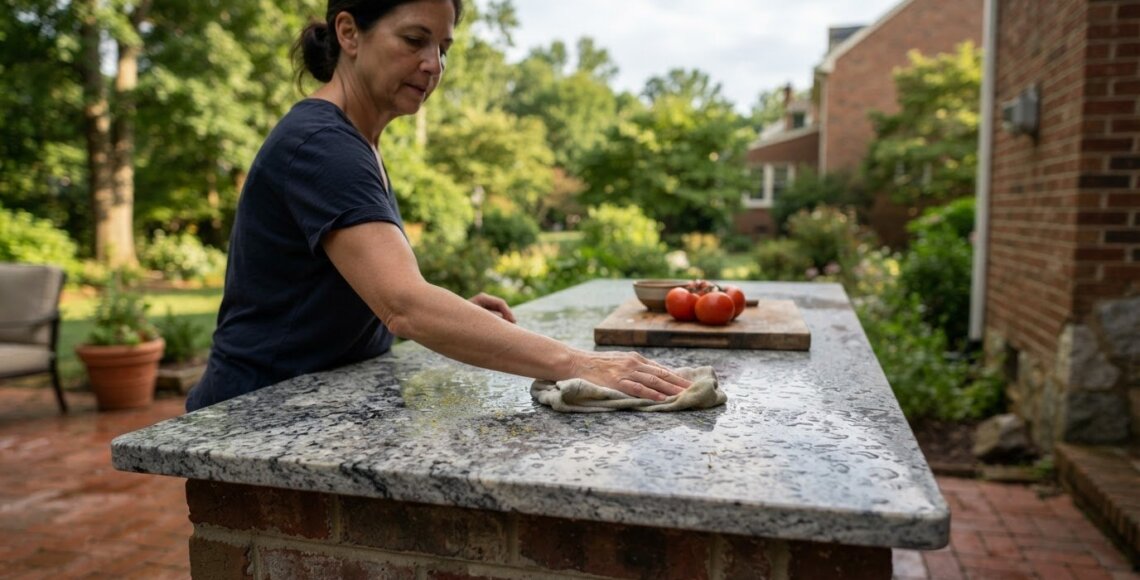
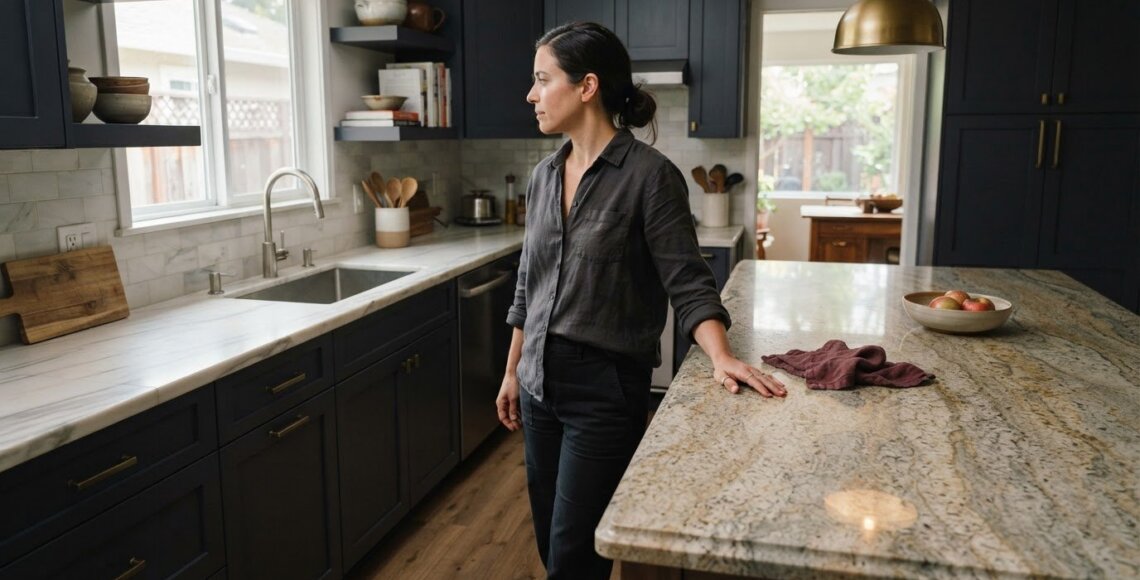
A homeowner wipes rain and pollen from a granite outdoor-kitchen countertop on a Richmond-area brick patio.

Outdoor Granite Countertops: Compare Costs, Climate and Care

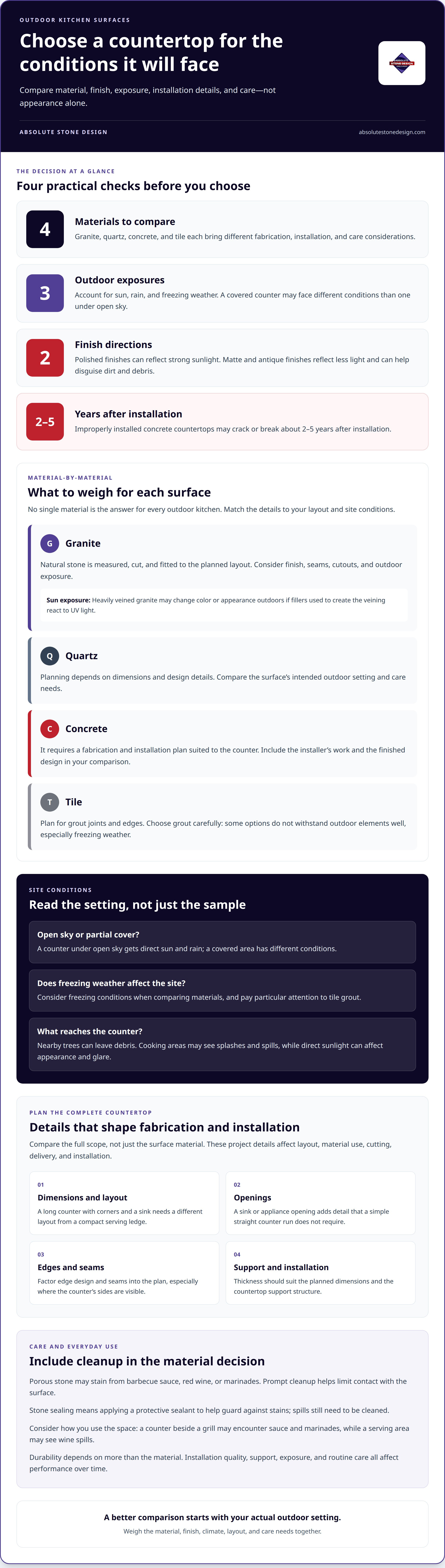
The best outdoor countertop isn’t automatically granite. Outdoor granite countertops can bring natural character to an outdoor kitchen, but climate, finish, durability, and upkeep all matter when comparing materials such as quartz, concrete, and tile. Heavily veined granite may change in appearance outdoors if fillers react to UV light.

Look beyond color and pattern: a surface should suit both your design and the conditions where you’ll use it, as well as the level of care you’re comfortable with. Weigh these practical factors alongside the look you want.

Compare how materials respond to sun, rain, and freezing weather, then consider the care each requires. Use those factors to narrow the options for your outdoor kitchen.

Key Takeaways

  • Compare granite, quartz, concrete, and tile by more than appearance; installation needs and upkeep also shape the overall decision.
  • Match the countertop material and finish to local exposure, since sunlight and freezing weather can affect surfaces differently.
  • Plan for routine care and outdoor spills when weighing durability, and consider how surface texture may affect the look of everyday debris.
  • Use the decision guide to narrow your options around your outdoor kitchen’s setting, design, and practical needs.

Countertop planning

Compare the full installation scope, not just the surface material. Granite, concrete, and tile involve different fabrication and fitting needs, while cutouts, edge profiles, seams, and the countertop support structure can affect the project plan. A sink opening, for example, adds detail that a simple straight counter run doesn’t require.

Granite and other stone surfaces are fabricated to fit the planned dimensions. Tile adds grout joints, while concrete requires a different fabrication approach. A long counter with several corners and a sink needs a different layout from a compact serving ledge. These details affect material use, cutting, delivery, and installation. A polished finish can reflect strong sunlight; matte and antique finishes reflect less light and can help disguise dirt and debris.

Option Fabrication and installation considerations Useful comparison
Granite Natural stone is measured, cut, and fitted to the planned layout. Consider finish, seams, cutouts, and outdoor exposure.
Quartz Engineered surface planning depends on dimensions and design details. Compare its intended outdoor setting and care needs.
Concrete Requires a fabrication and installation plan suited to the counter. Include the installer’s work and the finished design.
Tile Tile layout includes grout joints and careful edge planning. Consider grout selection alongside the surface.

Codes, permits, and warranties depend on the project and its location, so requirements vary between outdoor kitchens. Before construction, clarify local requirements and review the written warranty terms for the material and installation.

To compare options fairly, first define the counter dimensions, sink or appliance openings, edge design, finish, and installation scope. Then weigh those details against maintenance needs and climate suitability. Choose a surface that fits the complete project, rather than deciding by material name alone.

Climate considerations

Sun, rain, and freezing weather expose an outdoor countertop to conditions an indoor surface avoids. Choose for the setting, not appearance alone. Heavily veined granite may change color or appearance outdoors because fillers used to create the veining can react negatively to UV light. A dramatic pattern may therefore look different after ongoing sun exposure. Consider the stone’s veining and finish when assessing its outdoor suitability.

Consider exposure across the whole outdoor kitchen. A surface under open sky gets direct sun and rain, while a covered area has different conditions. Nearby trees can leave debris, and cooking areas may see splashes and spills. These factors help determine which surface and finish suit your layout. Matte and antique finishes reflect less light than polished ones and can help disguise dirt and debris.

Freezing weather also matters when choosing a material. Some materials do not hold up well to freezing or heavy UV exposure, so consider both conditions at your site. Tile needs particular attention at the grout joints: choose grout carefully, since some options do not withstand outdoor elements well, especially freezing weather. Grout is part of the climate decision, not a minor detail.

Use a simple sequence before choosing: identify whether the counter will be in full sun, partial cover, or open exposure; note whether freezing weather affects the site; then compare materials and finishes against those conditions. Heavily veined granite in direct sun raises a different concern from tile grout exposed to freezing weather. Matching the design to the actual setting supports a more informed choice for long-term outdoor use.

Countertop durability and maintenance

Outdoor surfaces face sun, weather, food spills, and regular use, so consider durability and upkeep together. Thickness, edge design, and finish also affect the appearance and suitability of the counter for your outdoor kitchen.

Thickness, Edge Profiles, and Finishes

No single countertop thickness or edge profile works best for every outdoor kitchen. Thickness should suit the planned dimensions and countertop support structure, while the edge profile shapes the finished look. On an exposed island, the edge is visible from several sides, so its design can influence the overall appearance. Matte and antique finishes reflect less light than polished ones and can help disguise debris.

Cracking, Fading, and Staining

Outdoor granite countertops can face different concerns from spills to sun exposure. Porous stone may stain from barbecue sauce, red wine, or marinades, so prompt cleanup helps limit contact with the surface. Granite with heavy veining may also change color or appearance outdoors if fillers react negatively to UV light. Improperly installed concrete countertops may crack or break about 2-5 years after installation.

For care planning, think about how you’ll use the outdoor kitchen. A counter beside a grill may encounter sauce and marinades; a serving area may see wine spills. These examples make porosity and cleanup practical selection factors, not just technical details. Stone sealing means applying a protective sealant to help guard against stains, but spills still need to be cleaned.

Compare expected upkeep alongside appearance and exposure. A polished finish may cause uncomfortable glare in strong sun, while a matte finish can soften reflections and help conceal everyday debris. Durability depends on more than the material: installation quality, support, exposure, and routine care all affect performance over time. Choose a finish and care approach that suit how you’ll use the outdoor kitchen.

Outdoor Granite Countertops: Compare Costs, Climate and Care

Can outdoor granite countertops crack, fade, or stain in sun, rain, frost, or heat?

Outdoor granite can change or become damaged, but the risk depends on the stone and its exposure. Heavily veined granite may change color or appearance outdoors because fillers used to create the veining can react negatively to UV light. The slab’s pattern matters, not just its label as granite. Consider how much direct sun reaches the counter throughout the day.

Rain can leave outdoor surfaces wet, while cooking and entertaining bring spills. Porous stone may stain from barbecue sauce, red wine, or marinades, especially if a spill sits on the surface. Plan to clean regularly after meals, particularly near a grill or serving area. Sealing stone can help guard against stains, though it doesn’t make the surface stain-proof.

Consider freezing weather and heat, but don’t assume the same outcome for every stone and installation. Choose outdoor materials with the local climate in mind, since some do not hold up well to freezing or heavy UV exposure. Assess cracks in context: the surface, installation, and support beneath it all matter. Don’t assume a crack or color change has a single cause based on appearance alone.

For a practical review, note whether the counter is in full sun or under cover, where rain collects, and how close it is to cooking activity. Then consider the stone’s veining, exposure, and care needs together. These details help distinguish a likely stain concern from a sun-related appearance change or a possible installation issue. They also give a stone professional useful context when assessing a surface.

If you’re planning an outdoor surface, discuss granite countertop selection with a stone professional.

Absolute Stone Design: Countertops

Absolute Stone Design can help you move from material comparison to a finished countertop for your outdoor kitchen. If you’re weighing granite against marble or quartz, the team can help you select a countertop suited to your design and the practical needs of your space.

The process includes precision measuring and templating, in-house stone fabrication, delivery, and countertop installation. Measurements help tailor the surface to the planned layout, including its edges and openings. This process connects material choice to the finished fit, giving you the opportunity to discuss how your design preferences meet the setting’s exposure and intended use.

When you’re ready to plan a countertop, contact Absolute Stone Design to discuss your project.

Shape an outdoor kitchen that feels like yours

The right surface should feel at home in the way you gather, cook, and unwind. When planning outdoor granite countertops, consider the atmosphere you want, from a quiet coffee spot to a welcoming place for shared meals. That design intention can guide your final choices alongside practical considerations.

Absolute Stone Design offers granite and marble countertops as natural stone options for your project. The team’s fabrication experience helps translate your chosen material and design direction into a finished surface. Share your priorities, whether you’re drawn to a particular stone pattern or want the counter to complement the wider outdoor setting.

Your outdoor kitchen can become a thoughtful extension of your home, shaped around the way you’ll use it. Contact Absolute Stone Design to discuss your countertop project and take the next step with confidence.

Frequently Asked Questions

What are the best outdoor kitchen countertops?

The best surface suits your design, intended use, and care preferences. Start by deciding how the counter will function: a broad prep area has different layout needs from a narrow serving ledge. Then compare full-size material samples with nearby finishes, such as patio stone or exterior trim, so the selection feels connected to the whole space.

Is granite suitable for outdoor countertops in different climates?

Granite can suit outdoor projects, but its suitability depends on the specific slab and setting. Ask about the particular material rather than treating every granite selection as identical. For a project in Richmond, share your planned layout and how you expect to use the counter; those details can guide a material recommendation for the space.

What types of granite are best for outdoor countertops?

No single granite variety is best for every outdoor kitchen. For outdoor granite countertops, review the full slab rather than relying only on a small sample; seeing more of it helps you judge how the pattern carries across the planned counter. Compare its appearance with the surrounding design, then select a slab suited to the intended setting.

How are outdoor granite countertops measured and planned?

The installed surface is defined by its finished dimensions and design, rather than by a generic countertop label. A professional measurement records each counter run, corner, edge, and requested opening. For example, a kitchen island and a perimeter counter are separate measured pieces. Establishing the layout gives you a clear description of the work involved.

Does outdoor granite need sealing, and how often should it be resealed?

Care guidance should match the specific stone and protective treatment. Keep the material and care instructions together after installation so you can refer to the right recommendations as you use the outdoor kitchen. If you no longer have those details, a stone professional can help identify relevant care guidance from the surface and installation records.

How do granite countertops compare with porcelain, quartzite, and concrete outdoors?

These materials differ in character and how they shape a design, so compare actual samples in the context of your outdoor kitchen. Place them beside the planned cabinetry, patio materials, or exterior finishes to see how they coordinate. Consider whether you prefer a natural pattern or a more uniform look; that preference can help narrow your shortlist.

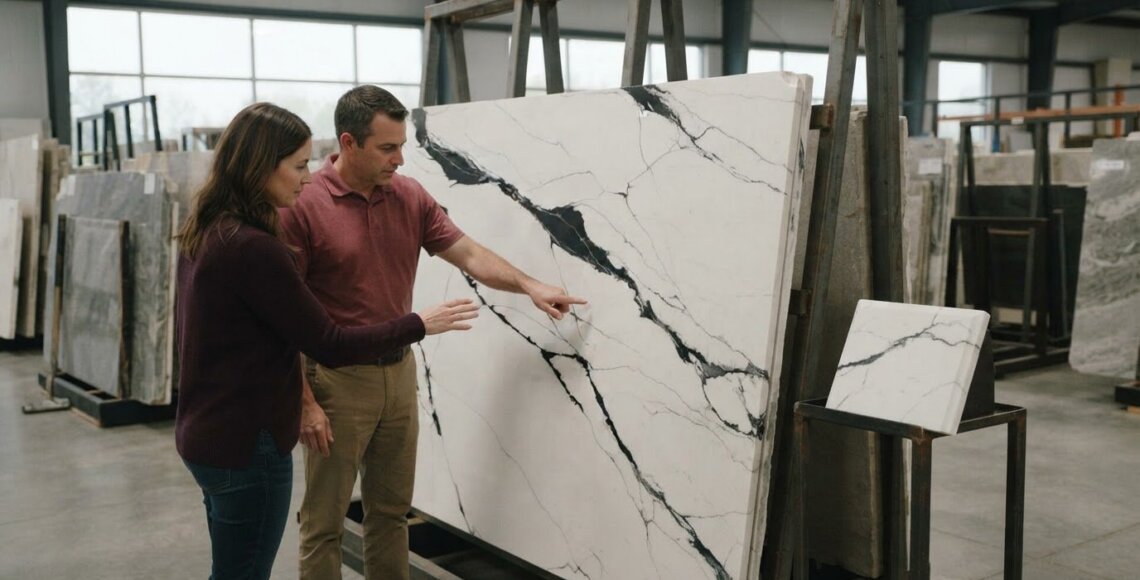
Homeowner inspecting a veined Super White stone slab with a specialist in a Richmond showroom

Super White Quartzite for Kitchen Countertops

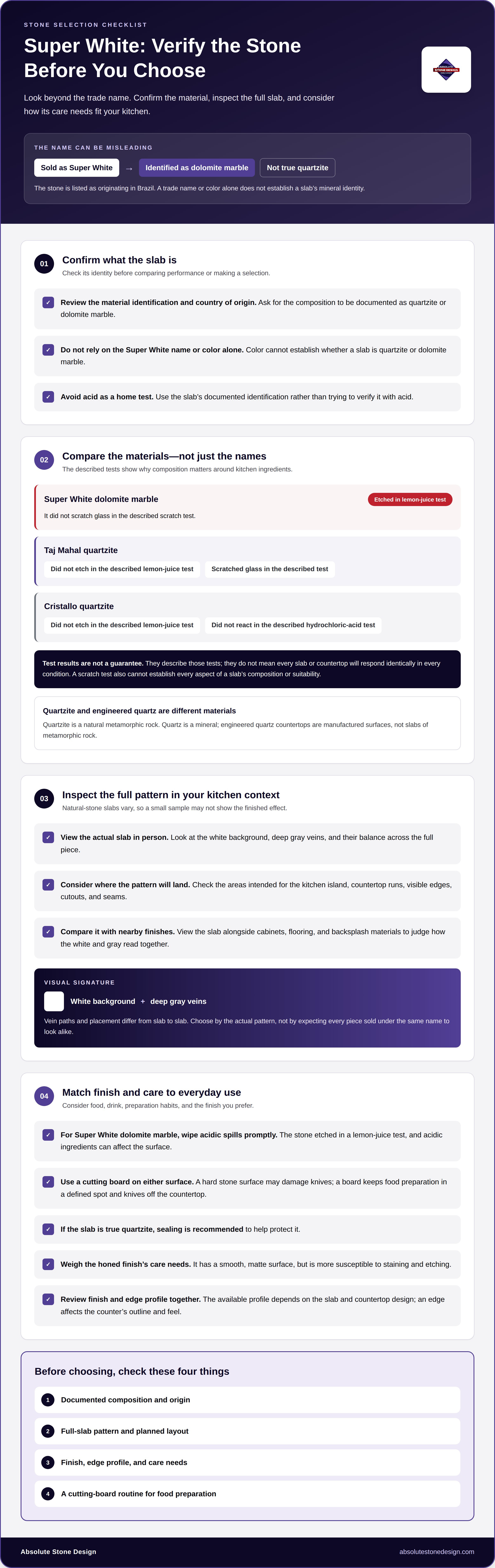
Stone sold as super white quartzite is identified as dolomite marble, not true quartzite. Its signature look is a white background crossed by deep gray veins.

If you’re drawn to its pale, expressive look, consider whether its composition and care needs suit your kitchen. Natural-stone slabs vary in pattern, so assess the actual slab before choosing.

This guide compares it with Taj Mahal and Cristallo, describes its veining, and covers kitchen use, lemon-juice etching, and why a cutting board is preferable to chopping directly on the stone.

Key Takeaways

  • Learn what to consider when deciding whether this stone fits your kitchen and how its Brazilian origin informs your selection.
  • See how natural pattern variation can shape the look of your counters and why viewing slabs in person helps with choosing.
  • Understand the differences among Super White, Taj Mahal, Cristallo, quartzite, and engineered quartz before you settle on a material.
  • Follow the key planning stages, from selecting a slab and measuring the kitchen to fabrication and installation.

Super White’s use as a kitchen countertop

Stone marketed as Super White can be used for a kitchen countertop, but its trade name needs careful attention. It is identified as dolomite marble, not true quartzite, and listed as originating in Brazil.

Countertop Suitability

Quartzite is commonly used for kitchen countertops, and stone sold as Super White is also used for this purpose. The distinction matters: Super White dolomite marble etched in a lemon-juice test. Acidic ingredients can therefore affect the surface, so wipe spills promptly and use a cutting board for food preparation. If the slab is true quartzite, sealing is recommended to help protect it.

Available Finishes and Edge Profiles

A honed finish has a smooth, matte surface, but it is more susceptible to staining and etching. That matters for a kitchen counter exposed to food and drink. The finish and edge profile are design and fabrication choices, and the available profile depends on the slab and countertop design. Review these details together, since an edge affects the counter’s outline and feel.

Verifying Slab Authenticity and Suitability

Color alone can’t establish whether a slab is quartzite or dolomite marble. Before choosing, review its material identification and country of origin, then view the actual slab to assess its white background, deep gray veins, and natural variations. Ask for its composition to be documented as quartzite or dolomite marble, rather than relying on the Super White trade name alone. Avoid using acid as a home test.

Super White quartzite’s color and veining

The stone’s signature look pairs a white background with deep gray veins. Because natural-stone slabs are unique, the balance and placement of these features vary from piece to piece.

Color Appearance

White forms the main field, while deep gray veining adds contrast. This combination can suit kitchens where you want a light stone with a distinct pattern rather than an uninterrupted solid color. The overall impression depends on the slab, so a small sample may not show the full visual effect.

View the slab alongside your kitchen’s cabinets, flooring, and backsplash materials. Compare how the white background reads against cabinet colors, then consider whether the gray marks feel balanced with nearby surfaces. This helps you judge the stone within your design, rather than by its trade name alone.

Veining Patterns

Deep gray veins are a defining feature, but their paths and placement differ from slab to slab. Some quartzite is present in the veining, even though stone sold under the Super White name is identified as dolomite marble. That distinction matters when discussing both appearance and composition.

View the full slab in person to see how its veins run across the surface. Pay attention to areas that may become the kitchen island, countertop runs, or visible edges. A vein near a cutout or seam can affect the finished layout, so consider the slab’s overall pattern rather than a small, isolated section.

The clearest takeaway: choose based on the actual slab’s white-and-gray balance and vein placement. Natural variation means two pieces may not create the same look, even when sold under the same name. Seeing the full pattern helps you picture how it will read across your kitchen, including the island and adjoining counter sections.

Comparison with Taj Mahal and Cristallo quartzites

The name “Super White quartzite” can obscure a key difference: the stone sold as Super White is identified as dolomite marble, not quartzite. Taj Mahal and Cristallo are described as quartzites, so comparing their performance means looking beyond color names and considering composition. A slab’s trade name alone does not establish its mineral identity.

In the described lemon-juice tests, Taj Mahal and Cristallo quartzite did not etch, while Super White dolomite marble did. Cristallo also did not react in the described hydrochloric-acid test. These results show why identifying the actual stone matters around acidic kitchen ingredients. They describe those tests, not a guarantee that every slab or countertop will respond identically in every condition.

The glass scratch tests offer another comparison. Taj Mahal quartzite scratched glass, while Super White dolomite marble did not. Quartzite is harder than glass and should scratch a glass surface; the Super White result is consistent with its identification as dolomite marble. Don’t treat a scratch test as a complete material assessment, since it cannot establish every aspect of a slab’s composition or suitability.

Quartzite and quartz are different materials. Quartzite is a natural metamorphic rock. Quartz is a mineral; engineered quartz countertops are manufactured surfaces, not slabs of metamorphic rock. This difference matters when describing and comparing the materials, even though their names sound similar.

For a kitchen, confirm whether the slab is quartzite or dolomite marble, then weigh the relevant etch and scratch-test information alongside its appearance and care needs. The practical takeaway is simple: choose based on the stone’s composition and your kitchen’s needs, not the word “quartzite” in a sales name.

Super White Quartzite for Kitchen Countertops

Cutting directly on quartzite

Use a cutting board rather than chopping directly on a quartzite countertop. A hard stone surface may damage knives, so cutting directly on it can dull or harm the blade. For everyday tasks such as slicing vegetables, trimming herbs, or cutting bread, place a board between the knife and countertop. It gives you a separate work area while helping protect your kitchen tools.

Make the board part of your regular prep routine. Set it on the counter before cutting, and prepare food on it rather than moving the knife across the stone. If you use an island for several tasks, keep a board nearby so it’s ready when you switch from serving or setting down groceries to chopping.

Material identity also matters for stone sold under the Super White name. Super White is identified as dolomite marble, not quartzite, so the label alone doesn’t tell you exactly what stone is in your kitchen. A cutting board is the sensible choice for either surface: it keeps knives off the countertop and food preparation in one defined spot.

Consider your kitchen countertop layout when choosing where to keep a board. One near the sink can suit washing and trimming produce, while one near the range keeps chopping close to cooking. Keep the board stable as you work, and move it rather than cutting over seams, edges, or openings. These habits help protect your knives and finished stone during everyday food preparation.

Quartzite can be selected for kitchen counters, but its hardness isn’t a reason to use it as a chopping surface. The practical rule is simple: prepare food on a cutting board, not directly on the stone. This helps protect your knives while reserving the countertop for the tasks it was designed to handle.

Planning a Super White Quartzite Countertop

Plan around the actual slab, not its label. The trade name Super White quartzite can refer to dolomite marble, so material identification should guide care expectations and project decisions. Review the slab’s white ground and gray veining, then decide how its pattern should appear across the main counter and kitchen island. This helps the layout feel intentional rather than pieced together.

Next, establish the kitchen countertop layout. Precision measuring and templating capture counter runs, corners, sink and cooktop openings, and planned seams. The countertop’s support structure matters too, since cabinets carry the finished stone. Measurements account for the room as it stands, so the template reflects the actual space rather than estimates or a generic cabinet plan.

Fabrication turns the approved layout into a fitted surface. Before fabrication begins, approve the selected slab and design details, including edge choices and visible seam placement. In-house fabrication lets the measurements and agreed layout guide the work directly. Planning where prominent veining falls helps coordinate separate countertop sections and any island surface.

Countertop installation follows fabrication and delivery. Before installation, clear the work area and ensure the cabinets are ready to support the new surface. The installation team fits the pieces to the templated kitchen, aligning seams and openings with the approved plan. Coordinating the process from measuring through fitting helps each stage reflect the same design decisions.

Keep the central decision clear: identify the stone correctly, choose the slab for its pattern, and plan the layout around your kitchen. This approach supports a countertop that suits the room and reflects the natural variation of the selected material.

As you shape your kitchen, let the stone support the atmosphere you want to create, from a quiet, light-filled gathering place to a room with a more pronounced natural pattern. A Super White dolomite marble countertop can be part of that vision, while the right choice also depends on how you want the finished space to feel and function.

Absolute Stone Design works with countertop projects and offers granite and marble as other natural-stone options. The team’s measuring, in-house fabrication, and installation services carry the selected material from planning through to the finished kitchen.

Ready to take the next step? Plan your countertop project with Absolute Stone Design, and start shaping a kitchen that feels like yours.

Frequently Asked Questions

What are the appearance, colors, and natural variations of Super White quartzite slabs?

If a slab is marketed as super white quartzite, assess its pattern at full scale before deciding where it belongs in your kitchen. Compare the slab with cabinet and flooring samples under the room’s planned lighting. This helps you judge whether the stone’s overall movement feels balanced with nearby finishes, instead of relying on a small sample or screen image.

How hard, durable, and heat-resistant is Super White quartzite?

Hardness and heat resistance are separate considerations, so one doesn’t establish the other. For everyday kitchen use, place hot cookware on a trivet and avoid dropping heavy pots on the counter. These habits help limit sudden heat exposure and impact. The stone’s name alone isn’t a practical guide to how it will respond.

Does Super White quartzite stain, etch, or scratch easily?

Stains, etching, and scratches are different kinds of surface change. A stain affects the stone’s appearance after a substance penetrates or leaves residue; etching can alter the finish, while a scratch is a physical mark. If you notice a change, view it in good light and identify its appearance before choosing a cleaning or repair approach.

How often does Super White quartzite need sealing, and what maintenance does it require?

Follow care guidance for the specific stone and sealer rather than relying on a schedule attached to a trade name. For routine upkeep, use a stone-safe cleaner and a soft cloth, and follow the sealer maker’s application directions. Keep the product information with your kitchen records so you can refer to the right care instructions later.

What are the pros and cons of using Super White quartzite for kitchen countertops and backsplashes?

A kitchen design using super white quartzite can carry the same material across the countertop and backsplash for a coordinated look. Plan the horizontal and vertical pieces together, considering vein direction, seams, outlets, and cutouts. Careful coordination helps the finished surfaces feel connected rather than like separate choices.

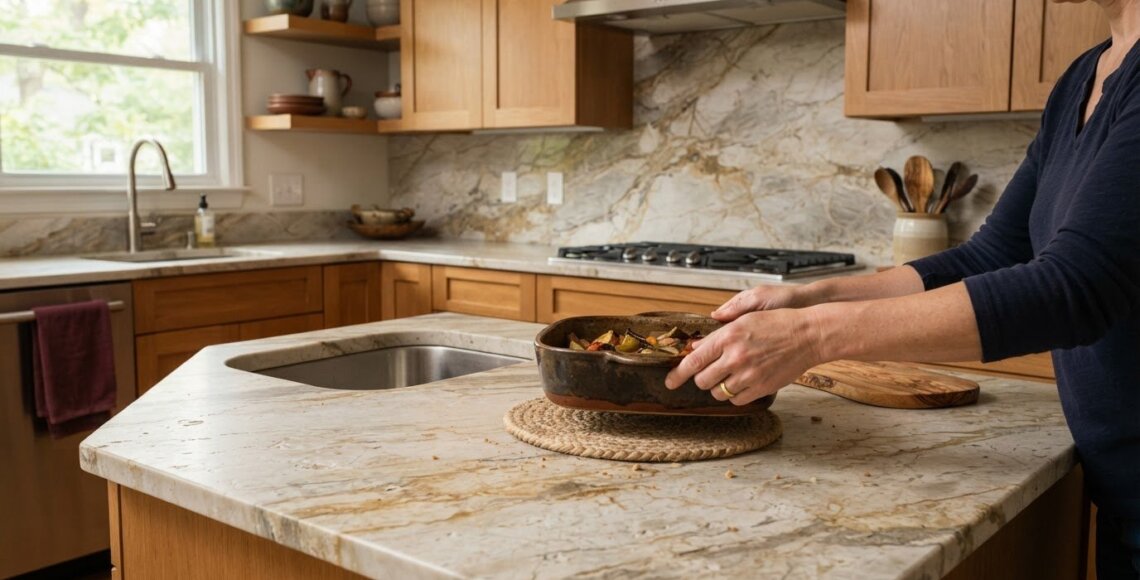
Homeowner using a Taj Mahal quartzite counter and full-height backsplash in a Richmond-area kitchen

Taj Mahal Quartzite Counters for Kitchen Durability and Style

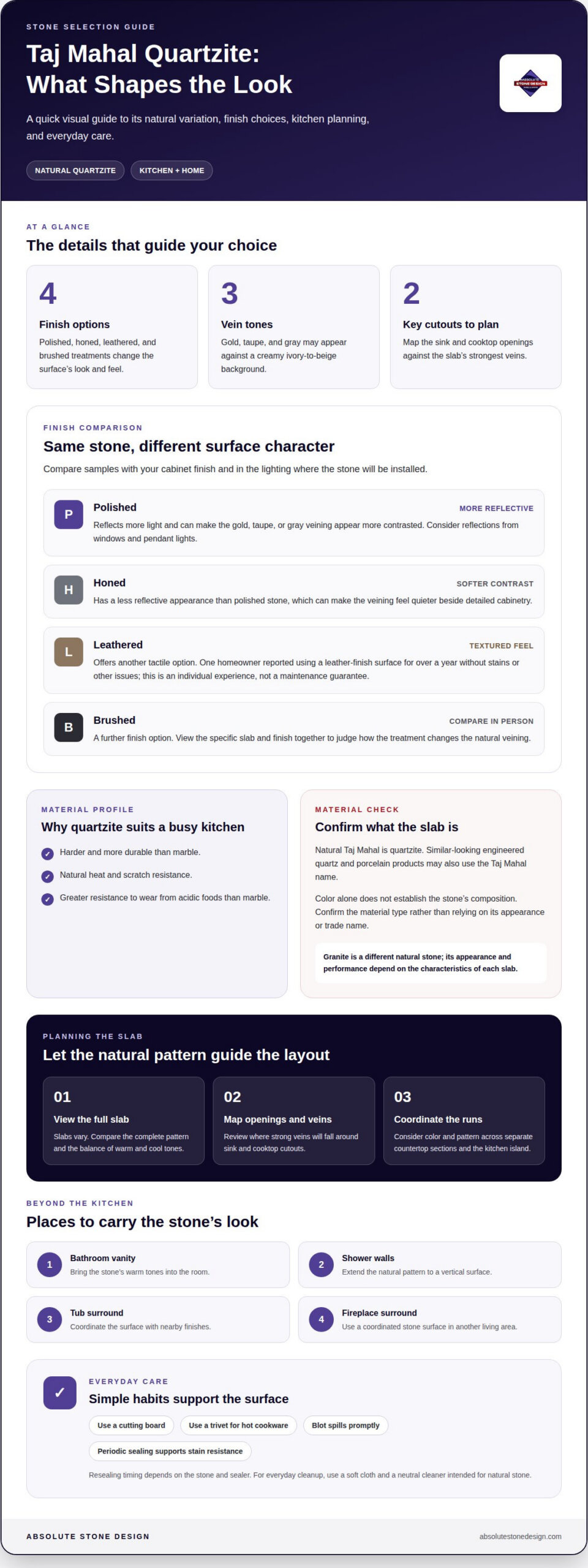
Taj Mahal quartzite counters offer a durable kitchen surface with natural heat and scratch resistance, and greater hardness than marble. Their warm ivory-to-beige coloring and gold, taupe, or gray veining vary from slab to slab, while polished, honed, and brushed finishes create different looks. Learn how this stone performs in everyday kitchen use, what to consider when choosing a slab and finish, and how it can bring a coordinated look to bathrooms and other spaces in your home.

Key Takeaways

  • Plan the slab layout around sink and cooktop openings so the natural veining falls where you want it.
  • View the actual slab before selecting it, since each piece has its own pattern and balance of warm tones.
  • Compare surface finishes in your room’s lighting to find the look and feel that suit your kitchen.
  • Consider this stone beyond the kitchen, including for bathroom vanities, shower walls, tub surrounds, and fireplace surrounds.

Is Taj Mahal Quartzite Durable Enough for a Kitchen?

Taj Mahal quartzite counters can suit a busy kitchen because quartzite is harder and more durable than marble. The stone also has natural heat and scratch resistance, while fabrication planning helps position prominent veins around sink and cooktop cutouts.

Thickness and Prefabricated Sizes

Thickness and prefabricated dimensions shape the edge profile and fit. A homeowner used 2-centimeter stone with an ogee-to-square edge; another selected a 2 1/4-inch mitered edge. These examples show how edge design changes the finished appearance, not universal specifications. A countertop professional considers the countertop support structure, island overhang, and openings when planning dimensions. Prefabricated pieces need to suit the measured countertop runs, so compare their dimensions with the kitchen layout before choosing.

Slab availability varies by lot, and every slab has its own usable pattern. During fabrication planning, map sink and cooktop cutouts against the strongest veins to avoid placing a striking vein awkwardly across an opening. Reviewing the full slab also helps coordinate color and pattern across separate countertop runs.

Comparing Countertop Materials

Compared with marble, Taj Mahal quartzite offers greater hardness and durability, including resistance to wear from acidic foods. Granite is another natural stone, but its appearance and performance depend on the characteristics of each slab. Quartz is engineered, unlike natural quartzite, and some engineered quartz and porcelain products use the Taj Mahal name for a similar look. When choosing Taj Mahal quartzite counters, consider the material identity and natural pattern alongside your kitchen’s needs.

Use a cutting board and trivet for hot cookware, and blot spills promptly. Periodic sealing supports stain resistance, though resealing timing depends on the stone and sealer.

Ask the fabricator where a chosen vein will fall around sink or cooktop cutouts; one homeowner expected fabrication and installation to take 8 weeks.

Taj Mahal quartzite appearance and color variations

Taj Mahal quartzite is a natural stone with a warm, light-colored palette. Its background ranges from creamy ivory to beige, with beige and taupe accents. Some slabs have an ivory background crossed by soft gold veining. Gray may appear alongside gold or taupe, adding a cooler note while keeping the overall look light. Perla Venata is another industry name for this stone.

Each slab looks distinct, so the balance of background and veining changes from piece to piece. One slab may read as mostly creamy ivory, while another has more visible taupe, gray, or gold. This variation can shape how the surface relates to cabinet color, flooring, and a stone backsplash. View the complete slab in person, then compare its tones with your project’s finish samples.

A countertop professional identifies real Taj Mahal quartzite by confirming the slab’s stone type, rather than relying on color or its trade name alone. Light beige and gold tones can resemble dolomite or other stones, so appearance alone doesn’t establish composition. The Taj Mahal name can also describe engineered quartz or porcelain with a similar look. Natural Taj Mahal is quartzite, while granite is a different stone.

When selecting a slab, consider where the strongest veining will fall across the kitchen countertop layout. A bold section may draw attention on an island, while quieter areas can suit surrounding work surfaces. If the slab includes both warm gold and cooler gray, see how those tones relate to nearby finishes. Viewing the full piece helps you judge pattern continuity and choose a visual balance that suits the room.

Its warm, light-colored base ranges from creamy ivory to beige, with beige and taupe accents. Veining may appear gold, taupe, or gray.

Polished, honed, and leathered finishes

A finish changes how Taj Mahal quartzite looks under kitchen lighting. Common options include polished, honed, and brushed surfaces; leathered finishes also appear in homeowner projects. Each treatment gives the same natural stone a different visual and tactile character, so compare samples with your cabinet finish and room lighting.

Polished quartzite reflects more light, which can make its veining appear more contrasted than honed stone. This finish can emphasize gold, taupe, or gray lines against an ivory background. Before choosing a polished surface, consider how reflections from windows and pendant lights will fall across the kitchen island.

Honed quartzite has a less reflective appearance than polished stone. Its softer contrast can suit a kitchen where you want the veining to feel quieter beside detailed cabinet fronts. Compare both finishes under similar lighting, since a showroom sample may look different from the slab in your home.

Leathered Taj Mahal quartzite offers another finish option for a more textured look and feel. One homeowner reported using a leather-finish surface for over a year without stains or other issues. That experience is an example, not a maintenance guarantee, so consider your kitchen’s daily use and care routine.

Brushed, honed, and polished finishes are also available for this stone. Look at the specific slab and finish together, since surface treatment can change how its natural veining appears. For example, a polished sample may make gold lines stand out, while a honed sample may present them more softly.

To choose a finish, compare samples beside a cabinet door in both daylight and evening lighting. Pay attention to reflections, visible veining, and surface feel. For everyday cleanup, use a soft cloth and a neutral cleaner intended for natural stone.

Taj Mahal Quartzite Counters for Kitchen Durability and Style

Quartzite countertop and home applications

Taj Mahal quartzite counters can connect a kitchen’s work surfaces with nearby living spaces. On an island, the stone’s light background can make a broad surface feel calm. A waterfall edge carries the pattern down the island sides, while a full-height backsplash can continue the veining behind a range or sink.

For an island or waterfall design, the fabricator plans how slab sections meet, accounting for edges, seams, and the pattern across the top and sides. A coordinated layout helps the veining appear intentional rather than interrupted. The kitchen countertop plan also guides where openings and joints fall across separate runs.

Bathrooms offer several ways to extend the stone’s look. A vanity can bring its warm tones into the room, while a tub surround creates a distinct focal point. Large-format slabs on shower walls can create a refined finish with fewer grout lines. Consider how the pattern will read across the vanity, shower, and nearby wall surfaces.

A fireplace surround can carry the stone’s soft ivory, beige, or gold tones into a living room. Taj Mahal quartzite can also be considered for outdoor kitchens and entertainment areas when the design and construction are carefully planned. Outdoor seating and dining surfaces require planning the entire installation, not just selecting a visually appealing slab.

Choose applications according to the room’s layout and the role you want the stone to play. A striking vein might anchor an island, while a quieter section suits a vanity. Planning Taj Mahal quartzite counters alongside a backsplash or fireplace surround lets the fabricator consider pattern placement across the project. Reviewing the intended pieces together helps you understand how the natural variation will carry through your home.

Absolute Stone Design: Quartz

Absolute Stone Design helps you turn a Taj Mahal quartzite selection into a countertop plan suited to your home. For a project in Richmond, Henrico, Glen Allen, Midlothian, or Chesterfield, the team can guide decisions about how the material will fit your room, cabinetry, and design priorities.

With a preferred slab and kitchen plan in place, the project moves from visual choices to precise decisions. Measurements and templates establish dimensions, while in-house fabrication turns those dimensions into the finished piece. Discuss edge shape, seam placement, and how the stone should relate to nearby surfaces before fabrication begins.

Absolute Stone Design works with natural and engineered surfaces, including quartzite, quartz, and granite countertops. If Taj Mahal quartzite is your preference, share what matters most: a quiet pattern, a particular edge, or continuity across connected surfaces. This gives the team a clear design direction while respecting that each homeowner’s priorities differ.

For a kitchen update, the team coordinates measuring, fabrication, delivery, and installation as connected stages. This keeps design choices tied to the actual room rather than an isolated slab image. Bring cabinetry selections and room plans into the discussion so surface decisions work with existing finishes and your intended layout.

This is a practical next step for homeowners planning countertop work in Richmond, Henrico, Glen Allen, Midlothian, or Chesterfield, as well as designers and contractors coordinating a local project. The team handles residential and commercial countertop projects, shaping material selection around each project’s design and installation needs.

Contact Absolute Stone Design to discuss your countertop project.

Frequently Asked Questions

Which project details shape a Taj Mahal quartzite installation?

The planned scope shapes the work involved. A project may cover existing countertop runs or include connected surfaces, such as a backsplash. Changes to the kitchen footprint also affect the sequence of measuring, templating, fabrication, delivery, and installation. Clarifying which surfaces are part of the renovation helps coordinate design decisions and gives the installation team a clear picture of the finished space.

What Are Taj Mahal Countertops Made Of?

Taj Mahal countertops can refer to different materials, so the name alone doesn’t identify the surface. Natural Taj Mahal is quartzite; engineered quartz or porcelain products may use the name to evoke a similar appearance. Check the material description on the slab or product documentation. This distinction helps you understand whether you’re choosing natural stone or a manufactured surface.

What does countertop installation for Taj Mahal quartzite involve?

Countertop installation follows preparation of the measured and fabricated pieces. The installation team positions and fits each section, aligning joints and finished edges with the approved design. Before work begins, the room needs to be ready for the pieces, and the existing cabinets must provide a suitable base. The planned sequence connects the finished surface to the kitchen’s actual layout.

What should you decide before a Taj Mahal quartzite project begins?

Decide which surfaces belong in the project and how they should relate visually. For example, you might want the countertop to coordinate with a stone backsplash or remain the room’s main focal point. Cabinetry and surrounding finishes can guide those choices. Clear design decisions help the measuring and fabrication stages reflect the result you want, rather than leaving key details unsettled.

Is Taj Mahal quartzite a suitable kitchen surface?

Yes. Its natural heat and scratch resistance make it suitable for kitchen use, and it is harder than marble. These qualities describe the stone’s general performance, not a guarantee that every slab or finish will respond identically to daily use. Your surface treatment and the way you use the kitchen can shape the experience over time.

Does Taj Mahal quartzite need sealing, and how often should it be sealed?

Natural Taj Mahal quartzite needs periodic sealing, but no single schedule applies to every installation. Keep the product information for the sealer used on your surface and follow its care directions. If you don’t know which sealer was applied, the stone’s finish and treatment history can help identify appropriate maintenance guidance. Avoid assuming one calendar interval fits every slab.

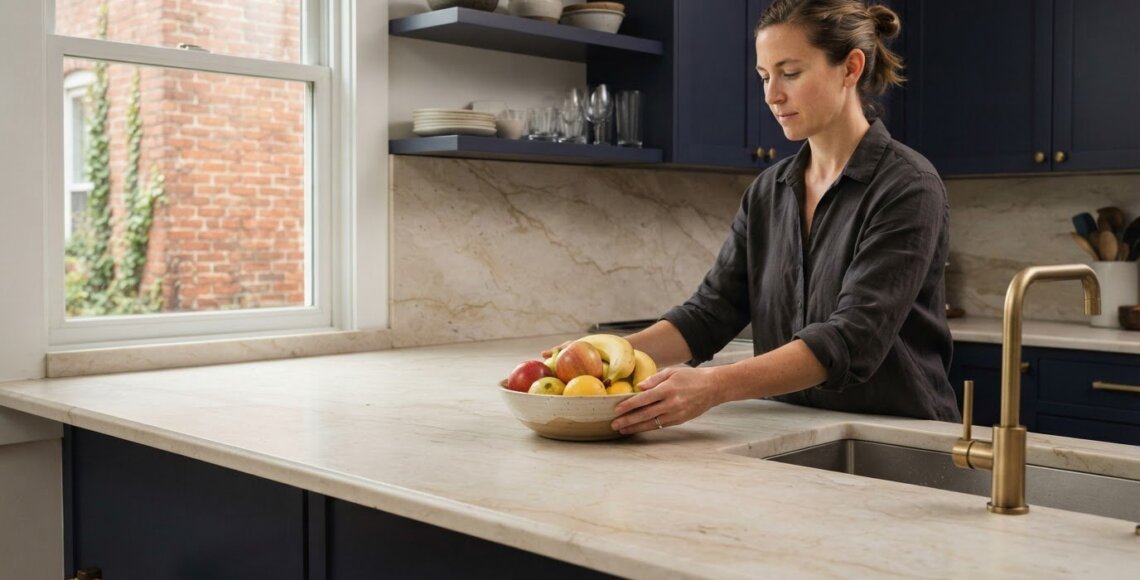
Taj Mahal quartzite island and full-height backsplash in a Richmond rowhouse kitchen

Taj Mahal Countertops for Homes and Commercial Spaces

The stone sold as Taj Mahal granite is actually natural quartzite, formed when sandstone changes under heat and pressure. Its creamy ivory-to-beige background and soft gold, taupe, or gray veining create a warm, understated look. Because slabs vary in color and movement, the specific piece you choose shapes the finished design.

That natural variation matters when planning a kitchen island, countertop runs, or a full-height backsplash, especially if you want the veining to flow across seams or around a sink opening. It also helps to understand how quartzite compares with granite and engineered surfaces, since materials with a similar appearance can have different compositions and care needs.

This guide explains what Taj Mahal quartzite is made of, what to look for when selecting slabs, and how its appearance and durability compare with other surfaces. You’ll also learn when stone sealing may be appropriate. Taj Mahal quartzite is commonly sealed about once a year, depending on kitchen use, to help improve stain resistance.

Key Takeaways

  • Plan slab selection around your island, backsplash, and cutouts so the stone’s natural movement works with the finished layout.
  • Learn how natural quartzite differs from granite and engineered surfaces before choosing the look and material for your project.
  • Consider how the surface will function in a home or commercial setting, including kitchens, bathrooms, and other design applications.
  • Weigh the visual appeal and care needs of quartzite to decide whether it suits your everyday routines.

Slab variation and in-person selection

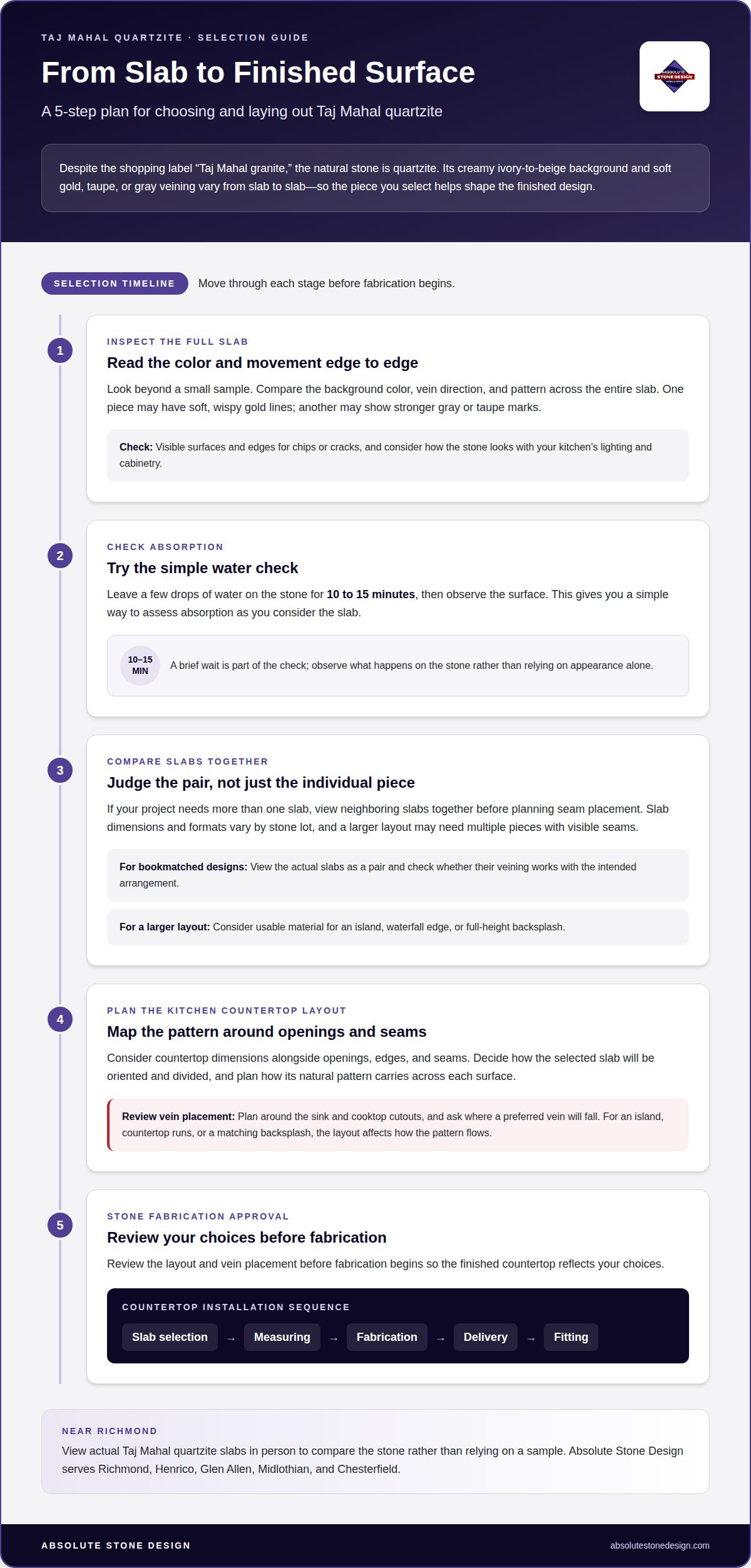
Taj Mahal quartzite ranges from creamy ivory to beige, with gold, taupe, or gray veining. For a kitchen, view the actual slabs before planning an island, seams, or a matching backsplash.

Assessing Slab Quality

Look across the full slab, not just a small sample. Compare the background color, vein direction, and pattern from edge to edge. One slab may have soft, wispy gold lines, while another shows stronger gray or taupe marks. Check visible surfaces and edges for chips or cracks, and consider how the pattern will look with your kitchen’s lighting and cabinetry.

A simple water check can help you assess absorption: leave a few drops on the stone for 10 to 15 minutes and observe the surface. Before deciding, view neighboring slabs together if your project needs more than one. This helps you compare their color and movement before planning seam placement.

Slab Sizes and Formats

Slab dimensions and formats vary by stone lot, so don’t assume one piece will cover every kitchen run or island. Consider the planned countertop dimensions alongside openings, edges, and seams. A large island, waterfall edge, or full-height backsplash may require more usable material, and the layout affects how the natural pattern carries across each surface.

Ask how the selected slab will be oriented and divided for your design. One slab may suit a smaller run, while a larger layout may need multiple pieces and visible seams. For bookmatched applications, view the actual slabs as a pair and check that their veining works with the intended arrangement.

Finding Slabs and Planning Installation

Near Richmond, view actual Taj Mahal quartzite slabs in person to compare the stone rather than relying on a sample. Absolute Stone Design serves Richmond, Henrico, Glen Allen, Midlothian, and Chesterfield, with a large stone viewing selection. For a waterfall island or bookmatched design, assess the chosen slabs together before settling on the layout.

Before fabrication, plan the kitchen countertop layout around the sink, cooktop, edges, and seams. The fabricator can show where a preferred vein will fall around sink or cooktop cutouts. Countertop installation involves slab selection and measuring, followed by fabrication, delivery, and fitting. Review the layout and vein placement before fabrication begins so the finished countertop reflects your choices.

Taj Mahal quartzite versus granite and engineered surfaces

Despite the shopping label “Taj Mahal granite,” natural Taj Mahal stone is quartzite, not granite. Quartzite forms when sandstone changes under heat and pressure over millions of years. It has a distinct geological origin from granite, even though both materials are considered for kitchen countertops.

Hardness offers one point of comparison. True Taj Mahal quartzite has a Mohs hardness of around 7, while granite typically measures between 6 and 6.5. Marble is softer, with a Mohs hardness range of 3-4. These figures describe scratch resistance, not every aspect of performance, so surface care and project needs matter too.

Engineered quartz and porcelain may use the Taj Mahal name to suggest a similar creamy, veined appearance. A quartzite countertop, however, is natural stone, and its pattern varies from slab to slab. Engineered surfaces are manufactured products, with different compositions and patterns. Compare the material itself, not just a label or photograph, before deciding.

Cabinet color can make the stone feel subtle or more defined. White or cream cabinetry echoes a pale quartzite background for a quiet, blended kitchen. Natural wood adds warmth, while dark cabinets create stronger contrast with ivory stone and gold veining. View cabinet samples beside the actual slab to judge how the combination looks.

Choose based on the look and care considerations that suit your space, rather than assuming every material performs the same way. For example, marble’s lower hardness differs from quartzite’s, while granite is a separate natural stone category. If you’re weighing natural and engineered options, explore quartzite countertops alongside granite, marble, and quartz to compare materials for your kitchen.

Taj Mahal Countertops for Homes and Commercial Spaces

Residential and commercial applications

In a home, Taj Mahal quartzite can bring a consistent stone look to kitchen countertops, bathroom vanities, and fireplace surrounds. Each setting gives the natural pattern a different role. A kitchen surface is part of daily food preparation, while a vanity or fireplace surround may serve as a quieter design feature.

For a residential kitchen, consider how the countertop connects with nearby finishes. A pale surface can complement light cabinetry, while wood or darker cabinets create contrast. On a bathroom vanity, the same stone can coordinate with nearby tile. A fireplace surround can carry the stone’s soft movement into a living room.

Commercial spaces can also use quartzite for visible surfaces, such as reception counters, office kitchenette tops, or hospitality service counters. Because routines vary, assess how the surface will be used and cleaned. A reception desk may prioritize a polished appearance, while a shared kitchenette needs a layout that supports everyday tasks.

Scale changes the design decisions. A broad reception counter may call for a calm, continuous pattern, while a smaller vanity can accommodate more noticeable veining. For a commercial project with several counters, planning stone selection and placement together can help create a consistent appearance across separate rooms.

Finish affects how the stone looks in each space. Polished Taj Mahal quartzite reflects more light and can make its veining appear more pronounced. That quality may suit a residential kitchen or reception area where a brighter look is desired. A honed finish has a matte appearance and creates a softer visual effect.

Consider the full setting before choosing. Note where the stone will sit, the cabinetry or tile beside it, and the surface’s daily role. A kitchen, bathroom vanity, fireplace surround, and commercial counter each call for a different balance of appearance and function. Matching the application to the design helps you choose with purpose.

What are the pros and cons of Taj Mahal quartzite for kitchens and bathrooms?

Taj Mahal quartzite pairs a creamy background with subtle veining, giving kitchens and bathrooms a natural stone surface with a soft, refined look. Its Mohs hardness rating is 7+, which makes it a hard surface, though hardness alone doesn’t prevent stains or damage.

In a kitchen, polished quartzite reflects more light and can make its veining look stronger. That finish may suit an island or countertop where you want the pattern to stand out. Honed quartzite has a matte appearance, while satin offers a gentler sheen than polished stone. Consider nearby lighting and cabinetry when choosing.

Bathrooms offer another application, from vanity tops to coordinated surfaces. The stone’s pale color can pair with tile to create a light, cohesive room. Its natural pattern varies, so the look across a vanity may differ from a small sample. For kitchens and bathrooms alike, viewing the slab helps you understand the finished appearance.

Care is one consideration. Sealing stone can improve stain resistance, and Taj Mahal quartzite is commonly sealed about once a year, depending on kitchen use. For everyday cleanup, use a soft cloth and a neutral cleaner intended for natural stone. Don’t assume quartzite is maintenance-free just because it is hard.

Natural stone varies, while engineered surfaces can offer a more consistent manufactured pattern. Quartzite also requires professional fabrication. Silica-containing material calls for careful handling during fabrication. That work calls for appropriate shop practices, not a do-it-yourself cutting approach.

For your project, weigh the natural variation, finish, and care routine against the look you want. If quartzite fits your kitchen or bathroom plans, plan a quartzite surface that suits the space.

Absolute Stone Design: Granite

Absolute Stone Design can help you move from comparing stone names to planning countertops for your space. If a slab labeled “Taj Mahal granite” caught your eye, remember that natural Taj Mahal stone is quartzite, not granite. For a different material direction, compare granite, marble, and quartz by appearance and how each suits your kitchen or bathroom.

For countertop projects, the team provides precise measurements and templates, in-house fabrication, and installation. This coordinated process connects your chosen surface with its dimensions, edges, and openings, helping turn material decisions into a finished countertop. Whether you’re updating a kitchen or planning a bathroom, clear design choices can guide the next steps.

Contact Absolute Stone Design to discuss your countertop project.

Shape a Surface Plan That Feels Like Yours

Your next step is to turn inspiration into a clear design direction. Think about the feeling you want the room to create, from a calm, softly blended kitchen to a reception area with a more defined focal point. If the label “Taj Mahal granite” started your search, use what you’ve learned to describe the look and material you have in mind.

Absolute Stone Design’s team can help you consider how countertops, granite, and marble fit your project’s design. Bring your ideas together around the room, the surrounding finishes, and how you want the surface to feel in everyday use. A thoughtful starting point makes the design conversation more focused, whether you’re planning a home or commercial project.

Start planning your countertop project with Absolute Stone Design, and take the next step toward a space that feels distinctly yours.

Frequently Asked Questions

What Are Taj Mahal Countertops Made Of?

Natural Taj Mahal countertops are made from quartzite, not granite. When purchasing, treat the name as a style label until the material is identified in the slab documentation. That distinction matters before you approve fabrication: the label alone cannot tell you whether the surface is natural stone or an engineered product made to resemble it.

What is Taj Mahal granite, and is it actually granite or quartzite?

The phrase “Taj Mahal granite” is a market label, not a reliable geological description. Natural stone sold under that name is classified as quartzite, while look-alike engineered surfaces may use similar wording. Before approving a slab, match its written material description to the surface you selected. This helps prevent an ambiguous label from carrying into fabrication decisions or project records.

What colors, patterns, and natural variations does Taj Mahal stone have?

Taj Mahal stone may show creamy ivory, beige, gold, taupe, or gray, with each slab offering its own balance of color and veining. If the room has adjacent surfaces, bring cabinet, flooring, or backsplash samples when viewing slabs. Compare the stone with those finishes in natural and interior lighting, then note which areas of the slab should remain visible in the final design.

How does Taj Mahal quartzite compare with granite, marble, and engineered quartz?

Compare samples side by side under the same lighting, then assess how the pattern works with your cabinet and backsplash choices. Natural quartzite, granite, and marble each have a distinct character, while engineered quartz is manufactured. For a large counter run, consider whether you prefer visible natural variation or a more controlled, repeatable look across the design.

Is Taj Mahal quartzite durable, heat-resistant, and scratch-resistant?

Quartzite is a hard surface, but a hardness rating alone can’t tell you how an installed countertop will handle every impact or heat exposure. In kitchens, protect the edges during use and don’t treat a stone top as a cutting board. Practical performance depends on the material, installation details, and daily habits. Keep those factors in mind when reviewing surface claims.

Does Taj Mahal quartzite need sealing, and how often?

Yes. Taj Mahal quartzite is commonly sealed about once a year, depending on kitchen use. Keep a note of the last application and follow the sealant label for preparation, application, and curing instructions. This interval is a maintenance guide, not a reason to apply another coat automatically. Assess the surface and its care history before repeating the treatment.

Veined quartzite countertop paired with a full-height stacked subway tile backsplash in a Richmond kitchen

Kitchen Countertop Backsplash Pairing: Which Element Should Lead

For a cohesive kitchen countertop backsplash pairing, start with the cabinets, choose the countertop next, and let the backsplash follow. The surfaces don’t need to match exactly; coordinating their undertones and giving each a distinct visual role helps the room feel balanced. With veined marble or quartzite, stacked subway tile can add clean lines and a quiet backdrop without competing with the stone.

Key Takeaways

  • Choose a visual lead for the kitchen, then let the other finishes support it rather than compete for attention.
  • Coordinate warm or cool undertones across cabinets, countertops, and backsplash to create a more cohesive palette.
  • Balance dramatic veining with a quieter tile, or use contrasting textures to add interest without visual clutter.
  • See how stacked subway tile can bring clean lines to veined marble or quartzite while keeping the stone in focus.

1. Should Backsplash Match Countertop or Cabinets?

You don’t need to match the backsplash exactly to the countertop or cabinets. A kitchen countertop backsplash pairing can coordinate through shared undertones or use contrast to define each surface’s role. The selection often begins with the fixed elements: cabinet color, floor tone, and appliance finish. These establish the palette, while the backsplash can connect those elements without copying any one of them.

To assess undertones, look beyond labels such as “white” or “gray.” Bright white cabinets can make creamy tile look more yellow, while a blue-gray counter may appear cooler beside warm flooring. Consider the whole room: warm wood cabinets may guide your palette toward warmer wall colors, while a cool-toned floor may call for a backsplash that bridges both finishes instead of introducing another strong undertone.

Your kitchen style also shapes the decision. In a traditional kitchen with detailed cabinet doors, a simple backsplash can keep the overall look settled. In a streamlined modern style kitchen, stronger contrast may add definition. Include appliance color in your plan: stainless steel often aligns with cool-toned materials, while black appliances can contribute a dark accent. Consider how prominent these finishes are and whether you want them to blend in or stand apart.

When your countertop has veining, use a quieter color within the stone to connect it subtly to the backsplash, rather than repeating the most prominent shade. Ceramic tile and stone are common backsplash choices near a range or sink, but suitability depends on the specific material and finish. Consider exposure to heat, moisture, and splashes, along with cleaning needs, before choosing a surface. The result can coordinate visually and suit your everyday kitchen use.

2. Balancing countertop and backsplash texture and finish

Balance texture by considering how each surface catches light and carries visual movement. A polished counter can feel sleek, while a honed backsplash gives the wall a softer finish. Pairing them creates contrast without adding another color. Let one surface provide visual energy and the other temper it. A kitchen countertop backsplash pairing feels balanced when sheen and texture work together rather than compete for attention.

Countertops with pronounced grain or veining often benefit from a backsplash with a quieter surface pattern. Smooth ceramic tile can calm the composition, while a subtle handmade texture adds depth without introducing another bold motif. If the counter is visually simple, a tile with a distinct shape or surface variation can bring interest to the wall. Consider the size and frequency of each pattern, not just its color.

For example, a linear countertop pattern may sit more comfortably beside tile with a softer, less regular texture than beside another strong grid. A patterned backsplash can also work with a solid countertop, keeping the overall mix easy to read. In smaller kitchens, related surface textures and restrained patterns can help maintain visual continuity. Judge the balance by how the materials look together across the full counter run and wall.

Use samples to judge those relationships before making your final selection. Tile and grout can be placed beside the countertop sample, then viewed upright to represent their installed position. This makes differences in sheen, texture, and pattern easier to compare. For a more continuous finish, a full-height slab backsplash carries the counter material up the wall. If that suits your design, full wall backsplashes can connect the counter and wall as one surface.

3. Choosing a focal point between countertop and backsplash

Begin by identifying the kitchen’s strongest visual surface from the main entry and work areas. Assess the countertop, backsplash, floor, and island as one composition. In many layouts, the counter or floor already carries the most visual weight. Choosing a clear lead prevents every element from competing equally. Give supporting surfaces a quieter role so the room feels composed rather than crowded.

A countertop can lead when its pattern or movement draws the eye. For example, granite with striking veining can become the focal point, while a subtle backsplash lets the stone’s natural variation stand out. Consider how much countertop is visible from nearby rooms. A large island may strengthen that feature, while a smaller counter run may leave more visual emphasis to the backsplash or cabinetry.

The backsplash can take the lead when the countertop is visually restrained. Patterned tile, a distinctive shape, or a full-height surface can create an expressive focal point. Keep the palette balanced by pairing that feature with simpler countertop and floor surfaces. Grout close in color to the tile softens the pattern; contrasting grout makes the layout more noticeable. Choose based on whether you want the tile’s shape or color to stand out.

Lighting and sightlines help refine the decision. A polished counter may catch light across an open kitchen, while a backsplash can stand out above a long work area. View the materials together under natural and under-cabinet lighting, then consider how the focal surface looks from the doorway and adjacent spaces. Give each finish a distinct role: a focal point, a supporting element, or a quiet background. This gives the eye a clear place to land without making other surfaces disappear.

Kitchen Countertop Backsplash Pairing: Which Element Should Lead

4. Pairing veined marble or quartzite with stacked subway tile

Quartz pairs well with ceramic tile, while granite can take a backsplash that echoes a quieter color in its pattern. Veined marble or quartzite benefits from simpler tile, such as white stacked subway tile. For butcher block, warm-toned tile can complement the wood without introducing competing patterns.

This combination works because the materials have contrasting visual rhythms. Marble and quartzite veining moves naturally across the surface; stacked subway tile brings orderly lines to the wall. White tile can give marble and deep blue cabinets a calm backdrop, while off-white tile can soften the contrast. The tile doesn’t need to repeat every color in the stone.

Start by identifying the stone’s dominant tone and secondary colors. Choose tile that relates to a quieter shade, then consider the grout and layout. Grout close in color to the tile keeps the wall looking more seamless; contrasting grout emphasizes the grid. Keep other patterns restrained so the stone and tile complement rather than compete with each other.

For a stacked layout, consider the wall’s size and the countertop’s visual scale. Subway tile creates clean lines, while larger tiles can reduce grout lines and create a simpler field. In a compact kitchen, appropriately scaled tile and a restrained palette help maintain continuity. View tile and grout samples vertically beside the countertop, since their appearance can shift on the wall.

For 2026, a considered combination is veined marble with white stacked subway tile, or quartz with ceramic tile in a coordinating tone. These are design directions, not rules; the stone’s pattern, cabinetry, and room scale guide the final selection.

Planning a stone-and-tile combination? Plan your countertop and backsplash pairing with a coordinated look in mind.

Absolute Stone Design: Countertops

Absolute Stone Design brings countertop and backsplash selections together through custom countertop fabrication and installation. For granite or marble, coordinating the stone’s veining with tile or a full-wall backsplash can shape the kitchen’s focal point and overall feel.

The process includes precision measuring and templating, in-house stone fabrication, delivery, and installation. This provides a clear path from material selection to fitted surfaces, with attention to how the countertop and backsplash relate in your kitchen. A full-wall backsplash can extend the stone’s visual presence, while a contrasting material can create a distinct transition.

If you’re ready to plan your surfaces, contact Absolute Stone Design to discuss your kitchen project.

Start shaping a kitchen that feels like yours

A thoughtful kitchen countertop backsplash pairing does more than coordinate finishes; it can express how you want the room to feel during everyday meals and gatherings. Before fabrication, settle on the mood you want throughout the kitchen: a quiet backdrop, a more pronounced stone feature, or a balance between the two. Those preferences give your material selections a personal direction.

Absolute Stone Design offers granite and marble countertops, with stone fabrication handled in-house. Your preferred colors, patterns, and overall style can guide the selection of surfaces that work together. Bringing your design ideas into the conversation helps keep the finished kitchen connected to your vision.

Ready to take the next step? Contact Absolute Stone Design to discuss your kitchen project. With a clear vision and thoughtful material choices, your kitchen can feel distinctly yours.

Frequently Asked Questions

Should you match the backsplash to the countertop or cabinets?

The surfaces don’t need to match exactly; your choice depends on which feature should guide the room’s palette. If your cabinetry is the main visual feature, a backsplash that relates to its color can create continuity. If your countertop has more character, let the backsplash support it instead. For kitchens in Richmond, Henrico, Glen Allen, Midlothian, Chesterfield, and Charlottesville, consider your cabinetry, counters, flooring, and lighting together before settling on the pairing.

Do Finishes Need to Match?

No. Different finishes can work together when the contrast feels intentional. A glossy backsplash can reflect light beside a matte floor, while a polished countertop and honed wall surface create a softer contrast. Surrounding colors matter too: an unexpected mix of warm and cool undertones can make finishes feel disconnected, even when their textures complement each other.

How Does Kitchen Style Affect Your Choice?

Your kitchen’s style helps determine whether the backsplash should blend in or add character. Subway tile can suit classic and modern rooms, while a distinctive tile shape can give a simpler kitchen a more individual feel. In a traditional space, a restrained pattern may preserve a familiar look; in a contemporary kitchen, clean lines can keep the design crisp.

Should You Use the Same Material?

Using the same material for your counter and backsplash can create a continuous, streamlined look, especially when the stone’s veining carries upward. It can also make a strong pattern more prominent across the wall. For clearer separation, choose a different backsplash material and let its color or texture relate to a detail in your countertop.

Should you choose a backsplash that is lighter or darker than your countertops?

Either direction can work. A pale backsplash can lift dark counters, while a darker wall surface can add depth beside a light countertop. If both your cabinets and counters are light, a deeper backsplash can introduce definition. If both are dark, a lighter, glossy tile can break up the visual weight, particularly in a kitchen with limited natural light.

How should you select a grout color for the backsplash?

Grout affects whether tile reads as a quiet surface or a distinct pattern. A grout shade close to the tile color softens the grid and keeps attention on nearby materials. Contrasting grout outlines each tile and makes the layout more noticeable. Compare grout and tile samples together, since the joint color changes the backsplash’s overall appearance.

A Richmond-area kitchen pairs veined marble perimeter counters with a crystalline quartzite island.

Quartzite vs Marble: Compare Cost, Durability and Care

Quartzite is harder and more scratch-resistant than marble, but that doesn’t automatically make it the better surface for your home. If you’re weighing quartzite vs marble, you’re likely balancing a distinctive natural look with how the stone will handle everyday cooking, spills, and cleanup; marble can etch when acidic liquids touch it, while quartzite is generally more resistant to scratches and etching, so the right fit depends on the character you want and the care you’re comfortable giving it. This guide compares their appearance, hardness, scratch resistance, and maintenance, then explains how each stone forms: marble develops from limestone under heat and pressure, while quartzite forms as heat and pressure fuse quartz grains in sandstone. You’ll come away with a clearer sense of which stone suits your kitchen or bathroom priorities, whether you’re drawn to marble’s veining or quartzite’s durability.

Key Takeaways

  • Learn how marble’s veining differs from quartzite’s varied patterns, and why individual slabs can look distinct.
  • Understand which stone better resists scratches and how everyday kitchen use can affect each surface.
  • Get practical guidance on sealing and simple care habits to help protect your countertop.
  • Discover how these stones form and use their natural differences to guide your choice.

Marble vs. Quartzite: Appearance and Veining

Carrara marble usually has a pale background with subtle gray veining, while Calacatta pairs a whiter background with bolder veins. Statuario, another Italian marble, is also known for pronounced veining. These patterns give marble countertops a classic, layered look in kitchens and bathrooms.

Quartzite can resemble marble, but its movement may look more dramatic, sometimes with a crystalline sparkle. Taj Mahal quartzite is known for creamy beige tones and soft veining, offering a quieter look than strongly veined Calacatta. Veining varies from slab to slab, so pieces with the same variety name can look quite different.

Color also shapes a room’s mood. Carrara’s gray lines suit a restrained palette, while Calacatta’s bold markings can make a kitchen island a focal point. Taj Mahal’s warm beige tones pair naturally with creamy cabinets and wood finishes. Compare full slabs to see how each pattern flows across a larger surface.

A mislabeled slab can lead you to expect quartzite’s hardness and scratch resistance from material that behaves more like marble. A slab may also have visible flaws or look less consistent than its sample suggests, so assess the specific piece you plan to use.

Stone option Typical appearance Color and veining Visual impression
Carrara marble Pale background Subtle gray veining Soft, classic pattern
Calacatta marble Whiter background Bold, pronounced veins High-contrast focal point
Taj Mahal quartzite Creamy beige tones Soft, variable veining Warm, understated movement
Other quartzite Varies by slab Can include dramatic movement and sparkle Distinct natural character

Choose marble for its recognizable veining, or quartzite for a marble-like look with varied natural movement. Compare the actual slab with your cabinets and the room’s lighting.

Hardness, durability, and scratch resistance

Quartzite is harder than marble and generally resists scratches and etching better. That difference is often central to a quartzite vs marble comparison, especially for busy kitchen surfaces. Cookware, utensils, and food preparation can leave marks. Quartzite suits frequent cooking, while marble’s timeless beauty may appeal when appearance matters more than wear. Both are natural stones, and careful use helps preserve their finish.

Marble contains calcite, which reacts with acidic liquids. Lemon juice can etch the surface, leaving a dull mark rather than a scratch. Marble is also more prone to staining, so clean spills promptly. Quartzite is more resistant to acid and scratches, but still benefits from sensible care.

For stains, etching, and heat, quartzite generally offers more resistance than marble. Lemon juice can etch marble, while quartzite can withstand a hot pan placed directly on its surface. Neither stone is indestructible, and cleaning spills promptly is a useful habit.

For high-traffic kitchens, bar tops, and outdoor applications, quartzite’s hardness and wear resistance make it a practical choice. Marble can suit bathroom vanities and other spaces where distinctive beauty is the priority. For bathroom floors, consider foot traffic and care needs: quartzite is harder, while marble needs more attention to etching and stains.

Surface finish and daily habits also affect long-term durability. Use a cutting board to help protect marble during meal preparation, and wipe spills quickly to limit contact with acidic ingredients. With either stone, consider how you use the space, not just how the surface looks.

The quartzite vs marble decision comes down to your priorities: choose quartzite for greater scratch and acid resistance in hardworking spaces, or marble for its character and a more attentive care routine.

Quartzite vs Marble: Compare Cost, Durability and Care

Maintenance: Which Stone Is Easier to Care For?

Both marble and quartzite need sealing, but their maintenance routines differ. Marble typically requires more frequent sealing, while quartzite generally needs less frequent upkeep. Sealing helps guard against stains but doesn’t make either natural surface impervious to spills. Follow the sealant’s care directions and clean the surface routinely.

For marble, wipe spills promptly and use a cutting board during meal preparation. These habits limit contact with acidic foods and reduce the chance of knife scratches. Quartzite also benefits from prompt cleanup, even though it’s generally more resistant to stains and etching. Neither natural stone countertop is maintenance-free.

A bathroom vanity has different daily demands than a kitchen work surface. In either room, clean spills promptly and follow the care guidance for the sealant. Marble’s natural colors and veining don’t change its care needs; even a pale surface needs prompt attention after a spill.

  • For marble: Wipe spills quickly, use a cutting board, and expect more frequent sealing.
  • For quartzite: Clean spills promptly and maintain its seal, though upkeep is generally less frequent.
  • For either stone: Use the sealant’s care directions to guide routine maintenance.

Heat and pressure shape these stones before they become countertops, but daily care happens at home. Build simple habits around your routine: clear spills after cooking, avoid cutting directly on the surface, and attend to bathroom splashes. These steps help preserve the finish without changing the stone’s natural pattern. If a scratch or dull mark appears, identify its cause: a scratch differs from etching, and the surface may need different care. Choose marble if you’re comfortable with a more attentive routine; quartzite suits those who prefer less frequent maintenance.

How marble and quartzite form

Marble begins as limestone or dolomite, rocks rich in calcite. Underground heat and pressure transform this starting material into marble. The process changes the rock’s structure, while its minerals contribute to color and veining. This geological history explains why marble has a natural pattern rather than a printed design. A slab cut from one block can reveal movement shaped long before it reaches a kitchen.

Quartzite starts as quartz sandstone. Heat and pressure fuse its quartz grains, transforming sandstone into a harder natural stone. The grains become tightly joined, helping explain quartzite’s greater hardness compared with marble. Original sandstone layers and mineral variations can contribute to its movement. A slab may have marble-like patterns, even though the stones formed from different starting rocks.

A stone’s formation offers a useful clue, but it can’t predict every slab’s appearance or performance. Marble’s calcite composition helps explain its sensitivity to acidic liquids, while quartzite’s fused quartz grains help explain its resistance to scratches. The distinction matters in a kitchen, where a stone’s origin relates to both its appearance and everyday use. Each natural stone varies with its geological history.

The key takeaway is that these stones aren’t simply two finishes with different colors. Marble comes from limestone or dolomite; quartzite comes from quartz sandstone. Their origins help explain their different care needs and resistance, even when their patterns look similar. Both need sealing, while traffic and daily habits shape how a surface wears. Understanding the starting rock gives you a more meaningful basis for choosing a natural stone than appearance alone.

Absolute Stone Design: Marble

Absolute Stone Design helps you compare marble, quartz, and quartzite for a countertop project. Serving Richmond, Henrico, Glen Allen, Midlothian, Chesterfield, and Charlottesville, the team can help you weigh the look you want against your household’s routines and the room’s needs. Bring those priorities into a material discussion to turn a broad preference into a clear design direction.

Whether you’re choosing a surface for a kitchen, bathroom, or another room, consider how the countertop relates to your cabinets, surrounding colors, and the overall feel you want. Absolute Stone Design offers design services alongside countertop materials, giving you an opportunity to discuss how your preferred stone can support the project’s visual goals.

Once you have a direction, Absolute Stone Design provides precision measuring, in-house stone fabrication, delivery, and installation. These connected steps carry your selected material and project dimensions through to the finished countertop. Discuss the practical differences and design details to decide which surface feels right for your home.

Marble, quartz, and quartzite each bring distinct character to a space, and the best fit depends on your priorities. Absolute Stone Design can help you consider these options for your countertop project, whether you’re updating a home in Glen Allen or elsewhere in the Richmond area. Start with your preferred look, room, and project needs.

To discuss your countertop project, contact Absolute Stone Design.

Frequently Asked Questions

What is the difference between quartzite and marble?

Quartzite forms from quartz sandstone, while marble forms from limestone or dolomite. This difference in origin affects how each stone responds to everyday use, so appearance alone isn’t enough to choose between them. For a kitchen, consider the surface’s role, your care preferences, and how its natural pattern will fit around sinks, cooktops, and countertop joints.

How can you tell natural quartzite from marble?

A slab’s appearance can’t reliably identify its stone type, since quartzite can have marble-like patterns. Marble reacts to acidic substances, while quartzite is more resistant, but applying acid or scratching a finished surface can cause damage. Use the slab’s material identification and have its composition assessed before fabrication, rather than trying a scratch test on an installed countertop.

Which is harder and more durable, quartzite or marble?

Quartzite is harder and generally more scratch-resistant than marble, which can make it a practical choice for a kitchen used for frequent meal preparation. Marble can still suit a kitchen where natural character is the priority, especially if you’re comfortable using cutting boards and cleaning spills promptly. Consider your daily routine, not just the stone’s appearance.

How often do quartzite and marble countertops need sealing?

Sealing is one part of caring for these countertops, and maintenance needs can vary. No single interval applies to every countertop, because care depends on the sealant and how the surface is used. Keep the sealant’s product information, follow its maintenance directions, and note when sealing is completed to plan future care.

What are the pros and cons of quartzite vs marble for kitchen countertops?

Quartzite offers greater resistance to scratching and etching, while marble brings distinctive natural patterns and calls for more attentive care. For a busy kitchen, consider how often you cook, whether you’re comfortable wiping spills promptly, and how the stone will look across the island and countertop runs. Marble can work well if its appearance is worth the extra care to you.

How do quartzite and marble compare in appearance, colors, and veining?

Marble often features a light background with gray veining, while quartzite ranges from soft, quiet patterns to striking movement. Color and veining vary from slab to slab, even within the same variety. Compare the full slab with your cabinet color and room lighting, and consider how its pattern will fall across joints, sink openings, and a kitchen island.

Calacatta Gold marble island and full-height backsplash in a Richmond rowhouse kitchen

Calacatta Gold Marble Countertops for Kitchens and Baths

Calacatta Gold marble countertops make a striking focal point, pairing a warm, buttery-white background with veining that ranges from deep gray to honey-toned gold. This natural pattern brings character to kitchens and bathroom vanities. But appearance is only part of the decision: marble can scratch and etch with everyday use, so the right fit depends on how you use the surface, the care you’re comfortable giving it, and the selected slab’s color and veining. This guide covers Calacatta Gold’s appearance and what to consider for a kitchen or bath, plus how to view slabs at Absolute Stone Design in Richmond. Seeing the stone in person helps you compare its pattern with your cabinets, fixtures, and overall design.

Key Takeaways

  • Match marble to how you use your kitchen or bath, and consider the care its surface needs in daily life.
  • Look at the full slab to understand how its natural pattern may flow across your countertop.
  • Plan the countertop layout, edges, and seams together so the finished surface feels cohesive.
  • Learn how measuring, in-house fabrication, and installation support a more coordinated countertop project.

Marble countertop suitability and applications

Calacatta Gold marble may suit kitchen counters, islands, and bathroom vanities when its care needs fit your routine. Consider daily use, exposure, and the surface’s role.

Countertop and Island Uses

In a kitchen, Calacatta Gold creates a distinctive surface for perimeter counters or an island. Whether it suits your kitchen depends on how you use the surface and care for it. Marble is not scratch resistant, so consider how you prepare food, handle cookware, and use the island before choosing it for a busy work area. In a bathroom, marble may be considered for a vanity, depending on the intended use and care requirements.

Stain, Etch, Scratch, and Crack Concerns

Calacatta Gold marble can stain or etch, and it can scratch because marble is not scratch resistant. Honed marble has a smooth, matte finish, but is more susceptible to staining and etching. Marble does not necessarily crack easily, though impacts and an uneven countertop support structure can damage a slab. Professional stone sealing is recommended annually, with surface restoration and protection specialists like Sealwerx highlighting the importance of regular protective treatments to guard porous natural stone against deep staining.

For a residential kitchen, weigh the visual appeal against the care involved in cooking and cleanup. A bathroom vanity may face different demands than a kitchen island, so choose the application with your daily routine in mind. A honed finish also affects how the surface responds to stains and etching, making finish selection part of the decision.

Commercial settings call for the same practical assessment. A marble reception counter may see different use from a restaurant work surface, while marble flooring requires consideration of foot traffic and maintenance. Match the stone to the setting rather than assuming one application suits every project. This helps you decide whether Calacatta Gold belongs on counters, floors, or selected feature surfaces.

Slab inventory and showroom viewing

Viewing a full slab lets you assess its color, veining, and pattern before fabrication. Calacatta Gold varies between natural stone blocks, so inspect the actual piece.

Slab Inventory and Thickness Options

Calacatta Gold slabs are available in 2 cm and 3 cm thicknesses. Thickness affects the slab profile and planned edge details. Compare the selected thickness with the countertop support structure and intended edge treatment. A fabricator can review the kitchen countertop layout and explain how the slab may be planned for counters, an island, and seams.

Listed examples include a Calacatta Gold Borghini polished slab measuring 117 by 78 inches and a Calacatta Gold Caldia polished slab measuring 128 by 74 inches. Slab dimensions help inform layout planning, but pattern placement also matters. Review how the fabricator plans to position the stone across countertop runs.

Natural Stone Variation and Slab Selection

How can a stone fabricator help you choose and inspect Calacatta Gold marble slabs? The fabricator can guide you through the slab, point out vein direction and color shifts, and discuss how those features may align with your countertop plan. Seeing the full stone helps you assess its character beyond a small sample.

Natural stone blocks can vary in appearance, and gold-vein intensity differs between quarry blocks. One slab may look warmer or more dramatic than another. Examine the entire face and consider where prominent veins will fall across long countertop runs.

Inventory details can complement a full-slab inspection. A New Jersey Calacatta Gold A1 Select marble slab is 1-1/4 inches thick, measures 70X128, and has 62.22 square feet available. A Texas Calacatta Gold A1 Select marble slab measuring 70 by 135 inches is 1-1/4 inches thick and has 65.63 square feet available. Another New Jersey Calacatta Gold A1 Select marble slab measures 79 by 129 inches and has 70.4 square feet available.

Other listed Calacatta Gold A1 Select slabs include one measuring 69 by 138 inches with 66.13 square feet available, and one measuring 74 by 121 inches with 62.18 square feet available. Comparing available area and dimensions with the countertop plan can help narrow the slabs to inspect, while viewing the actual stone lets you consider its color and vein placement.

Calacatta Gold Marble Countertops for Kitchens and Baths

Calacatta Gold marble appearance and characteristics

Calacatta Gold’s visual character depends on the scale and direction of its veining. Broad, sweeping lines can create a dramatic focal point, while finer movement may feel quieter across a long counter. Consider how the pattern will sit beside cabinet colors, hardware, and flooring. Warm cabinet finishes can echo the gold tones; cooler finishes can bring the gray veins forward.

Calacatta Gold marble is quarried natural stone, while Calacatta Gold quartz is an engineered surface inspired by marble’s appearance. Marble’s individual pattern comes from the stone itself, so the finished surface has natural variation. Other marble countertops also differ in background color and vein character. Compare the actual material with nearby finishes to decide which overall effect suits your room.

Edge profiles, surface finishes, and backsplash choices shape the design as a whole. A more decorative edge can add detail, while a restrained profile keeps attention on the stone’s pattern. For the backsplash, consider whether you want a coordinated stone surface or a contrasting material. Lighting matters, too: it can change how a polished surface reflects and how its veining reads.

Professional measurement captures the countertop’s dimensions, wall contours, overhangs, and sink or cooktop openings. A template then guides fabrication, including cutout placement. Before installation, the room and countertop support structure are prepared for fitting. Installers position the fabricated sections, join planned seams, and assess how the finished edges meet adjoining walls and cabinets.

These choices work together. A broad-veined slab, for example, may call for a simpler edge and a quieter backsplash, while a subtler pattern leaves room for more decorative details. Consider the whole room, not just a small sample, when shaping the final design.

Planning a Calacatta Gold Marble Countertop Project

Start with how the room needs to work, not just how it should look. In a family kitchen, you may want a clear prep zone separate from the area where guests gather. For a bathroom vanity, consider who shares the space and how much counter area supports your morning routine. These priorities help shape the project brief.

Next, coordinate the countertop project with the wider renovation. Cabinet changes, flooring work, and wall finishes can affect the room’s readiness and how design choices fit together. If you’re keeping existing cabinets, include that in the plan early. A new build may offer more freedom to coordinate the room’s finishes from the start.

Think through how the space will function during the work. A kitchen renovation may temporarily limit access to cooking and cleanup areas, while a bathroom project may affect a shared daily-use space. Discuss the project schedule and household needs with the team so the work can be planned around the room’s role.

For a commercial project, consider how staff and visitors use the space. A reception counter has different demands from a food-service work area, and the surrounding operation may affect access during the project. Share the intended use, cleaning routine, and any site constraints with the project team. Those details keep the design discussion grounded in the setting.

Finally, choose a clear point of contact for decisions. When homeowners, designers, and contractors are involved, shared priorities help keep selections consistent. Agreeing on the preferred balance between a striking focal point and a quieter overall room, for example, makes later choices easier to evaluate. A well-defined brief gives the team a practical direction from the outset.

Absolute Stone Design: Countertops

Absolute Stone Design manages marble countertop projects from material selection through installation. Its countertop services include precision measuring, templates, in-house stone fabrication, delivery, and installation. This connected process helps account for the slab’s natural pattern alongside the room’s dimensions and planned edges.

For a Calacatta Gold project, visit Absolute Stone Design’s Richmond showroom to view marble and discuss how its veining may suit your kitchen or bathroom. Measurements and a template translate the selected material into countertop pieces, including sink openings and an island. Reviewing the layout and design details before fabrication helps align the finished surface with your plans.

Absolute Stone Design also offers granite and quartz countertops. Each material offers a different way to coordinate your room’s surfaces, so your choice can reflect the appearance and everyday use you have in mind. If you’re comparing marble with another option, the team can discuss the materials and how each may fit your project, without treating them as interchangeable.

Whether you’re renovating a bathroom vanity or planning kitchen counters and an island, begin with the room and the decisions that shape its finished look. Absolute Stone Design manages the process from measurements through delivery and installation, with in-house fabrication keeping the stone work within one workflow. Share your design priorities with the team to discuss the next steps for your project.

Contact Absolute Stone Design to discuss your countertop project.

Frequently Asked Questions

What is Calacatta Gold marble and what does it look like?

Calacatta Gold is marble quarried in Italy, known for expressive natural patterning. Its appearance can shift from slab to slab, so the stone’s name alone does not tell you exactly what a particular piece will look like. If your room has several finishes, compare the selected stone with cabinet and flooring samples under the planned lighting.

Is Calacatta Gold marble durable and suitable for kitchens and bathrooms?

Calacatta Gold can work in either room if you’re comfortable caring for marble as a natural surface. In a kitchen, consider whether you regularly prepare food directly on counters or can use cutting boards and trivets. In a bathroom, think about how the vanity is used and cleaned. The right application depends on your routine, not just the room’s appearance.

How do you seal, clean, and maintain Calacatta Gold marble countertops?

Build a simple care routine around gentle daily use: place a cutting board under food, use trivets for hot cookware, and choose nonabrasive cleaning tools. Keep cosmetics and toiletries on trays where practical, especially near a bathroom sink. Ask the fabricator which care products suit the selected finish, then follow its guidance for maintenance and resealing.

Where can you buy Calacatta Gold marble slabs near me, and what should you ask a stone fabricator?

For homeowners in Richmond, Henrico, Glen Allen, Midlothian, and Chesterfield, Absolute Stone Design’s Richmond showroom offers a place to view slabs in person. For a large project, consider whether slabs from the same lot would help maintain a consistent look, since gold-vein intensity can vary between quarry blocks. Discuss how the team can help assess the selected stone’s overall pattern for your project.

What countertop edge profiles, finishes, and backsplash options work with Calacatta Gold marble?

A decorative edge adds detail, while a restrained profile keeps attention on the veining. A honed finish is smooth and matte, but more susceptible to staining and etching. For the backsplash, choose coordinated stone or a contrasting material; broad veining can pair well with a quieter backsplash.

White quartz waterfall island with dark veining aligned across its mitered edge in a Richmond-area kitchen

Waterfall Edge Quartz Islands in Richmond, VA: Costs and Choices

Choosing quartz for a waterfall edge quartz island in Richmond, VA, starts with the look you want across the top and sides. Unlike natural stone, quartz is designed, rather than selected as a unique natural slab, so focus on how its color and pattern will carry through the island’s full design.

With waterfall sides, the surface shapes the look of the entire kitchen countertop layout, not just the island top. Pattern, dimensions, panel placement, and edge details all affect the finished design, so plan them before fabrication begins.

This guide covers what to consider when choosing quartz, how professional measuring and templating inform the design, and how fabrication, delivery, and countertop installation fit together. You’ll get a clearer view of the decisions involved and how thoughtful planning can turn your island idea into a finished feature.

Key Takeaways

  • Understand how material selection affects whether you can choose a specific slab or focus on a quartz design.
  • See how measurements, the kitchen layout, and the countertop support structure shape waterfall island planning.
  • Learn how fabrication and installation turn design details into a finished island.
  • Compare quartz colors and patterns with other countertop materials to find a fit for your kitchen and daily needs.

Planning a Waterfall Edge Quartz Island in Richmond, VA

For a waterfall-edge quartz island in Richmond, VA, begin with the kitchen countertop layout and the countertop support structure. Quartz suits a coordinated look, while granite and quartzite offer natural variation; porcelain is another surface option. The right fit depends on your design priorities, intended use, and project details.

Templating follows the design plan. A fabricator measures the island top, cabinet edges, overhangs, sink or cooktop openings, and waterfall panels. These measurements guide fabrication and help align the pattern across the top and sides. The process then moves through fabrication, delivery, and installation. The same planning can also cover kitchen countertops and bathroom vanity tops.

Measure clearances around the island in relation to cabinets, appliances, walkways, and doors. The template also records the island’s length, width, finished height, and panel dimensions. In Richmond, permits may apply if the work involves electrical, plumbing, or structural changes. Requirements depend on project scope, so a countertop replacement differs from a broader remodel.

Installation timing follows the project sequence: measurement, fabrication, delivery, and fitting. Countertop removal and site readiness also affect when installation can proceed, so there isn’t one schedule for every kitchen. During countertop removal, the existing surface comes out before the countertop support structure is prepared. Waterfall edges need careful handling because exposed corners can chip from impact; follow the surface’s care guidance for routine cleaning. Service areas include Richmond and the surrounding Central Virginia communities, with expert craftsmanship provided by Absolute Stone Design.

Project Details That Shape Your Island Design

Start by defining the island’s shape and how many sides will have finished panels. A waterfall on one end requires a different surface plan from matching panels on both ends. The kitchen countertop layout matters too: a long island beside a full-height backsplash creates a different visual balance from a compact island with open sides.

Quartz pattern direction is another decision. If veining runs across the island top, panel placement can help create a coordinated appearance. Natural stone, including marble, varies from slab to slab, so selecting a particular piece helps define the final look. At a Richmond showroom, viewing a slab in person makes color, veining, and surrounding finishes easier to compare.

Existing conditions shape the work plan. Cabinet placement, countertop support structure, and sink or cooktop openings all affect fabrication details. For example, the sink location must be incorporated into the island design. If the project involves countertop removal, coordinate that work before fitting the new surface.

Let daily use guide the island’s details. A seating overhang affects how people gather, while nearby appliance doors need space to open. Pendant lights can make the island a focal point, so consider their placement in relation to the surface. In Richmond-area homes with open kitchens, check how the waterfall panels look from adjoining rooms. Cabinet finishes, flooring, and a nearby marble backsplash also shape the overall composition, helping the island feel connected to the room.

Custom Quartz Fabrication and Installation

Once the design is set, fabrication turns the approved plan into finished quartz pieces. Installation then fits the island components into the kitchen.

Custom Countertop Fabrication

Fabrication begins with the approved template and quartz selection. The fabricator plans the island top and waterfall panels as connected pieces, accounting for edges, openings, and visible seams. If the chosen pattern has prominent veining, panel placement can help create a coordinated appearance. Review the colors and design details during stone fabrication approval, before cutting begins. In-house fabrication keeps the planned details connected to the finished pieces.

Countertop Installation Service

During countertop installation, the team brings the fabricated pieces into the kitchen and positions them on the prepared countertop support structure. The top and side panels must follow the approved design, including the island’s edges and any sink or cooktop openings. Careful handling protects exposed corners. The team checks the fit and joins the pieces so the waterfall reads as one intentional design.

  1. Confirm the approved quartz selection and design details.
  2. Use the template to guide the planned cuts and panel shapes.
  3. Fabricate the island top, edges, and waterfall panels.
  4. Deliver the finished pieces for fitting in the kitchen.
  5. Align and secure the components during countertop installation.

Each stage shapes the next: a clear template guides fabrication, and precise fabrication supports a clean fit. For example, matching veining across the top and side starts with panel planning and continues through cutting and installation.

Waterfall Edge Quartz Islands in Richmond, VA: Costs and Choices

White quartz with soft gray veining is a familiar choice for waterfall islands. It keeps the kitchen feeling light while adding movement across the top and side panels. Solid white creates a quieter look beside detailed cabinetry. Gray with fine white markings can tie together stainless appliances, pale tile, and cool-toned cabinets.

For a warmer palette, cream and beige quartz can complement wood cabinets, brass hardware, or tan flooring. A subtle pattern adds depth without competing with a stone backsplash. Dark charcoal or black surfaces create stronger contrast against white cabinets and light floors, making the island’s shape stand out, especially when both waterfall panels are visible.

Pattern direction matters as much as color. Broad veins can become a focal point as they continue from the countertop onto the waterfall sides, while fine, scattered markings create a more even appearance. Before fabrication, consider how the pattern will meet at the island’s corners and where seams may fall. The same color can look different across a large island than in a small sample.

Compare quartz samples with your kitchen’s fixed finishes, including cabinet doors, flooring, and backsplash tile. View them in daylight and evening light, as lighting can change how whites and grays appear. Warm wood with cream quartz creates a softer palette, while black quartz with white cabinets feels more graphic. Consider the island top, side panels, and surrounding finishes together.

Choosing Quartz for Your Kitchen Island

Choose an island surface by balancing appearance, daily routines, and the look you want across the waterfall sides. Quartz offers designed colors and patterns, while natural stones have distinctive variation. Decide whether you prefer a coordinated surface or the individual character of a particular slab, and consider how the island will relate to nearby counters and cabinetry.

Granite, marble, and quartzite are natural stones, so their colors and markings vary from slab to slab. Viewing the specific slab helps you understand the pattern that will shape the island. Granite is easy to clean and can last for decades. Marble brings its own natural character, while quartzite offers another natural-stone option to consider.

Quartz and porcelain offer alternatives to natural stone. Choose by comparing the look you want with the surface care that suits your household. Ask how to handle routine cleaning, then follow the guidance for your chosen material. For a waterfall design, consider how the surface will look across the top and exposed sides.

Before deciding, compare full-size views when possible, not just small samples. Look at the material beside cabinet finishes, flooring, and backsplash choices. Then consider pattern continuity, visible seams, and the island’s role as a focal point. A quiet surface lets cabinetry stand out, while stronger veining draws attention to the island. Choose a surface that suits your kitchen’s style and how you use the space.

Your next step is to turn the island idea into a clear design direction. Consider how the quartz pattern should carry across the top and waterfall sides, and how the finished island will complement your kitchen. A waterfall edge quartz island in Richmond, VA, feels at home when its details are planned around your space and style.

Absolute Stone Design offers countertops in quartz, granite, and marble, giving you material options to consider for your project. The team’s hands-on experience with measuring, in-house fabrication, and installation helps carry approved design details through to the finished surface.

Bring your preferred look and project plans together, then take the next step with Absolute Stone Design. Your island can start with a thoughtful choice and become a distinctive part of the kitchen you enjoy every day.

Frequently Asked Questions

What does “waterfall edge” mean?

A waterfall edge continues the countertop surface down one or both sides of the island, creating a finished vertical panel. The design makes the island’s side part of its visible composition rather than leaving the cabinet end exposed. It can frame the island as a distinct feature, especially in kitchens where its sides are visible from adjoining spaces.

Can a waterfall edge suit a traditional kitchen?

Yes. A waterfall island can suit different kitchen styles when its surface, cabinetry, and surrounding finishes work together. In a traditional room, a quieter quartz pattern and classic cabinet details can keep the island connected to the existing design. Treat it as part of the room’s character, rather than as a separate trend-led feature.

Can I preview design options before making a selection?

Absolute Stone Design’s kitchen and bath visualizer tool helps you preview options and explore possible combinations before making final decisions. Use it to develop a general direction, then consider how the selected surface and finishes look together in your kitchen’s lighting and beside its existing materials.

Do the island and perimeter countertops need to match?

No. A coordinated kitchen can use a different surface or color on the island, as long as the materials feel intentional together. A distinctive island can stand apart while perimeter counters take a quieter role. Repeating a finish in cabinet hardware or a nearby accent can connect the two areas without making them identical.

How can I make the island a focal point without overwhelming the kitchen?

Give the island one clear design feature, such as a waterfall side or distinctive surface, and let other finishes play a supporting role. If the cabinetry has strong detailing, a restrained island pattern can balance the room. In a simpler kitchen, the island can bring more visual interest while still relating to the surrounding finishes.

What should I bring to an initial design conversation?

Bring inspiration images, cabinet or flooring samples, and any kitchen plans you have. Room photos can help communicate the current layout and finishes. If you’re working with an interior designer or remodeling collaborator, their design direction can help align the island with the wider project. These references make it easier to discuss the look you want.