Tag: granite countertops

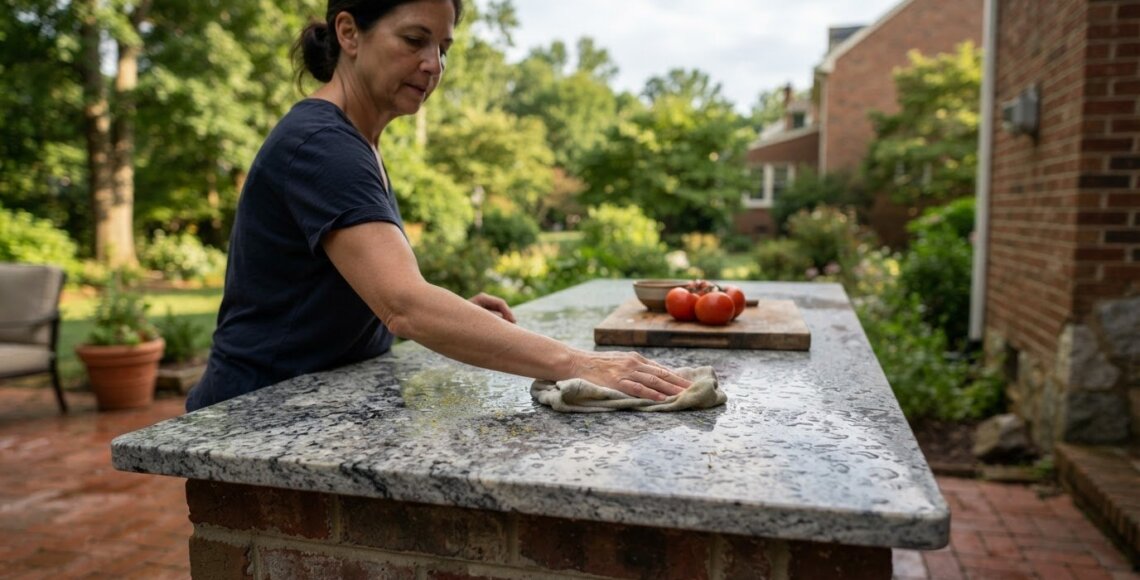
A homeowner wipes rain and pollen from a granite outdoor-kitchen countertop on a Richmond-area brick patio.

Outdoor Granite Countertops: Compare Costs, Climate and Care

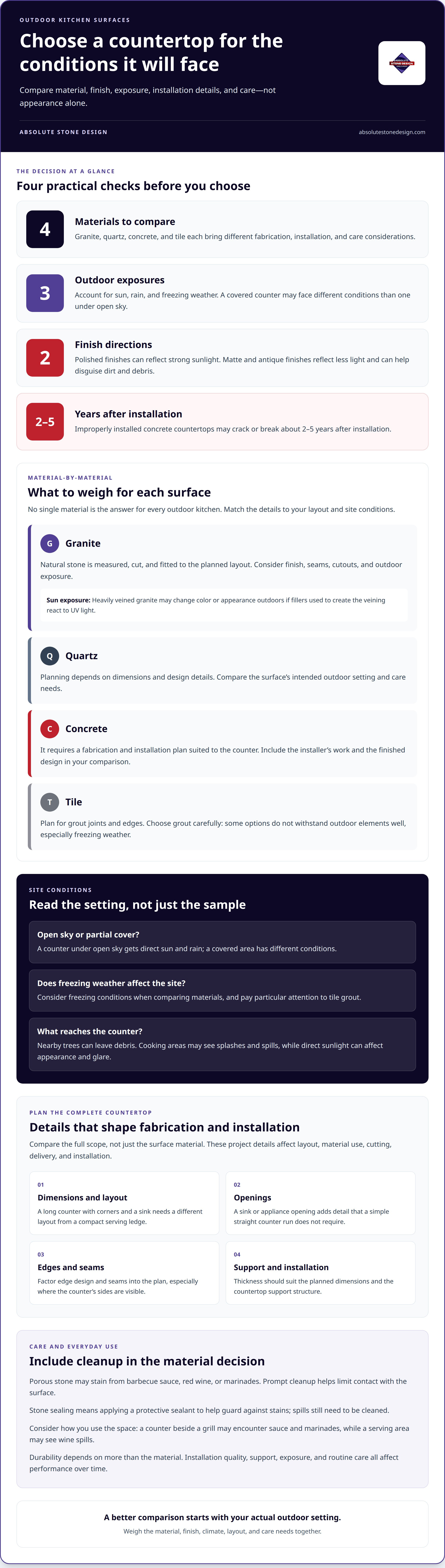
The best outdoor countertop isn’t automatically granite. Outdoor granite countertops can bring natural character to an outdoor kitchen, but climate, finish, durability, and upkeep all matter when comparing materials such as quartz, concrete, and tile. Heavily veined granite may change in appearance outdoors if fillers react to UV light.

Look beyond color and pattern: a surface should suit both your design and the conditions where you’ll use it, as well as the level of care you’re comfortable with. Weigh these practical factors alongside the look you want.

Compare how materials respond to sun, rain, and freezing weather, then consider the care each requires. Use those factors to narrow the options for your outdoor kitchen.

Key Takeaways

  • Compare granite, quartz, concrete, and tile by more than appearance; installation needs and upkeep also shape the overall decision.
  • Match the countertop material and finish to local exposure, since sunlight and freezing weather can affect surfaces differently.
  • Plan for routine care and outdoor spills when weighing durability, and consider how surface texture may affect the look of everyday debris.
  • Use the decision guide to narrow your options around your outdoor kitchen’s setting, design, and practical needs.

Countertop planning

Compare the full installation scope, not just the surface material. Granite, concrete, and tile involve different fabrication and fitting needs, while cutouts, edge profiles, seams, and the countertop support structure can affect the project plan. A sink opening, for example, adds detail that a simple straight counter run doesn’t require.

Granite and other stone surfaces are fabricated to fit the planned dimensions. Tile adds grout joints, while concrete requires a different fabrication approach. A long counter with several corners and a sink needs a different layout from a compact serving ledge. These details affect material use, cutting, delivery, and installation. A polished finish can reflect strong sunlight; matte and antique finishes reflect less light and can help disguise dirt and debris.

Option Fabrication and installation considerations Useful comparison
Granite Natural stone is measured, cut, and fitted to the planned layout. Consider finish, seams, cutouts, and outdoor exposure.
Quartz Engineered surface planning depends on dimensions and design details. Compare its intended outdoor setting and care needs.
Concrete Requires a fabrication and installation plan suited to the counter. Include the installer’s work and the finished design.
Tile Tile layout includes grout joints and careful edge planning. Consider grout selection alongside the surface.

Codes, permits, and warranties depend on the project and its location, so requirements vary between outdoor kitchens. Before construction, clarify local requirements and review the written warranty terms for the material and installation.

To compare options fairly, first define the counter dimensions, sink or appliance openings, edge design, finish, and installation scope. Then weigh those details against maintenance needs and climate suitability. Choose a surface that fits the complete project, rather than deciding by material name alone.

Climate considerations

Sun, rain, and freezing weather expose an outdoor countertop to conditions an indoor surface avoids. Choose for the setting, not appearance alone. Heavily veined granite may change color or appearance outdoors because fillers used to create the veining can react negatively to UV light. A dramatic pattern may therefore look different after ongoing sun exposure. Consider the stone’s veining and finish when assessing its outdoor suitability.

Consider exposure across the whole outdoor kitchen. A surface under open sky gets direct sun and rain, while a covered area has different conditions. Nearby trees can leave debris, and cooking areas may see splashes and spills. These factors help determine which surface and finish suit your layout. Matte and antique finishes reflect less light than polished ones and can help disguise dirt and debris.

Freezing weather also matters when choosing a material. Some materials do not hold up well to freezing or heavy UV exposure, so consider both conditions at your site. Tile needs particular attention at the grout joints: choose grout carefully, since some options do not withstand outdoor elements well, especially freezing weather. Grout is part of the climate decision, not a minor detail.

Use a simple sequence before choosing: identify whether the counter will be in full sun, partial cover, or open exposure; note whether freezing weather affects the site; then compare materials and finishes against those conditions. Heavily veined granite in direct sun raises a different concern from tile grout exposed to freezing weather. Matching the design to the actual setting supports a more informed choice for long-term outdoor use.

Countertop durability and maintenance

Outdoor surfaces face sun, weather, food spills, and regular use, so consider durability and upkeep together. Thickness, edge design, and finish also affect the appearance and suitability of the counter for your outdoor kitchen.

Thickness, Edge Profiles, and Finishes

No single countertop thickness or edge profile works best for every outdoor kitchen. Thickness should suit the planned dimensions and countertop support structure, while the edge profile shapes the finished look. On an exposed island, the edge is visible from several sides, so its design can influence the overall appearance. Matte and antique finishes reflect less light than polished ones and can help disguise debris.

Cracking, Fading, and Staining

Outdoor granite countertops can face different concerns from spills to sun exposure. Porous stone may stain from barbecue sauce, red wine, or marinades, so prompt cleanup helps limit contact with the surface. Granite with heavy veining may also change color or appearance outdoors if fillers react negatively to UV light. Improperly installed concrete countertops may crack or break about 2-5 years after installation.

For care planning, think about how you’ll use the outdoor kitchen. A counter beside a grill may encounter sauce and marinades; a serving area may see wine spills. These examples make porosity and cleanup practical selection factors, not just technical details. Stone sealing means applying a protective sealant to help guard against stains, but spills still need to be cleaned.

Compare expected upkeep alongside appearance and exposure. A polished finish may cause uncomfortable glare in strong sun, while a matte finish can soften reflections and help conceal everyday debris. Durability depends on more than the material: installation quality, support, exposure, and routine care all affect performance over time. Choose a finish and care approach that suit how you’ll use the outdoor kitchen.
Outdoor Granite Countertops: Compare Costs, Climate and Care

Can outdoor granite countertops crack, fade, or stain in sun, rain, frost, or heat?

Outdoor granite can change or become damaged, but the risk depends on the stone and its exposure. Heavily veined granite may change color or appearance outdoors because fillers used to create the veining can react negatively to UV light. The slab’s pattern matters, not just its label as granite. Consider how much direct sun reaches the counter throughout the day.

Rain can leave outdoor surfaces wet, while cooking and entertaining bring spills. Porous stone may stain from barbecue sauce, red wine, or marinades, especially if a spill sits on the surface. Plan to clean regularly after meals, particularly near a grill or serving area. Sealing stone can help guard against stains, though it doesn’t make the surface stain-proof.

Consider freezing weather and heat, but don’t assume the same outcome for every stone and installation. Choose outdoor materials with the local climate in mind, since some do not hold up well to freezing or heavy UV exposure. Assess cracks in context: the surface, installation, and support beneath it all matter. Don’t assume a crack or color change has a single cause based on appearance alone.

For a practical review, note whether the counter is in full sun or under cover, where rain collects, and how close it is to cooking activity. Then consider the stone’s veining, exposure, and care needs together. These details help distinguish a likely stain concern from a sun-related appearance change or a possible installation issue. They also give a stone professional useful context when assessing a surface.

If you’re planning an outdoor surface, discuss granite countertop selection with a stone professional.

Absolute Stone Design: Countertops

Absolute Stone Design can help you move from material comparison to a finished countertop for your outdoor kitchen. If you’re weighing granite against marble or quartz, the team can help you select a countertop suited to your design and the practical needs of your space.

The process includes precision measuring and templating, in-house stone fabrication, delivery, and countertop installation. Measurements help tailor the surface to the planned layout, including its edges and openings. This process connects material choice to the finished fit, giving you the opportunity to discuss how your design preferences meet the setting’s exposure and intended use.

When you’re ready to plan a countertop, contact Absolute Stone Design to discuss your project.

Shape an outdoor kitchen that feels like yours

The right surface should feel at home in the way you gather, cook, and unwind. When planning outdoor granite countertops, consider the atmosphere you want, from a quiet coffee spot to a welcoming place for shared meals. That design intention can guide your final choices alongside practical considerations.

Absolute Stone Design offers granite and marble countertops as natural stone options for your project. The team’s fabrication experience helps translate your chosen material and design direction into a finished surface. Share your priorities, whether you’re drawn to a particular stone pattern or want the counter to complement the wider outdoor setting.

Your outdoor kitchen can become a thoughtful extension of your home, shaped around the way you’ll use it. Contact Absolute Stone Design to discuss your countertop project and take the next step with confidence.

Frequently Asked Questions

What are the best outdoor kitchen countertops?

The best surface suits your design, intended use, and care preferences. Start by deciding how the counter will function: a broad prep area has different layout needs from a narrow serving ledge. Then compare full-size material samples with nearby finishes, such as patio stone or exterior trim, so the selection feels connected to the whole space.

Is granite suitable for outdoor countertops in different climates?

Granite can suit outdoor projects, but its suitability depends on the specific slab and setting. Ask about the particular material rather than treating every granite selection as identical. For a project in Richmond, share your planned layout and how you expect to use the counter; those details can guide a material recommendation for the space.

What types of granite are best for outdoor countertops?

No single granite variety is best for every outdoor kitchen. For outdoor granite countertops, review the full slab rather than relying only on a small sample; seeing more of it helps you judge how the pattern carries across the planned counter. Compare its appearance with the surrounding design, then select a slab suited to the intended setting.

How are outdoor granite countertops measured and planned?

The installed surface is defined by its finished dimensions and design, rather than by a generic countertop label. A professional measurement records each counter run, corner, edge, and requested opening. For example, a kitchen island and a perimeter counter are separate measured pieces. Establishing the layout gives you a clear description of the work involved.

Does outdoor granite need sealing, and how often should it be resealed?

Care guidance should match the specific stone and protective treatment. Keep the material and care instructions together after installation so you can refer to the right recommendations as you use the outdoor kitchen. If you no longer have those details, a stone professional can help identify relevant care guidance from the surface and installation records.

How do granite countertops compare with porcelain, quartzite, and concrete outdoors?

These materials differ in character and how they shape a design, so compare actual samples in the context of your outdoor kitchen. Place them beside the planned cabinetry, patio materials, or exterior finishes to see how they coordinate. Consider whether you prefer a natural pattern or a more uniform look; that preference can help narrow your shortlist.
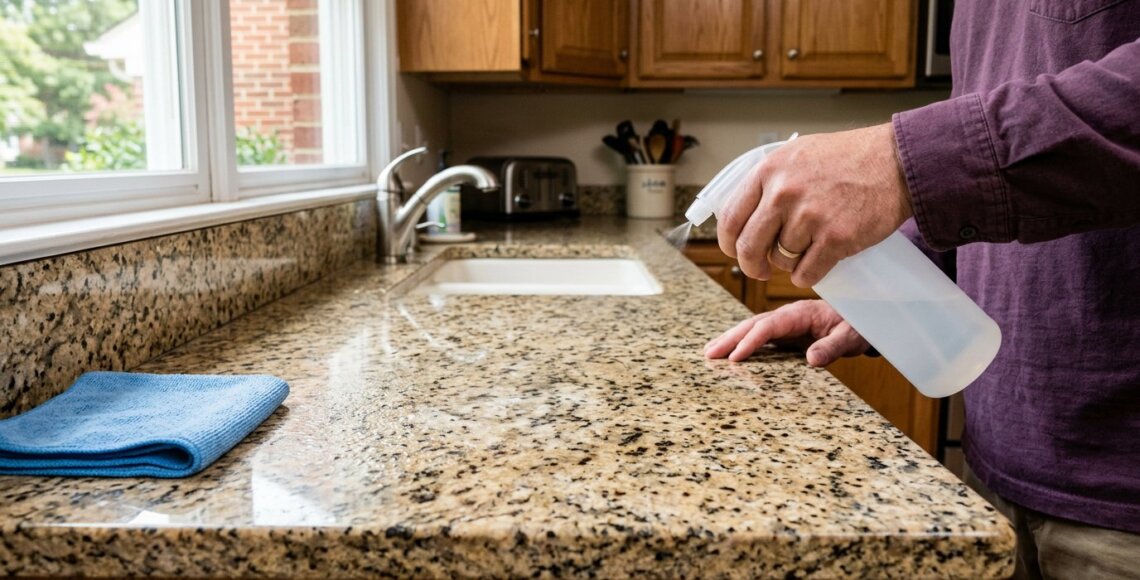
A homeowner applies alcohol to disinfect a speckled granite kitchen countertop in Glen Allen.

How to Clean Granite Countertops Safely and Disinfect Them

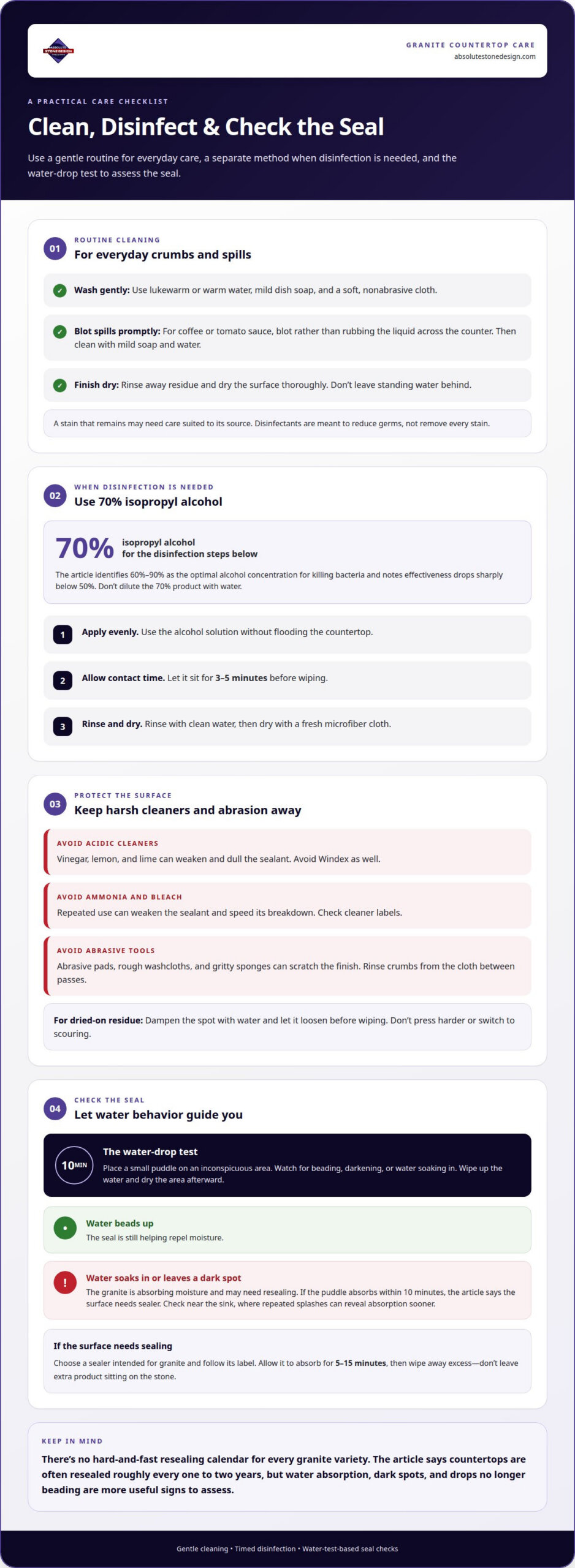
For everyday cleaning granite countertops, use lukewarm water, mild dish soap, and a soft cloth, then dry the surface thoroughly; to disinfect, apply 70% isopropyl alcohol, let it sit for 3 to 5 minutes, rinse with water, and dry with a clean microfiber cloth. Routine cleaning and disinfection are different tasks, and choosing gentle products helps protect the granite’s sealant: acidic cleaners such as vinegar and lemon, products containing ammonia or bleach, and abrasive sponges can dull or damage the surface over time. You’ll learn how to clean up spills, choose a suitable cleaner, disinfect when needed, and spot signs that your countertop may need attention, so daily care feels straightforward and your stone stays ready for the next meal, gathering, or quiet morning at home.

Key Takeaways

  • Use a water-drop test to see whether your granite may need resealing, and watch for signs that moisture is soaking in.
  • For disinfection, choose an appropriate alcohol solution and follow the recommended contact time before rinsing and drying.
  • Protect the sealant by avoiding acidic or harsh cleaners and choosing soft cloths over abrasive sponges.
  • Clean spills promptly, use mild dish soap for routine care, and dry the surface instead of leaving standing water.

Should You Use a Special Granite-Safe Cleaner?

  1. Start by testing the seal, because cleaner choice alone can’t protect stone that absorbs spills. Place a small puddle of water on an inconspicuous part of the granite surface. Watch for darkening or water soaking in. If the stone absorbs the puddle within 10 minutes, it needs sealer. Unsealed granite can absorb spills, oils, and stains, so wipe up the test water and dry the area afterward.
  2. Use water’s behavior as a sign of whether the surface is sealed. If drops bead up, the seal is still helping repel moisture. If water soaks in or leaves a dark spot, the granite is absorbing moisture and may need resealing. Check near the sink, where repeated splashes can reveal absorption sooner. Granite is less porous than marble, but its seal still needs attention.
  3. Let the test guide your timing instead of relying on a fixed calendar. Granite countertops are often resealed roughly every one to two years, but there’s no hard-and-fast rule for every variety. If a water puddle hasn’t soaked in after 10 minutes, the stone may need only a mild sealer or none. Recheck when water stops beading or dark spots appear.
  4. If the surface needs sealing, choose a sealer intended for granite and follow its label. Allow the sealer to absorb for 5 to 15 minutes before wiping away excess. Don’t leave extra product sitting on the stone. Once the surface is sealed, routine cleaning usually calls for a mild approach rather than a specialized cleaner. A granite-safe cleaner can be useful, but a suitable product won’t replace sealing when water absorbs into the stone.

Use the water-drop test as a practical guide rather than relying on a fixed calendar interval: water that soaks into the surface indicates the granite may need sealing. If drops no longer bead up, assess the countertop for resealing. These signs help you evaluate the surface instead of assuming every stone behaves alike.

Dark spots around a granite countertop sink can indicate that the granite is absorbing water and needs resealing. There is no hard-and-fast rule that every variety of granite must be resealed every 1-3 years, so the visible response to water is more useful than a universal schedule. Consider the test results together with changes in beading and any darkening, then base sealing decisions on those signs.

Disinfecting granite countertops

  1. For a fresh stain, blot the spill promptly with a soft cloth rather than scrubbing. Clean the area with warm water and mild dish soap, then dry it thoroughly. Tomato sauce and coffee can stain granite. Disinfectants are intended to reduce germs, not remove every stain. A mark that remains may need care suited to its source.
  2. Choose 70% isopropyl alcohol when you need to disinfect a granite surface. Apply it evenly, without flooding the counter, and let it sit for 3 to 5 minutes before wiping. Rinse the surface with clean water, then dry it with a fresh microfiber cloth. This sequence limits lingering residue while giving the solution time to work.
  3. Check the concentration before applying alcohol. According to the Centers for Disease Control and Prevention, alcohol’s effectiveness at killing germs drops sharply below 50% concentration. The Centers for Disease Control and Prevention identifies 60% to 90% as the optimal alcohol concentration for killing bacteria. A 70% isopropyl alcohol product falls within that range; don’t dilute it with water.
  4. Keep vinegar and other acidic cleaners away from granite, even if they seem useful for stains. They can weaken the sealant, while abrasive scrubbing may damage the finish. Granite is less porous than marble, but its seal still matters: moisture can enter through an unsealed or worn area. If a mark remains after gentle cleaning, don’t switch to harsher chemicals.
  5. Use disinfection when the counter needs more than routine washing, such as after handling raw ingredients. For everyday crumbs or spills, mild soap and water are often the gentler choice. If you’re planning a new surface, explore granite countertop options as part of your kitchen design.

How to Clean Granite Countertops Safely and Disinfect Them

Avoiding harsh and abrasive cleaners

  1. Prevent damage by using a soft cloth and a gentle cleaner for routine care. Abrasive pads and rough washcloths can scratch granite, especially if grit gets trapped beneath them. For dried-on residue, dampen the spot with water and let it loosen before wiping. Don’t press harder or use a scouring pad to remove stubborn marks.
  2. Keep acidic cleaners, including vinegar, lemon, and lime, away from the countertop. Frequent use can weaken and dull the sealant, leaving the surface less protected. Avoid Windex as well. For a tomato sauce spill, blot first, then clean with mild dish soap and water.
  3. Read cleaner labels and avoid products containing ammonia or bleach. Repeated use can weaken the sealant and speed its breakdown. A product that removes grease from another household surface may be too harsh for granite. Choose a mild cleaner instead, and wipe away residue rather than letting it dry on the surface.
  4. Use a clean, nonabrasive cloth for each pass, especially after food preparation. A gritty sponge can drag particles across the surface and leave scratches. Rinse the cloth as it collects crumbs, then wipe again with clean water. This helps prevent debris from turning routine cleaning into abrasive scrubbing.
  5. Clean spills promptly, particularly coffee and tomato sauce, which can stain granite. Blot instead of rubbing liquid across a wider area, then wash with mild dish soap and water. If a mark remains, don’t reach for vinegar, bleach, or abrasive powder. Harsh liquids can dull the sealant, while scrubbing can scratch the finish.

Keep the cleaning approach consistent: use a gentle cloth rather than an abrasive sponge or washcloth, since these materials can potentially scratch granite countertops. Even when wiping away residue, avoid letting the cleaning tool itself add abrasion to the surface.

Choose cleaning products carefully. Harsh liquids can weaken and dull the sealant, and repeated use can speed its breakdown. Avoid acidic cleaners such as vinegar, lemon, and lime, as well as Windex and products containing ammonia or bleach. A mild cleaner is a gentler choice for granite.

Granite countertop cleaning do’s and don’ts

  1. For routine cleaning, mix lukewarm water with mild dish detergent, then wipe with a soft washcloth. Work in small sections to pick up crumbs and residue instead of spreading them across the counter. Don’t flood the granite with water. Standing moisture can enter areas where the seal has worn, so use a damp cloth rather than pouring water onto the surface.
  2. Dry each cleaned section thoroughly with a soft, clean cloth. This removes moisture and soap film that can leave a polished surface streaky. Pay extra attention around the sink, where splashes can collect. If the cloth becomes wet or gritty, rinse it before wiping again so debris doesn’t drag across the stone.
  3. Blot acidic food spills promptly, including tomato sauce and coffee. These spills can stain granite, especially if they sit on an area with a weakened seal. Lift the liquid with a clean cloth, then wash the spot with mild dish detergent and water. Avoid scrubbing hard with a sponge; abrasive surfaces can scratch the finish.
  4. Keep acidic cleaners such as vinegar and lemon away from granite, along with products containing bleach or ammonia. Frequent use can weaken and dull the sealant. Use a mild cleaner for everyday messes instead. If a spill leaves a mark, don’t assume a harsher chemical will remove it safely; avoid abrasive powders and pads.
  5. Protect the counter while cooking by placing hot cookware on a trivet or wire rack, not directly on granite. Direct contact with hot items can leave marks or cause damage. Use a protective coaster for glasses, particularly near the sink or other spots where moisture often gathers. These habits help reduce avoidable wear between cleanings.
  6. For a kitchen update, explore granite countertop options that suit your space and daily routine.

Absolute Stone Design: Countertops

For Richmond-area homeowners planning a kitchen update or choosing a new countertop, Absolute Stone Design provides precision measuring, in-house stone fabrication, delivery, and countertop installation. The team helps connect material selection with the finished surface in your home.

If you’re considering granite, marble, or quartz, the right choice depends on the look you want and how you use your kitchen. Discuss your layout and material preferences with Absolute Stone Design to explore a countertop suited to your space.

Have a countertop project in mind? Contact Absolute Stone Design to start planning.

Keep Your Countertop Ready for Everyday Life

A thoughtful routine for cleaning granite countertops helps keep your kitchen ready for everything from quick breakfasts to shared meals. When you’re ready for a kitchen refresh, material and design choices can be tailored to your space. Absolute Stone Design offers granite and marble countertops among its natural stone options. The team handles material selection, fabrication, and installation, connecting your chosen design with the finished surface in your home.

You don’t need to plan every detail at once. Start with the change that matters most, whether updating a worn counter or choosing a stone for a new kitchen. A conversation with Absolute Stone Design can help you explore the next step at your pace.

Contact Absolute Stone Design to discuss your countertop plans and begin shaping a space that feels right for you.

Frequently Asked Questions

Is Granite Capable of Harboring Bacteria?

Yes, bacteria can remain on granite if food residue or other contamination is left on the surface. A sealed finish doesn’t replace regular cleaning after food preparation, especially after handling raw ingredients. Remove residue with an appropriate cleaner and a clean cloth, then disinfect when needed. Keeping the counter free of crumbs and spills helps prevent food debris from lingering between meals.

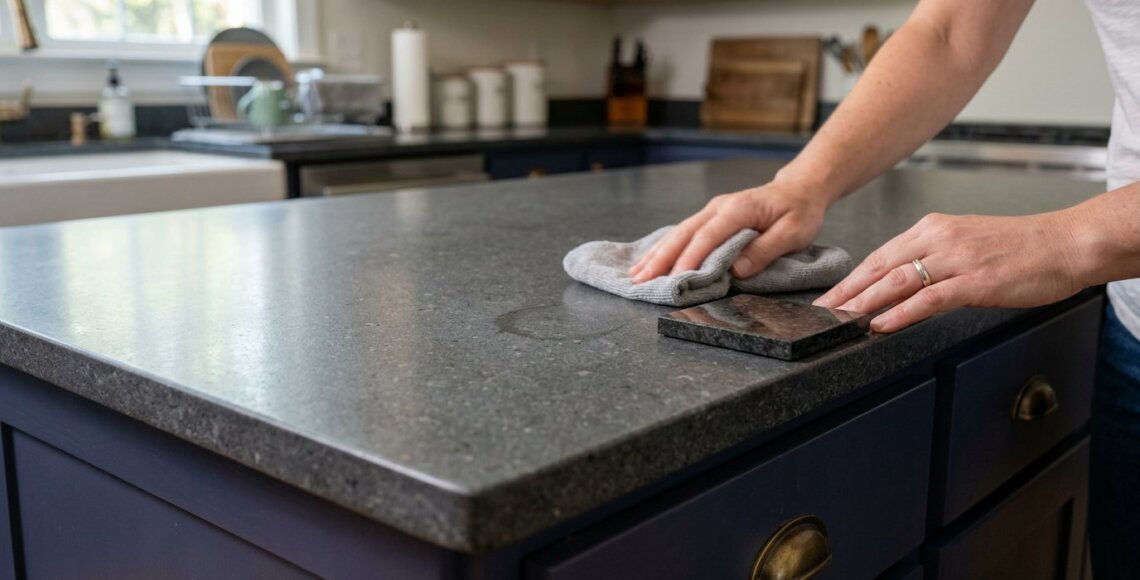
A homeowner wipes a water spot from a honed granite island beside a glossy sample of the same stone.

Honed or Polished Granite: Which Finish Fits Your Kitchen

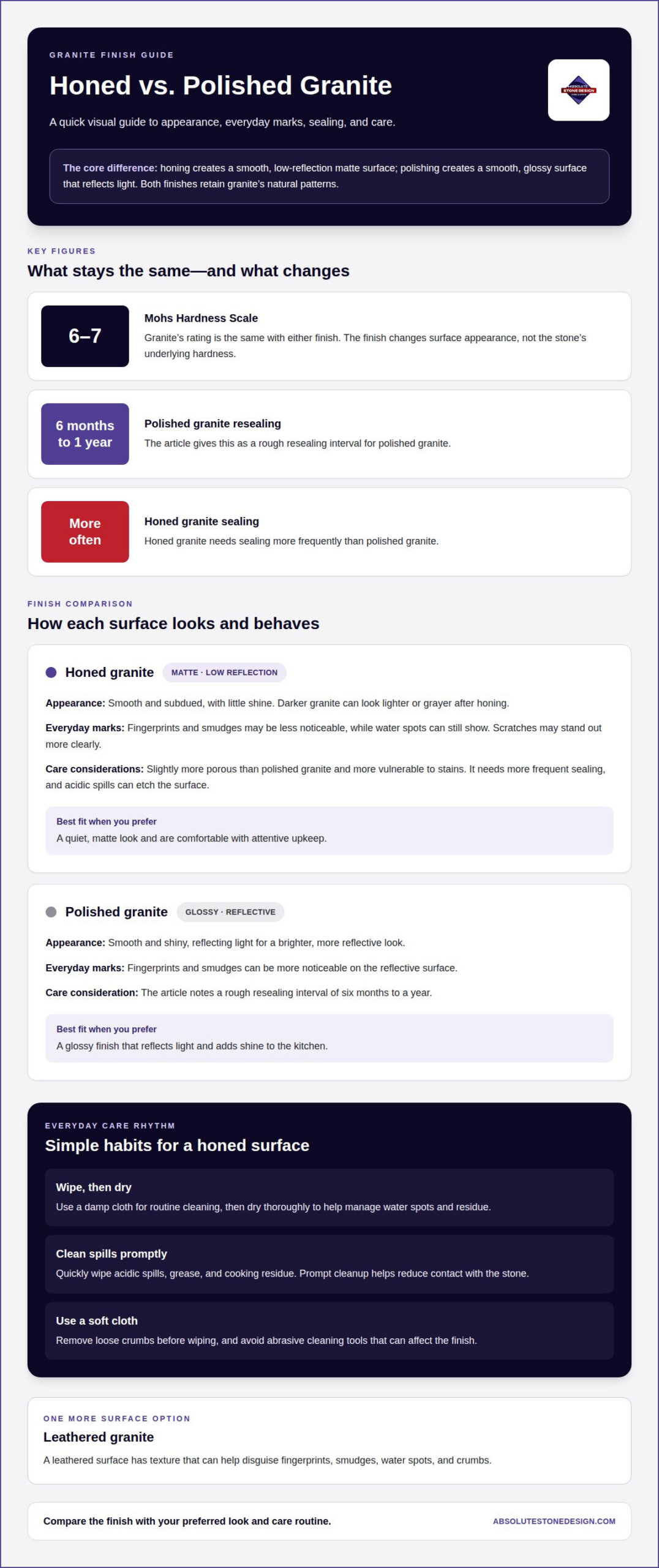
Honed granite countertops have a smooth, matte surface rather than the glossy shine of polished granite. That understated look comes with a practical consideration: honed stone may be slightly more porous and vulnerable to staining. Both finishes showcase natural stone character, so the right choice depends on your preferred look and how you approach everyday care.

A nonreflective finish can make fingerprints less conspicuous, but water spots and smudges may still show. Regular wiping and thorough drying matter. Honed granite also needs attentive sealing, while acidic spills can etch the surface. Polished granite’s shine creates a different look and maintenance experience.

This guide compares the finishes for appearance, fingerprints, upkeep, stains, and etching, helping you picture how each could work in your kitchen and choose with confidence.

Key Takeaways

  • Compare the soft, matte look of honed granite with polished granite’s reflective finish to see which better suits your kitchen’s style.
  • Consider your cleaning routine: a muted surface may disguise some fingerprints, but water spots and smudges can still call for regular wiping.
  • Learn how sealing, quick spill cleanup, and care around acidic foods can help manage honed granite’s vulnerability to stains and etching.
  • Use your kitchen’s look and everyday demands to guide your finish choice, then explore how granite countertop design and installation can bring the plan together.

What Is Honed Granite?

Honed granite is natural stone ground with coarse abrasives, stopping before the surface is polished. Colors and patterns vary by slab, and darker granite can look lighter or grayer with a honed finish.

Smooth Matte Appearance

The surface feels smooth, with little shine or reflection. This matte appearance sets honed granite apart from polished granite, whose glossy finish reflects light. Across a large countertop, honed granite looks subdued, while polished granite can appear brighter and more reflective. Both finishes retain the stone’s natural patterns.

Decor Compatibility

Honed granite suits decor built around understated surfaces, such as kitchens with wood cabinets, simple hardware, or soft, muted colors. Its low-sheen appearance lets the stone’s natural pattern add interest without a glossy focal point. Polished granite may better suit a kitchen designed around shine and contrast. Since darker granite can look grayer after honing, consider how the finish will look beside your cabinets and backsplash.

Granite’s natural variety means each slab has its own color and pattern. A honed finish changes the surface appearance, not the underlying pattern, so veins, flecks, and color variation remain part of the stone’s character. Compare the slab with nearby kitchen materials to see how the pattern and finish work together.

Finish Appearance Surface
Honed Matte, subdued Smooth, low reflection
Polished Glossy, reflective Smooth, shiny

Choose honed for a quieter, matte look; choose polished if you prefer a glossy, light-reflecting surface.

Choosing a finish based on lifestyle and maintenance

Your kitchen routine can help settle the choice. Honed granite suits homeowners who prefer a low-sheen surface and are comfortable with regular care. Polished granite has a glossy finish, but its reflective surface can make fingerprints and smudges more noticeable.

Honed granite’s advantages include a muted look and fingerprints that may be less apparent. Trade-offs include more frequent sealing than polished granite and greater vulnerability to staining and etching. Clean up acidic spills promptly, and remember that scratches may show more clearly on a honed surface.

Before choosing honed granite for a kitchen countertop, consider whether you’ll maintain the sealant and wipe spills promptly. Polished granite should be resealed roughly every six months to a year; honed granite needs sealing more frequently. The right care routine depends on how you use the kitchen and maintain the surface.

Think about a typical day: cooking with citrus, setting down a glass, or wiping the counter after breakfast. Acidic substances can etch honed granite, and water spots or fingerprints may still show. A protective coaster and prompt cleanup can limit contact with spills, but they don’t replace regular sealing.

Granite’s Mohs Hardness Scale rating is six to seven, regardless of finish; the finish changes the surface appearance, not the stone’s underlying hardness. Compare your preferred look with the care you’re comfortable giving it. If you’re weighing finishes for your kitchen, explore granite countertop options as part of your decision.

Honed granite’s nonreflective finish may make fingerprints and scratches less noticeable than on polished granite. A leathered surface’s texture can help disguise fingerprints, smudges, water spots, and crumbs.

Honed or Polished Granite: Which Finish Fits Your Kitchen

Fingerprints, grease, and dust on honed surfaces

Honed granite may disguise fingerprints better than polished granite, but water spots and everyday residue can still show. For routine cleaning, wipe with a damp cloth, then dry the surface thoroughly.

Fingerprints and Surface Imperfections

Because a honed finish reflects less light, fingerprints and smudges may be less noticeable than on glossy polished granite. But not every mark disappears: scratches can show more clearly on honed stone. A drag mark near a frequently used cutting area, for example, may stand out against the matte surface. Consider how visible wear will look beside your backsplash and its finish.

Water Spots

Water spots may be more visible on honed granite than you expect, even if fingerprints seem less prominent. Drops around a sink or a damp glass left on the counter can leave marks as water dries. Wipe the area with a damp cloth, then dry it thoroughly. This simple step helps remove visible spots and prevent residue from lingering.

Clean up grease and cooking residue promptly, too. After preparing a meal, wipe splashes near the stove and kitchen island with warm water and a soft cloth. Avoid abrasive cleaning tools, which can affect the stone’s finish. A quick wipe after cooking helps prevent ordinary buildup around food-preparation areas.

Dust and crumbs can collect along counter edges, beside appliances, or where the counter meets a backsplash. Remove loose debris with a soft cloth before wiping, so particles aren’t dragged across the stone. Dry the cleaned area rather than letting water evaporate. This routine is especially useful on a matte surface, where dried spots may catch your eye.

In short, honed granite can make fingerprints less conspicuous, but water spots and scratches may remain visible. Consistent wiping and thorough drying help manage everyday marks.

Honed granite’s susceptibility to stains and etching

Honed granite is slightly more porous than polished granite, so spills may stain it more easily. Knowing the difference between stains and etching helps you respond appropriately.

Stain Susceptibility

A stain occurs when a spill absorbs into stone, and honed granite may be more vulnerable than polished granite. Spilled cooking oil, for example, can leave a mark if it sits on an unsealed surface. Wipe spills promptly and maintain the sealant to help reduce absorption. A leathered finish has texture, but granite still needs protection from spills.

Etching Susceptibility

Etching differs from staining: acidic substances can affect the stone’s surface rather than simply leaving absorbed color. Lemon juice or vinegar, for example, should be wiped up promptly instead of left to sit. Honed granite can etch, so even durable stone needs care around acidic ingredients. Sealing helps guard against stains, but it doesn’t prevent etching.

Sealing Frequency

Honed granite countertops should be resealed at least annually, or even every few months, to help prevent spills and water from absorbing into the stone. Honed granite may need more frequent sealing than polished granite. Regular sealing supports stain protection, while prompt cleanup addresses spills between applications. Include both steps in your care routine.

Choosing granite for a kitchen means weighing its natural character against the care its finish calls for. Explore granite countertop options as you plan a surface that fits your kitchen and everyday routine.

Respond consistently: clean up spills quickly and maintain the sealant, since both steps help prevent stains on honed granite countertops. Treat them as parts of routine surface care rather than relying on either one alone. The goal is to reduce the chance of spills leaving stains.

Absolute Stone Design: Countertops

Absolute Stone Design helps turn your finish preference into a kitchen countertop plan. For homeowners in Richmond, Henrico, Glen Allen, Midlothian, Chesterfield, and Charlottesville, its design services connect visual goals with practical material selection. Bring cabinet tones, lighting, and backsplash ideas into the conversation, along with the care routine you prefer. These details help shape a considered surface choice that suits your kitchen.

After you choose a material and direction, Absolute Stone Design handles countertop measuring, templating, in-house fabrication, delivery, and installation. Precise measurements and templates account for the kitchen’s dimensions, countertop runs, and openings. This process carries your design choices through fabrication and fitting, planning the finished surface for its intended space.

Granite is one option; quartz and quartzite offer other material choices for your project. The right fit depends on the appearance you want and how you use your kitchen. If you’re drawn to granite, consider the finish alongside the stone’s color and pattern. Your preference for a matte or glossy look, and the upkeep you’re comfortable with, can guide your decision.

As your plans take shape, Absolute Stone Design can help bring the material and countertop details together. Discuss how your preferred finish suits the room and project layout before fabrication begins.

If you’re ready to discuss your kitchen countertop project, contact Absolute Stone Design.

Plan a Finish That Feels Like Yours

Your kitchen should feel considered, from the first impression to everyday details. As you decide whether honed granite countertops suit your plans, think about how the finish will work with your lighting, cabinet colors, and daily routine. Taking the whole room into account can help your selection feel cohesive.

The Absolute Stone Design team brings practical knowledge of stone selection and custom countertop projects, helping you shape a design around your preferences. A conversation can be a useful next step as you refine the direction for your kitchen.

Ready to keep planning? Contact Absolute Stone Design to talk through your ideas. Your kitchen can begin with one thoughtful choice.

Frequently Asked Questions

Can stone sealing change honed granite’s color?

It can affect the appearance. One reported experience described a lighter gray honed slab becoming darker after sealing. If preserving the stone’s original tone matters to your design, consider how a sealed sample looks beside your cabinet and backsplash colors before settling on the finished palette.

Can every granite color be honed?

No. Some granite colors may not suit a honed finish because their mineral content can compromise the slab’s integrity during finishing. Your preferred color and finish may not always be available together. Keep your overall design in mind and consider other granite options if a particular slab cannot take the finish.

Which cleaner is suitable for honed granite?

Use gentle, nonabrasive soap and warm water, or a specialty stone cleanser. Choose a cleaner made for natural stone rather than a harsh household product. Apply it with a soft cloth and follow the product directions to clean everyday kitchen residue without abrasive products.

What colors and patterns are available in honed granite countertops?

Colors and patterns vary by slab, and veins, flecks, and natural color variation remain. Darker granite may look lighter or grayer when honed.

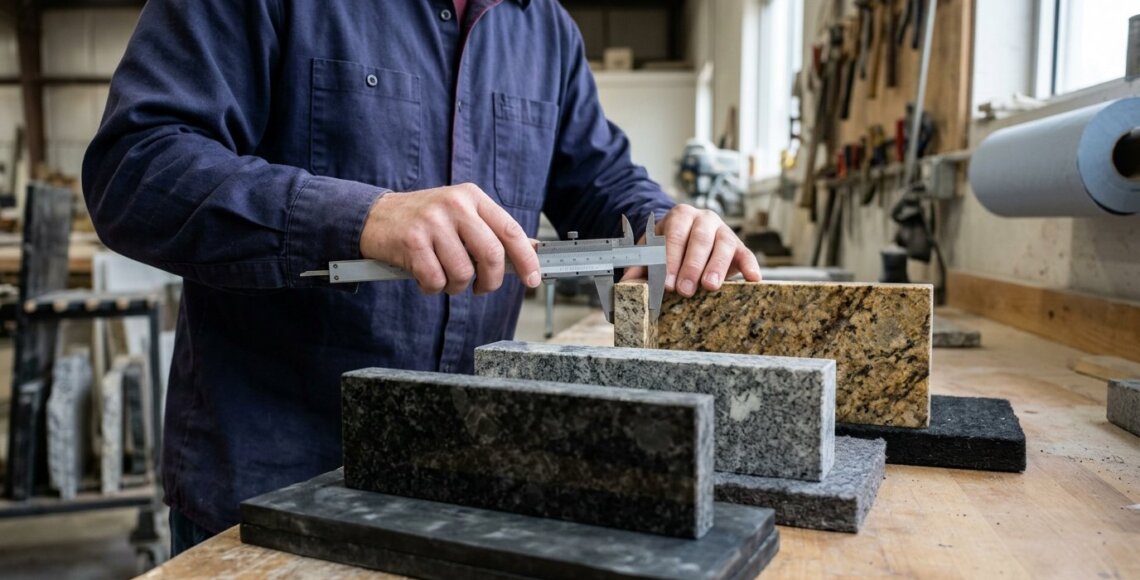
A fabricator checks granite slab thickness beside charcoal, gray, and gold-brown granite offcuts.

Types of Granite Compared by Color, Grade, and Slab Thickness

No granite color is automatically the most durable. The right choice depends on the specific stone and how its slab will suit the countertop. Types of granite are often grouped by appearance, including black, red, green, gold, yellow, pink, gray, and blue. Geologically, granite is defined by its mineral composition: feldspar, quartz, mica, and hornblende. Color can guide the look of your kitchen or bathroom, but it does not tell you everything about performance. Grade labels and slab thickness offer additional points of comparison, but neither is a stand-alone measure of durability. This guide explains how color, grade, thickness, and granite’s geological meaning fit together to help you make an informed selection. Viewing the full slab matters too: natural veining and tone can vary, and the stone may look different across a large surface than in a small sample.

Key Takeaways

  • Learn why a commercial grade label and a geological classification describe different things about a slab.
  • Compare slab thickness thoughtfully, instead of assuming a thicker option or higher grade automatically means greater durability.
  • See how regional names can help you make sense of granite varieties and narrow your material choices.
  • Explore popular kitchen selections and weigh appearance alongside practical factors such as porosity and intended use.

Does the granite’s strength differ between granite colors?

Color alone doesn’t determine how durable a granite countertop will be. Black, red, green, gold, yellow, pink, gray, and blue describe appearance, while a stone’s porosity and condition affect its care and suitability. For an outdoor kitchen, low-porosity granite is generally a better fit. Compare the available colors with the room’s needs and the stone’s care requirements.

Cabinet color can help narrow your choices. Black or gray granite can contrast with white cabinets, while gold or red tones can complement warm wood. Green, pink, and blue varieties add distinctive color, so consider how their patterns will work with cabinet finishes and other surfaces. Granite colors and textures can vary between batches. View the full slab, because a small sample may not show its complete veining or tone.

Granite, quartzite, and engineered quartz are different materials: granite and quartzite are natural stones, while engineered quartz is manufactured. Granite’s geological makeup includes feldspar, quartz, mica, and hornblende, but a stone’s name or color doesn’t reveal its porosity. For a natural-stone project, assess the specific slab rather than assuming every dark or light variety performs alike.

Polished granite has a glossy surface and is often chosen for easier cleaning, though streaks and smudges can show. Honed granite has a matte look, while leathered granite has a textured, more rustic appearance. Matte finishes can help disguise fingerprints and watermarks, making them worth considering for busy countertops.

For maintenance, clean granite with a pH-neutral stone cleaner and use a penetrating sealer as needed. Granite countertops are commonly resealed every 1-2 years; lighter varieties may need particular attention. A water drop that soaks in and leaves a darker area can indicate that the surface needs sealing. Dense black granite may turn cloudy if sealed.

Natural granite comes in varied colors, veining, and textures, giving each slab its own look. Its porosity is an important care consideration, and sealing may be part of upkeep. Compare the slab’s appearance, finish, and care needs together. That gives you a more useful basis for choosing than color alone.

Commercial and geological definitions of granite

“Granite” can mean different things in a geology book and a countertop showroom. Geologically, granite is a natural igneous rock identified by its mineral composition and coarse-grained structure. In commercial stone, the label may describe a broader category of durable, polishable natural stone. So a slab marketed as granite may not fit the narrow geological definition.

For geological classification, mineral content matters more than a slab’s color or trade name. Granite includes feldspar, quartz, mica, and hornblende, and its visible crystals contribute to its natural texture. A geologist evaluates composition and structure, while homeowners typically encounter commercial labels that help distinguish materials during selection.

That difference matters when you compare samples. A product tag reading “granite” is useful when shopping, but it doesn’t tell you every detail about mineral proportions, porosity, or appearance. Looking closely at the slab can reveal crystal size, veining, and color variation that a category name alone can’t convey.

Commercial names also help organize choices by appearance. Two slabs sold as granite may have very different patterns and tones, even though both are natural stone. In a bathroom, one homeowner might prefer a quiet, consistent look, while another might choose pronounced movement as a focal point. The geological label can’t decide which appearance suits the room.

Use each definition for its purpose: geological classification describes what the rock is, while commercial terminology helps identify materials for a project. When reviewing a slab, consider its actual appearance and intended use alongside its sales label. That distinction can make conversations about natural stone clearer and help you compare options with confidence. For a closer look at granite material options, focus on the slab’s visible character and how it will work in your space.

Types of Granite Compared by Color, Grade, and Slab Thickness

What are the main types of granite?

Granite is often grouped by color or variety name, rather than by one universal classification. Common color groups include black, red, green, gold, yellow, pink, gray, and blue. These labels help you start comparing appearance, but they don’t capture every detail of an individual slab. Patterns, crystal distribution, and tone can differ even within one color group.

Variety names offer another way to describe granite. They identify specific commercial options, often with names that suggest a color or visual character. Examples include Absolute Black, Black Galaxy, New Kashmir White, Vizag Blue, Steel Grey, and Imperial Gold. Names can help organize your choices, but they don’t replace seeing the stone itself.

Other named varieties include:

  • New Imperial Red and Jhansi Red
  • Crystal Yellow and Alaska White
  • Blue Dunes, Platinum White, and Rajasthan Black

These labels provide a starting point for narrowing your selection by broad appearance. For example, Steel Grey suggests a different color direction from Imperial Gold, while Blue Dunes points to another palette. The names alone don’t establish how much veining, contrast, or variation a particular slab will have. Natural stone can differ from slab to slab.

Use color groups and variety names to organize your options, then compare actual slabs for tone, pattern, and how each will look in your room. If you’re considering a kitchen countertop, view the stone alongside your cabinets and other finishes. Types of granite may be described by color or by a specific variety name. Understanding both labels helps you compare appearance without treating a name as a ranking of quality or durability.

There isn’t one universal ranking that makes a granite variety right for every kitchen. The useful question is how a candidate will work with your room’s shape and planned countertop details. A long peninsula, compact work area, and broad kitchen island each present the stone differently. Consider where you want the surface to draw attention before settling on a selection.

Countertop planning also affects how a slab becomes a finished surface. Sink and cooktop openings interrupt the stone, while seams divide longer runs into sections. A bold feature near an opening may be partly removed during fabrication, so planned cuts matter as much as the slab’s overall appearance. Mapping those details early helps you understand what will remain visible after fabrication.

  • For a long run: Consider how the visual movement carries across the usable counter area.
  • For a sink zone: Think about which parts of the pattern will remain around the opening.
  • For a kitchen island: Decide whether the surface should anchor the room or complement other design elements.

Edge selection is another design decision. A simple edge keeps attention on the stone’s surface, while a more defined profile adds detail along the counter’s perimeter. The choice can change how the countertop relates to cabinet doors, nearby trim, and the room’s overall style. Consider the edge alongside the planned shape of each countertop section.

Rather than choosing solely by a variety’s reputation, consider how the planned pieces will look after fabrication. A coordinated selection accounts for visible areas, cutouts, edges, and transitions as one design. This gives you a practical way to compare popular options based on the finished kitchen, not just a catalog label.

Ready to plan your kitchen surface? Plan your granite countertop selection around the details of your project.

Absolute Stone Design: Granite

Absolute Stone Design helps Richmond-area homeowners turn a granite selection into a countertop planned for their space. If you’re comparing colors, patterns, or slab details, the team can guide material selection and coordinate precision measuring, in-house fabrication, and installation. This is especially useful when you want the finished surface to fit your kitchen layout and complement your cabinets.

Granite is one option alongside marble and quartz, and each material brings a different look to your project. Consider your priorities, such as natural variation or a more consistent appearance, to clarify which surface suits your plans.

Contact Absolute Stone Design to discuss your countertop project.

Shape a Granite Choice Around Your Home

Your next step is to turn your preferences into a clear design direction. Decide whether the surface should feel quiet or expressive, and how it should support the room’s everyday use. This makes comparisons between types of granite more purposeful, because you’re judging each option against your space rather than an abstract ranking.

Absolute Stone Design offers granite and marble countertops, with a team that can connect material selection to your project’s design. Bring your priorities for color, pattern, and the overall feel of your kitchen or bath into the conversation. The team’s stone expertise can help shape a considered, personal direction.

Whether you’re planning a new surface or refining a renovation plan in Richmond or the surrounding area, make the choice around your home, not a passing trend. Contact Absolute Stone Design to talk through your project and take the next step with confidence.

Frequently Asked Questions

What is the most durable type of granite?

No variety name by itself establishes which slab will be most durable. Start with how you use the surface: a kitchen used frequently for food preparation has different demands from a guest bathroom vanity. Then consider how much routine care you’re comfortable providing. These practical priorities help you compare options without treating a color, label, or grade as a guarantee of performance.

Granite: What’s In a Name?

A variety name helps distinguish one marketed granite selection from another, but it shouldn’t be the only identifier in your project notes. Record the exact name alongside the slab you selected and its intended location. This can keep design discussions clear when coordinating a kitchen countertop, island, and other surfaces. The physical slab remains the reference for its particular appearance.

Which granite is best for outdoor use?

Choose a slab with the outdoor setting in mind, including the surface’s exposure and the look you want alongside nearby materials. For example, an outdoor kitchen beside stone paving may call for a different visual balance from a covered entertaining area next to wood cabinetry. Consider the whole setting and intended use together, rather than choosing based on a granite name alone.

What are the different granite colors and patterns?

Granite ranges from pale, relatively quiet appearances to darker stones with stronger visual movement. For a practical comparison, look at how a pattern reads across the full surface, then picture it around a sink or cooktop opening. Cutouts can change which parts of the design remain visible. This helps you judge the finished countertop, not just an isolated patch of stone.

How do granite types differ in hardness, durability, and porosity?

These properties represent different considerations, so don’t treat one as a substitute for another. A surface may suit your preferred appearance yet require care that doesn’t fit your routine. Think about daily use, likely spills, and how you clean your counters. These habits help you assess what performance means for your household, beyond a broad label or a single material characteristic.

Which granite types are best for indoor and outdoor use?

A slab marketed for a bathroom countertop may also work in a kitchen, but suitability depends on the specific slab and its intended use. For outdoor spaces, consider the setting and the surface’s exposure as part of your selection. Matching the slab to its location means looking beyond the room name and considering how the surface will be used and experienced there.

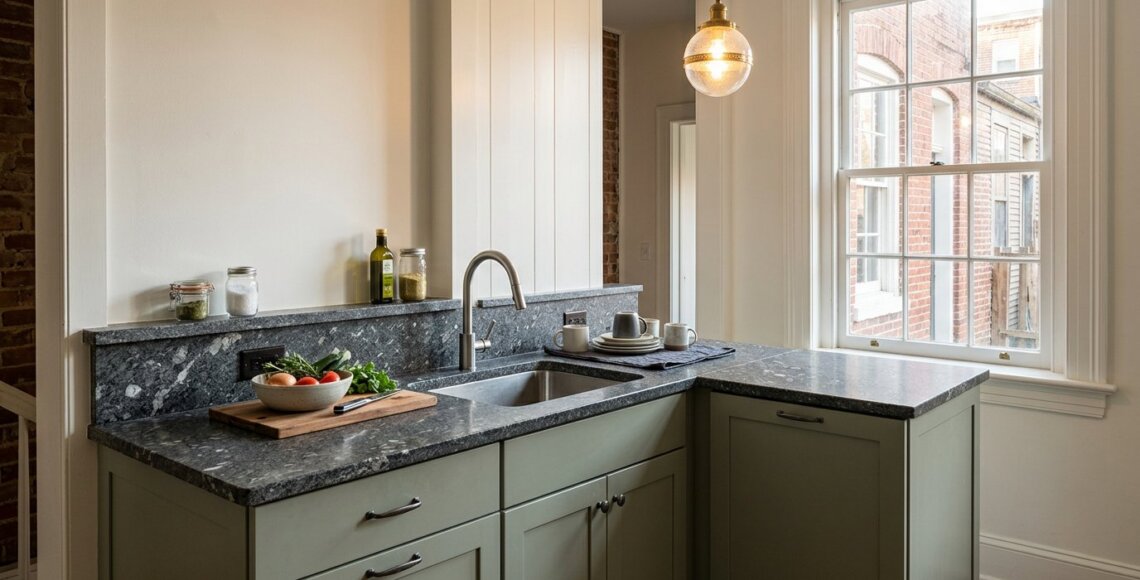
Charcoal-gray granite countertop with natural mineral flecks in a Richmond rowhouse kitchen

Granite Countertop Colors for Your Room and Lasting Appeal

The best granite countertop colors complement your cabinetry, lighting, and overall palette while still feeling right for years to come. White granite can bring creamy tones and subtle gray veining into a room, while gray options range from soft neutrals to dramatic dark patterns. Explore how color shapes a space, what to consider for lasting appeal, and why viewing the full slab helps you choose with confidence.

Key Takeaways

  • Compare white and gray granite patterns, from subtle veining to bold mineral flecks, to find the look that suits your room.
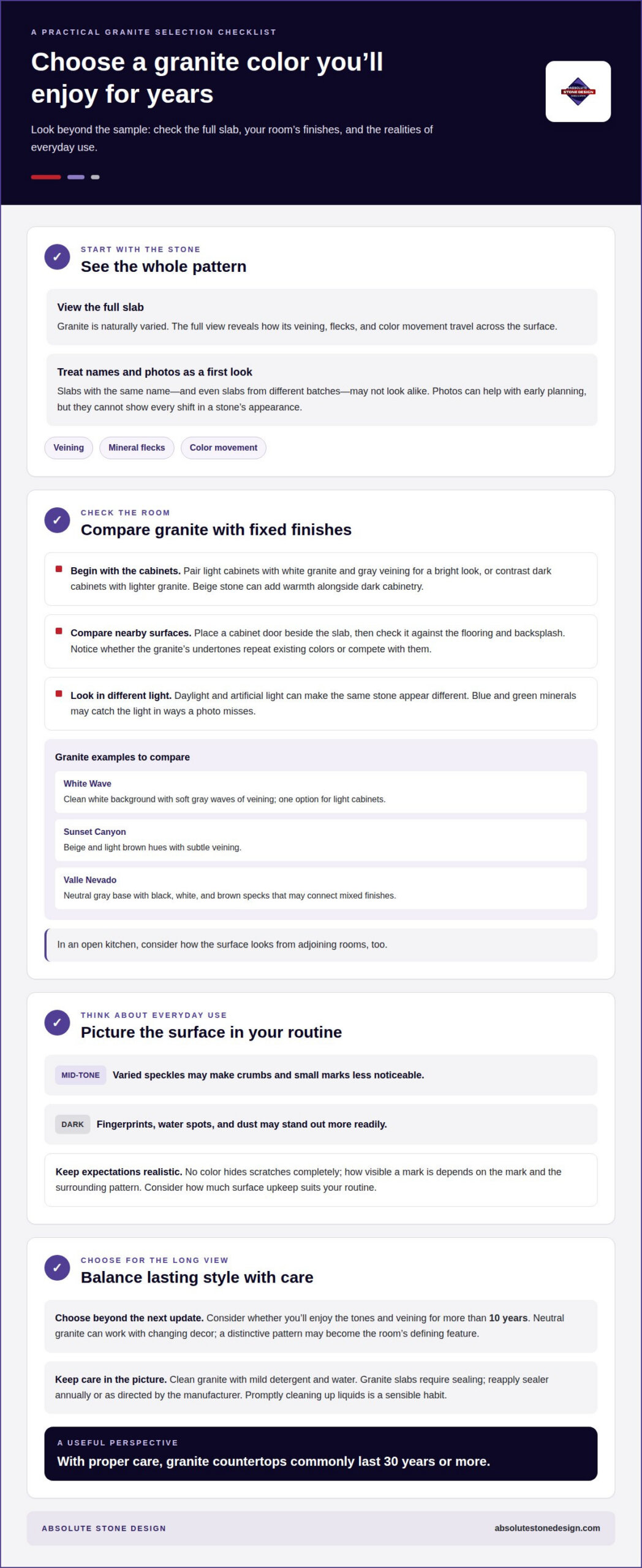
  • View the full slab and consider whether its pattern is one you’ll enjoy for years.
  • Assess colors beside your cabinetry and in different lighting, since daylight and indoor light can change how a stone appears.
  • Choose a countertop shade with both your room’s palette and your everyday preferences in mind; darker surfaces may make dust and water spots more noticeable.

White and gray granite color options

White granite ranges from creamy to bright, and its mineral patterns make every slab distinctive. White Spring has a creamy base with light gray veins, while New River White pairs soft white with delicate gray lines. Bianco Frost features black, gray, and rust-colored speckles. Pure white granite is rare, so expect natural variation rather than a completely blank surface.

For a lighter kitchen, White Sand blends beige and gray with darker flecks, while White Ornamental has brown and beige specks. Steel Grey offers dark gray tones and a subtle pattern. Black granite creates a deeper look, while brown granite often features warm, earthy shades. Blue granite can contain minerals that catch the light and create depth that photographs may miss.

Quartz generally has more consistent color and requires less maintenance than granite, according to JOEH, LLC. Granite’s natural mineral patterns vary, so slabs with the same name may not look exactly alike. Differences can also occur between batches. Review the actual slab to see its veining, flecks, and color movement before choosing.

Some granite colors can be harder to find because availability depends on the stone and its quarry source. Brown and beige granite are often widely available. Since color names do not guarantee an exact match, assess the specific slab instead of relying only on a sample.

For routine care, clean granite with mild detergent and water. Granite slabs require sealing, so reapply sealer annually or as directed by the manufacturer. The U.S. Environmental Protection Agency notes that liquid may enter granite’s pores or bond strongly to its surface, making prompt cleanup a sensible habit.

Repair options depend on the damage. A small chip may be filled with color-matched stone epoxy, while a crack needs assessment to determine an appropriate repair. Avoid abrasive cleaners around a repaired area, and follow the repair professional’s care instructions.

Snowfall has a white background speckled with gray and black minerals. Bianco Frost has a creamy white background with black, gray, and rust-colored speckles. White Valley has a smooth, light background with subtle gray veining.

Stream White has a soft white background with delicate gray and light brown veins. White Wave has a clean white background with soft waves of gray veining. Steel Grey is dark gray granite with a smooth texture and subtle pattern.

Choosing granite for long-term appeal

A granite pattern can feel striking in a sample but look different across a full counter. Each slab is unique, so you should consider the overall movement, mineral contrast, and balance of colors. Viewing the full slab gives a clearer sense of how patterns will run across the kitchen or bathroom. Choose a color you expect to enjoy for more than 10 years, not only one that matches a temporary accent.

Consider daily cleanup, too. Mid-tone granite with varied speckles can make crumbs and small marks less noticeable than a uniform surface. Dark granite tends to show fingerprints, water spots, and dust more readily. No color hides scratches completely; visibility depends on the mark and the surrounding pattern. Consider how much surface upkeep suits your routine before deciding.

Long-term appeal also depends on how the stone works with lasting room elements. Compare the slab with cabinet colors, flooring, and backsplash materials, then picture the combination if you repaint or replace hardware. A neutral granite can suit changing decor, while a distinctive pattern may become the room’s defining feature. With proper care, granite countertops commonly last 30 years or more.

Follow this practical selection sequence to balance appearance with everyday use:

  • View the full slab to assess its pattern and color movement.
  • Compare it with cabinet finishes and other fixed surfaces in the room.
  • Consider whether its tones and veining suit your preferred look beyond the next renovation.
  • Picture routine crumbs, spills, and dust against the surface before settling on a shade.

For a kitchen used throughout the day, prioritize a pattern and tone that feel comfortable to live with, not just dramatic at first glance. If you’re considering a natural-stone surface, explore granite countertop options as you narrow your selection.

Use a small sample as an initial reference, then review the full slab before choosing. The broader view makes it easier to assess how the pattern travels across the stone, rather than relying on a limited glimpse. This closer look can help you decide whether the overall effect suits your room.

Granite Countertop Colors for Your Room and Lasting Appeal

Granite color selection for room design

Start with your cabinets, then choose granite that complements or contrasts with their finish. With light cabinets, white granite with gray veining can keep the room bright while adding pattern. White Wave pairs a clean background with soft gray movement. Dark cabinets can contrast with lighter granite or blend with warm beige stone.

For example, Sunset Canyon combines beige and light brown hues with subtle veining, while Monte Cristo adds darker speckles and veins. These natural patterns can echo wood floors, cabinet undertones, or nearby tile. Valle Nevado has a neutral gray base with black, white, and brown specks, which can help tie together mixed finishes.

Granite color also responds to room lighting. Daylight and artificial light can make the same stone appear different, so view a sample in both conditions. Blue and green minerals may catch the light and create depth that photographs do not capture. Photos are useful for early planning, but they cannot show every shift in a stone’s appearance.

To assess a pairing, place a cabinet door beside the granite slab, or compare the slab with a clear cabinet photo. Check the combination near the flooring and backsplash, too. This shows whether the granite’s undertones repeat existing colors or compete with them. In an open kitchen, consider how the surface looks from adjoining rooms.

Use these pairings as starting points, not fixed rules:

  • Light cabinets with White Wave can create a bright, softly patterned setting.
  • Dark cabinets with beige granite can bring warmth and contrast into the room.
  • Mixed gray, brown, and black finishes may connect with Valle Nevado’s varied minerals.

Choose a combination that supports the room’s existing palette and the atmosphere you want, whether calm, warm, or dramatic.

Granite selections often center on white, gray, black, and warm beige or brown. Each palette offers a different balance of contrast and pattern, with no single look suited to every room. White Galaxy pairs a bright background with black and gray specks. White Napoli has a warmer base with light gray veining, while white granite is rarely completely pure.

Gray options range from quiet neutrals to bolder patterns. Silver Waves mixes gray and black in swirling patterns, while Steel Grey has a dark gray tone and subtle pattern. Both can complement similar cabinet shades or contrast with lighter finishes. Brown and beige granite adds warmth through earthy tones and darker flecks.

Black granite can anchor a room with a deeper surface, but dark finishes tend to show dust, fingerprints, and water spots more readily. Blue and green varieties offer color and mineral depth that can shift with the light. Because every natural slab has its own markings, the same color family can feel calm or dramatic depending on its veining and flecks.

Use these examples to narrow down the look you want for your room:

  • Bright and defined: White Galaxy adds contrast with black and gray minerals.
  • Soft and warm: White Napoli brings gentle gray lines across a warm white base.
  • Moody and layered: Silver Waves combines dark tones with flowing movement.
  • Earthy and grounded: White Ornamental pairs a creamy base with brown and beige specks.

Names describe a general color direction, not an exact appearance. Look at the particular slab under the room’s lighting to understand its tone, pattern, and visual weight. Explore granite countertop options as you refine the palette for your space.

Absolute Stone Design: Countertops

Absolute Stone Design helps homeowners in Richmond, Henrico, Glen Allen, Midlothian, Chesterfield, and Charlottesville turn granite color choices into countertop plans. When you are ready to move from comparing patterns to planning a surface, the team provides measuring, in-house fabrication, delivery, and installation.

Granite is not the only option to consider. Absolute Stone Design also offers marble and quartz, giving you natural-stone and engineered options to compare as your project takes shape. The right choice depends on the look you want and how the surface will serve your home.

For help planning a countertop for your Richmond-area home, contact Absolute Stone Design.

Turn your color choice into a room plan

Your granite countertop colors can set the direction for the rest of the room. Once you have a favorite, consider how its tones could guide choices such as cabinet hardware, lighting, and decorative accents. A clear design direction can help later updates feel connected, even as individual details change.

Absolute Stone Design offers granite and marble countertops, giving you natural-stone options to consider as your project takes shape. The team’s stone selection and in-house fabrication services can help turn your preferred look into a countertop plan for your space. Whether you are updating a kitchen or adding a surface in another room, start with the colors and details that appeal to you.

Start planning your countertop project with Absolute Stone Design, and take the next step toward a room that feels distinctly yours.

Frequently Asked Questions

How do I choose the right granite color?

First decide whether the countertop should tie several finishes together or stand apart as a focal point. Then consider the visual weight of nearby materials. If a backsplash has a pronounced pattern, for example, quieter granite can help balance the room; a simpler backsplash leaves more room for a strongly veined surface. This gives your color choice a clear design role.

How can I choose a granite color using samples and full slabs?

Use a sample to narrow down the color family, then review the exact slab before fabrication. If your project needs multiple slabs, view them together and consider how their patterns will meet across the countertop runs. Discuss which sections are planned for the island and perimeter, too, to see how the selected stone will read across the design.

What lighting and kitchen features affect how granite countertop colors look?

Task lights can cast shadows across mineral patterns, while direct window light may bring out details that appear subtler in shaded areas. Consider where you prepare food and how light falls across those work zones. Ceiling fixtures, windows, and the direction of nearby light all affect the surface’s appearance, so pay attention to the areas where you spend the most time.

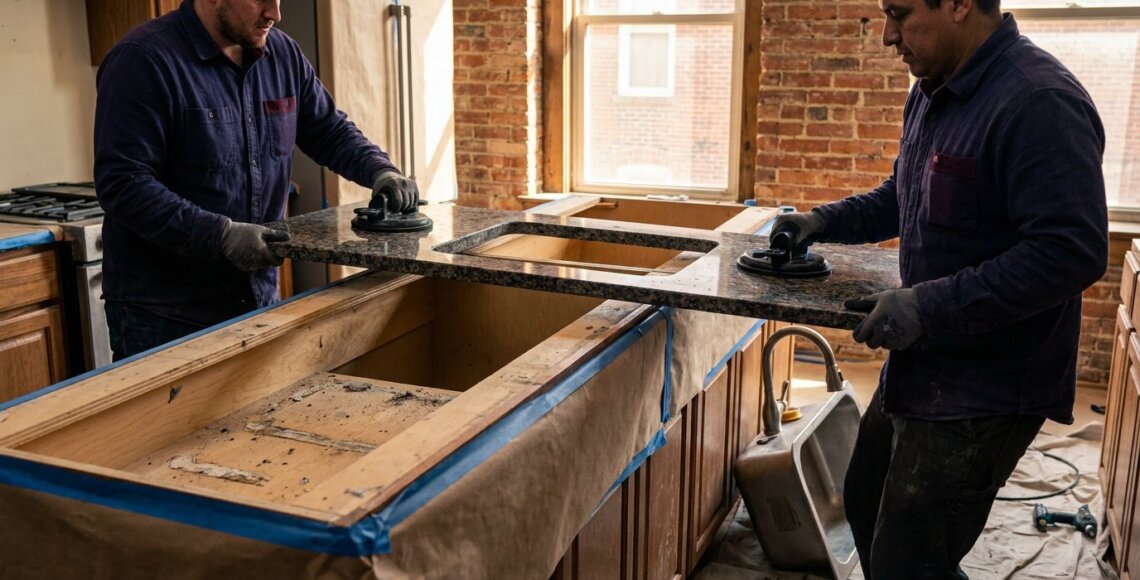
Installers lift a removed granite countertop section from a Richmond kitchen cabinet run.

Granite Counters Near Me in Richmond for Installation and Removal

A countertop project involves more than choosing a beautiful slab. In Richmond, a search for granite counters near me can lead to decisions about material, installation, and removing an existing countertop. The right choice balances the look you want with the practical needs of your space.

It’s natural to want clarity before updating a kitchen or bathroom. Learn how granite compares with quartz, marble, quartzite, and porcelain, what affects installation and removal, and which decisions to make before the project begins.

Customer projects, material samples, and showroom visits can help you picture the finished space. From natural stone’s distinctive character to the details of replacing an old surface, this guide will help you plan your Richmond countertop project with confidence.

Key Takeaways

  • Understand the main stages of countertop installation and removal so you can plan the transition to a new surface.
  • Compare granite, quartz, marble, quartzite, and porcelain by their appearance and practical characteristics.
  • Use customer project galleries to explore design possibilities and see how different materials look in finished spaces.
  • Make samples and a showroom visit part of your decision process to assess how countertop choices suit your home.

Countertop installation and old-countertop removal

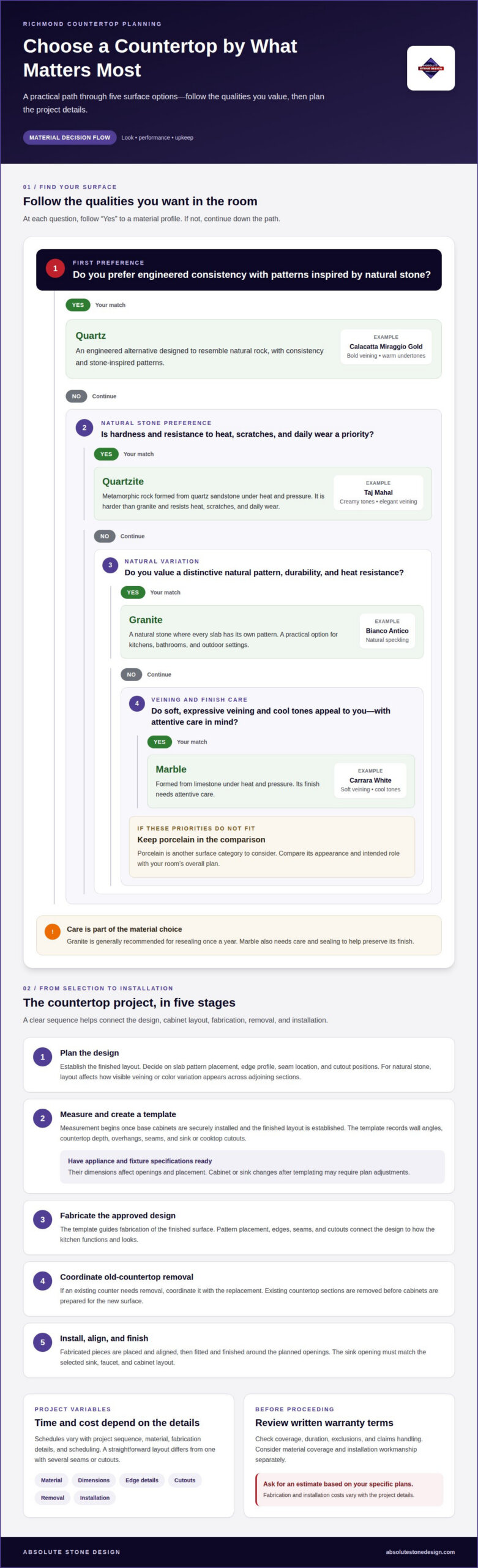
A Richmond kitchen countertop project follows a clear sequence: plan the design, measure the cabinets, create a template, fabricate the surface, and install it. If an existing counter needs removal, coordinate that work with the replacement so the countertop and sink area transition cleanly. For example, the sink opening must match the selected sink, faucet, and cabinet layout.

Granite countertop measurement begins once the base cabinets are securely installed and the finished layout is established. A professional template records wall angles, countertop depth, overhangs, seams, and sink or cooktop cutouts. Have appliance and fixture specifications ready because their dimensions affect openings and placement. Changes to cabinets or sink selections after templating may require adjustments to the plan.

Fabrication turns the approved template into a finished surface. Key design decisions include slab pattern placement, edge profile, seam location, and cutout positions. With natural stone, the layout also determines how visible veining or color variation appears across adjoining sections. Good craftsmanship connects those choices to the kitchen’s function as well as its appearance.

Removal and installation schedules depend on the project sequence, material, fabrication details, and scheduling. A straightforward layout differs from one with several seams or cutouts, so project durations vary. During removal, existing countertop sections are taken away before the cabinets are prepared for the new surface. Installation then involves placing and aligning the fabricated pieces, followed by fitting and finishing around planned openings.

Fabrication and installation costs vary with the project, including material, dimensions, edge details, cutouts, removal, and installation. Ask for an estimate based on your specific plans. Before proceeding, review any warranty or installation-guarantee terms in writing, including coverage, duration, exclusions, and claims handling. Consider material coverage and installation workmanship separately when reviewing those terms.

Granite, quartz, marble, quartzite, and porcelain countertops

Each material brings a distinct character to a kitchen or bathroom. Granite is natural stone, so every slab has its own pattern. Its durability and heat resistance make it a practical option for kitchens, bathrooms, and outdoor settings. For example, Bianco Antico granite pairs natural speckling with traditional or transitional interiors.

Quartz is engineered to resemble natural rock, offering a manufactured alternative to stone’s individual patterns. Calacatta Miraggio Gold shows how bold veining and warm undertones can create a focal point. Marble, by contrast, forms from limestone under heat and pressure. Carrara White marble is known for soft veining and cool tones, and its finish needs attentive care.

Quartzite is metamorphic rock formed when quartz sandstone is exposed to heat and pressure. It is harder than granite and resists heat, scratches, and daily wear. Taj Mahal quartzite brings creamy tones and elegant veining to a design. Porcelain offers another option; consider how its appearance and intended role fit the room’s overall plan.

Compare materials by the qualities that matter most in your space:

  • Granite: natural variation, durability, and heat resistance.
  • Quartz: engineered consistency and patterns inspired by natural stone.
  • Marble: expressive veining and a finish that needs careful maintenance.
  • Quartzite: distinctive natural veining with hardness and wear resistance.
  • Porcelain: another surface category to consider alongside stone and quartz.

Granite countertops are generally recommended for resealing once a year. Marble also needs care and sealing to help preserve its finish, so consider upkeep alongside appearance when choosing a surface.

Seeing materials together can clarify the choice. Explore granite, quartz, and marble countertops as you consider which surface best suits your room and design.

Granite Counters Near Me in Richmond for Installation and Removal

Customer reviews and project galleries

Reviews and project photos offer different insights into a countertop project. A review may describe communication, scheduling, or installation, while a gallery lets you inspect visible details. For example, look at how a granite surface meets a backsplash, cabinet edge, or sink opening.

Look for specific project details in reviews rather than relying on a general rating alone. A useful account might describe removing an old countertop, changing the planned layout, or finishing an edge. Notice whether the reviewer explains the concern and how it was addressed. That context helps you identify which parts of the experience matter most for your kitchen or bathroom.

Project galleries connect design choices with finished rooms. Compare the stone pattern, cabinet color, backsplash, and countertop finish as a whole. A custom granite countertop may show natural variation across its surface, so photos can help you picture how a pattern looks in a real space. Keep in mind that lighting and screen settings affect how colors appear.

Prefab and custom-size countertops suit different project needs. A prefab piece comes in a pre-cut format, while a custom-size countertop is shaped for a particular layout. An island with an unusual edge or sink cutout, for example, may need measurements tailored to its design. The cabinet configuration and chosen surface help determine which approach fits.

Use reviews and images together, not as substitutes for project-specific planning. A gallery can reveal a finish or layout you like, while a review may highlight details to discuss in an estimate request. Save examples of features you prefer, such as a softly rounded edge, visible natural veining, or a continuous granite pattern. These references make your design goals easier to explain.

  • Reviews: Look for project details about communication, removal, and installation.
  • Photos: Note material appearance, finish, edges, and how the surface meets nearby features.
  • Design references: Save examples that reflect the layout and style you want.

Countertop samples and showroom visits

A sample lets you assess color and texture beyond a photograph. When choosing granite, compare its pattern with your cabinets, flooring, and backsplash. A small piece won’t show every variation in a full slab, but it can help you decide whether warm veining or cooler tones suit your kitchen.

Lighting affects how colors appear. Creamy stone beside a white cabinet may look different under warm indoor lighting than it does near a window. During a showroom visit, compare a sample in different lighting and view it beside finishes similar to your planned cabinets. This helps you judge whether the surface feels cohesive.

Bring design references into the decision. A cabinet-door finish, flooring sample, or room photo makes comparisons more specific. If you’re planning Carolina blue accents, for example, consider whether the countertop’s undertones complement that color or compete with it. Aim for a balanced palette rather than an exact match between every surface.

During a showroom visit, look beyond color. Examine the stone’s texture, veining, and polished or subdued appearance, then consider how those details suit the room’s daily use. Compare similar tones side by side. A subtle difference in pattern movement or contrast may affect the overall impression more than a small color shift.

Samples help narrow your choices, while viewing larger sections of material helps you understand natural variation. This is especially useful with granite, since a small sample cannot represent every feature of a full surface. Keep your preferred colors, edge style, and room references together when requesting an estimate. They provide a clear starting point for the design conversation.

  • Compare: View samples beside cabinet and flooring finishes.
  • Consider: Check how lighting changes color and texture.
  • Decide: Keep the palette and surface details that best suit your room.

Ready to connect your material selection with a project plan? Request a countertop estimate with your preferred colors and design references.

Absolute Stone Design: Granite

Absolute Stone Design helps plan Richmond countertop projects around your space, material preferences, and design goals. When you’re ready to move from comparing surfaces to planning granite countertops, the team provides measuring, fabrication, and installation. You can also consider marble, quartz, or quartzite.

Bring your preferred colors, room details, and project examples to the conversation. These references help clarify what matters most, whether you’re updating a kitchen surface or considering a different countertop look. With your material choices in mind, you can focus your estimate request on the project scope and finish that suit your home.

Contact Absolute Stone Design to discuss your countertop project.

Make Your Countertop Plan Personal

The next step is choosing what fits your home. Consider how you want the room to feel, which surfaces you use every day, and which details matter most. If you’re searching for granite counters near me in Richmond, let those priorities guide a project conversation rather than choosing a material based on appearance alone.

Absolute Stone Design fabricates and installs countertops in granite, marble, quartz, and quartzite, giving you several natural and engineered stone options for your space. Share the room you’re updating, the look you hope to create, and any design references that express your vision. These details help shape a countertop plan that feels distinctly yours.

Contact Absolute Stone Design to discuss your countertop project. Your next step can begin with a simple conversation and a clearer picture of the space you want to create.

Frequently Asked Questions

Where can I find granite countertop fabricators and installers near me?

For granite counters near me in Richmond, Absolute Stone Design fabricates and installs granite countertops in Richmond, Henrico, Glen Allen, Midlothian, Chesterfield, and Charlottesville. Precision measuring and templating tailor the finished surface to your layout. A kitchen island and perimeter counters, for example, can be measured as separate sections so the fabrication plan accounts for each area’s dimensions and intended use.

What does granite countertop installation cost per square foot near me?

Granite installation pricing depends on the project, and an estimate is provided after a quote request. The area being covered is only one factor: granite selection, layout, cutouts, edge details, removal, and installation can all affect the scope. A countertop with a sink opening and separate island, for example, involves different fabrication details from a simple run of counter. Use these factors to understand what shapes an estimate when comparing granite counters near me.

How much do granite countertop slabs cost near me?

Granite slab pricing depends on the material selected and the countertop project. Request an estimate based on your plans. The estimate considers the stone alongside the planned dimensions and fabrication needs. A slab’s pattern and its layout across connected counter sections can also influence your selection. When requesting an estimate, share the areas you’re updating and your preferred granite look.

What is the granite countertop installation process and timeline?

Granite installation proceeds from project planning and measurement to templating, fabrication, and installation. The schedule depends on the chosen stone, layout, cutouts, and coordination with removal of the existing counter. A kitchen with a separate island and sink opening needs those details included in the project plan. Absolute Stone Design provides measuring, delivery, and installation for countertop projects.

Where can I read granite countertop contractor reviews and ratings near me?

Look for reviews describing a specific countertop experience rather than relying on a rating alone. Absolute Stone Design customer feedback includes Lorraine K., who described work on four kitchens, and Nathan D., who shared positive feedback about granite countertop installation. Their comments offer different perspectives: one reflects multiple kitchen projects, while the other focuses on a granite installation in the Richmond area.

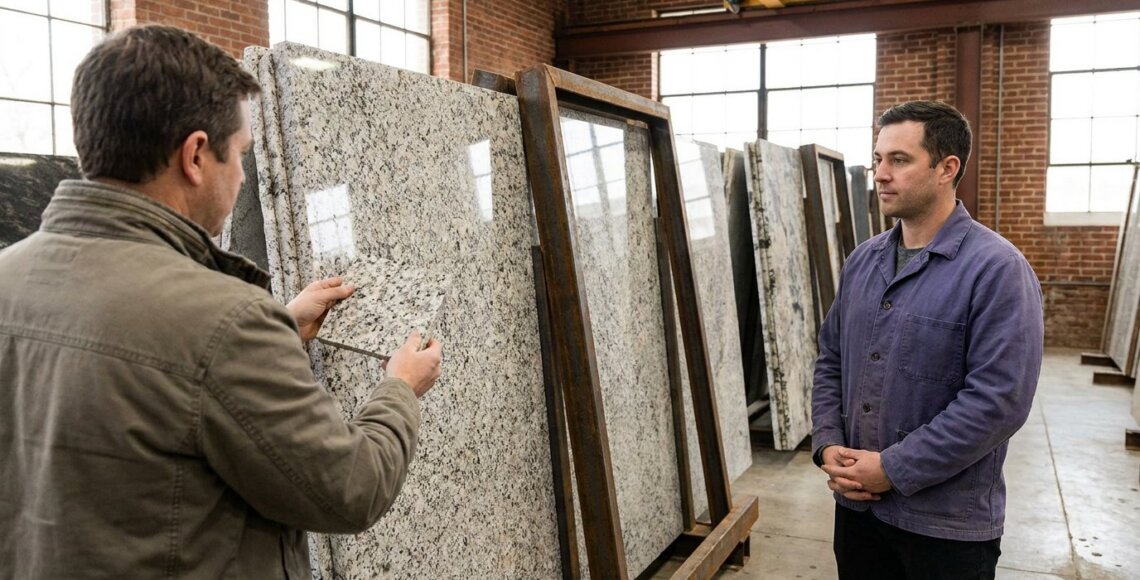
A Richmond homeowner compares a small sample with full-size granite slabs in a stone showroom.

Granite Countertops in Richmond, VA: Costs and Slab Selection

Yes, you can choose the exact natural-stone slab for your project. With granite countertops in Richmond, VA, each slab has its own pattern and color variation, so viewing the specific stone helps you picture the finished space. One Richmond customer review describes a project completed from the first phone call to installation in ten days.

The stone’s appearance is only one part of the decision. Project pricing depends on factors such as dimensions, material, cutouts, edge details, and backsplash work; a quote reflects the specific scope.

It’s natural to want a countertop that suits your home and a clear understanding of the practical details. This guide explains what affects custom countertop pricing, how to compare materials and select a slab, and what shapes installation timing, so you can plan your Richmond project with confidence.

Key Takeaways

  • See which project details shape a custom countertop quote, from the material and layout to the fabrication choices.
  • Learn how granite, marble, and quartz differ so you can narrow your material options to suit your home.
  • Understand which steps and project conditions can affect installation timing for kitchen, bathroom, fireplace, and outdoor countertops.
  • Get a clearer sense of how to plan a Richmond-area countertop project from material decisions through installation.

How much do custom countertops cost in Richmond, VA?

Custom countertop pricing starts with the project measurements and material choice. Granite, marble, and quartz each involve different slab options and fabrication needs. A quote also accounts for the countertop’s shape, edge profile, sink cutouts, and backsplash details. For example, a long island with a waterfall edge requires different fabrication from a simple straight run. The layout and number of seams can affect how the stone is cut and installed. Removing an existing surface or preparing cabinets may also change the project scope.

The total covers more than the stone itself. Fabrication shapes the selected material for your kitchen or vanity, while installation positions and secures the finished pieces. Precise measurements account for corners, walls, appliances, and openings. A custom countertop project can also include finished edges or a matching backsplash. The estimate depends on the material, dimensions, layout, cutouts, edges, backsplash, and installation needs.

Are permits required to replace kitchen countertops in Richmond, VA? It depends on the work involved, not simply the countertop material. A surface replacement differs from a project that also changes plumbing or electrical components, so Richmond requirements depend on the specific scope.

How should granite countertops be sealed and maintained? Sealing needs vary by stone and sealant, so follow the sealant maker’s directions. Wipe spills promptly and use a cleaner labeled for natural stone to care for granite.

Customer experiences can show how a project may unfold, but they don’t establish a standard schedule. One Richmond customer review describes a countertop project completed from the first phone call to installation in ten days. That is one customer’s experience, not a guaranteed timeline. For granite countertops in Richmond, VA, measurements, slab selection, fabrication, and installation all shape the project plan. Settling material and design choices helps define the work before fabrication begins.

Stone countertop materials and slab selection

Start with the material’s appearance, care needs, and how each slab will fit your design vision. Granite, marble, and quartzite are natural stone, so veining, color, and movement vary from slab to slab. For these materials, selecting the exact slab helps you see the pattern that will become your finished surface. A premium stone may have striking movement, while a quieter slab can keep attention on cabinetry and lighting.

How does granite compare with quartz and quartzite for cost, durability, and maintenance? Cost depends on the selected material, slab, layout, and fabrication, rather than a single statewide rate. Wiley describes engineered-stone countertops as durable, affordable, and easier to maintain than natural stone; granite and quartzite are natural stones with individual patterns.

Which granite colors and slab styles are popular in Richmond, VA? No single local style suits every kitchen, so consider how warm beige, gray, or darker tones work with your cabinets and floors. A broad, flowing pattern can make an island a focal point, while fine speckling gives surrounding surfaces a more restrained look. Bring a cabinet or flooring sample to compare colors directly.

Where can I view granite slabs near Richmond, VA? View the exact slab as part of your stone selection, rather than relying only on a small sample or photograph. This matters because natural stone’s pattern can shift across the full slab. For a project in Virginia, countertop material selection can help connect your preferred stone with the finished layout.

Quartz offers a different selection process because its engineered pattern is designed for a more consistent appearance. Compare samples in the room’s lighting, then consider edge shape, seams, and how the pattern will meet around a sink or corner. A responsive selection process keeps those details aligned with your design and practical needs. Highly recommend viewing full slabs before settling on natural stone, especially when a prominent vein or color contrast matters.

Granite Countertops in Richmond, VA: Costs and Slab Selection

How long does countertop installation take?

Countertop installation is one stage in a longer sequence: material selection, measurements, fabrication, delivery, and fitting. The time between stages depends on the material, layout, and preparation. A kitchen with an island, sink openings, and several corners requires different fabrication from a single straight bathroom vanity. Installation itself is only part of the overall schedule.

For a kitchen, accurate measurements account for cabinet edges, appliances, sink placement, and wall angles. After fabrication, installers position the pieces, join seams where needed, and fit the countertop around cutouts. A change in sink choice or cabinet setup can affect the sequence because the finished surface must match the final layout. A clear design and ready cabinets help keep each step coordinated.

Bathroom countertops may be smaller, but a vanity still needs precise sink and faucet openings. A remnant can suit a compact vanity if its dimensions and pattern work with the layout. The finished edge, backsplash, and wall alignment also shape fabrication. For a bathroom project that includes tile work, coordinating the countertop and wall finish helps the components meet cleanly.

Fireplace surrounds require careful attention to the opening, hearth, and adjacent wall surfaces. Measurements and cutouts must follow the design so the stone fits without disrupting the room’s lines. Outdoor countertops bring another consideration: the selected material and installation details need to suit the intended location. Site access and countertop shape also affect delivery and fitting.

To understand your project schedule, distinguish fabrication from installation day. Confirm the final material, layout, sink or appliance openings, and edge profile before fabrication begins. Then plan around cabinet readiness, site access, and connected work. A countertop in a prepared kitchen follows a different path from a bathroom vanity coordinated with tile or an outdoor surface requiring additional site planning. These steps clarify what must happen before the finished surface is ready for use.

Granite countertops in the Richmond area

Granite countertops in Richmond, VA, call for choices that connect the stone’s natural character with your room’s layout. A slab selected for a kitchen island may look very different from one used on a narrow bathroom vanity. Look at the full surface, not just a small sample, and note where strong veins or color changes fall. These details can guide seam placement, sink openings, and finished edges.

What granite countertop companies serve Richmond, VA? Fabricators and installers in the area handle steps such as measuring, cutting, and fitting stone. A useful project sequence is straightforward: choose the slab, confirm the layout, complete fabrication, then install the finished pieces. For a commercial counter or home kitchen, these steps connect the design to the actual space. Learn more about stone worktop supply, fabrication, and installation.

Richmond projects also benefit from decisions based on how the room will be used. A busy kitchen may call for a practical edge profile and a pattern that works with the cabinets and flooring. A bathroom vanity may put more emphasis on the sink opening and backsplash. Natural stone varies from slab to slab, so matching the specific piece to your design helps create a cohesive result. Careful fabrication and installation show in the alignment of edges, seams, and cutouts.

Before fabrication, settle the slab, layout, edge, and cutout positions. These choices give the finished surface a clear design direction and help avoid changes after cutting begins. The result can be beautiful without relying on elaborate details; a simple granite pattern can make an amazing focal point when it complements the surrounding room. For help planning a Richmond granite project, start a granite countertop project.

Absolute Stone Design: Countertops

Absolute Stone Design helps you choose countertops that suit your home, preferred material, and room design. If you’re weighing granite’s natural variation against marble’s distinctive veining or quartz’s more consistent appearance, the team can help you consider what fits your project. Choices about color, pattern, and edge detail bring the surface into harmony with your cabinets and flooring.

Turn to Absolute Stone Design when you’re ready to move from ideas to a countertop project. Whether you’re updating a kitchen surface or planning a bathroom vanity, you can discuss the material and look you have in mind. Start with how you want the room to feel and function.

Contact Absolute Stone Design to discuss your countertop project.

Shape a countertop plan around your home

A countertop is part of daily routines, from setting out breakfast to gathering around the kitchen island. Before moving forward, decide what matters most in your space: a distinctive natural pattern, a particular color relationship with your cabinets, or a surface suited to everyday use. That priority can guide your choices while keeping the room as a whole in view.

For granite countertops in Richmond, VA, consider how the stone will look beside existing finishes and where its most noticeable patterns should appear. Discuss your preferences, room, layout, and material with Absolute Stone Design. The company offers granite and marble countertops to suit a range of project plans.

Ready to take the next step? Contact Absolute Stone Design about your countertop project and begin shaping a surface that feels at home in your space.

Frequently Asked Questions

Can I pick my exact slab?

Yes, you can select the specific granite, marble, or quartzite slab for your project. Natural stone varies from slab to slab, so choosing the actual piece lets you consider its color and pattern. For example, you can choose veining that works with the direction of a kitchen island or the scale of a bathroom vanity. That choice helps shape the finished design.

Do you offer free estimates?

Request a quote for project-specific countertop pricing. The estimate reflects the scope, including material, measurements, cutouts, edge details, and installation needs. For example, a countertop with a sink opening and a full-wall backsplash involves different work from a simple vanity surface. Share the project details so the quote reflects its requirements.

What areas do you serve near Richmond?

Absolute Stone Design serves Richmond, Henrico, Glen Allen, Midlothian, Chesterfield, and Charlottesville. Local projects include kitchen countertops in Henrico and bathroom surfaces in Midlothian. Your project location helps shape planning for measurements, fabrication, and installation. Mention your city and the room you’re updating when you request project pricing.

What countertop materials do you offer?

Countertop materials include granite, marble, quartz, and quartzite. Granite, marble, and quartzite are natural stone, while quartz is engineered stone. Your choice can reflect the look you want, such as natural veining for a statement island or a more consistent pattern across adjoining counters. Material selection also shapes fabrication and care considerations for the finished surface.

How much do granite countertops cost per square foot in Richmond, VA?

Granite countertop pricing per square foot depends on the selected slab and the work required for your layout. Measurements, sink or cooktop cutouts, edge profiles, seams, and backsplash details all affect the project scope. A compact vanity and a kitchen with an island have different fabrication needs. Request a quote based on your specific design.

How long does granite countertop installation take in Richmond, VA?

The full project timeline depends on the sequence from final measurements and slab selection through fabrication and installation. Installation day is only one part of the process. A kitchen with an island, multiple cutouts, and several seams has different requirements from a straightforward bathroom counter. Finalized design choices and ready cabinets help establish the work sequence.