Tag: bathroom countertops

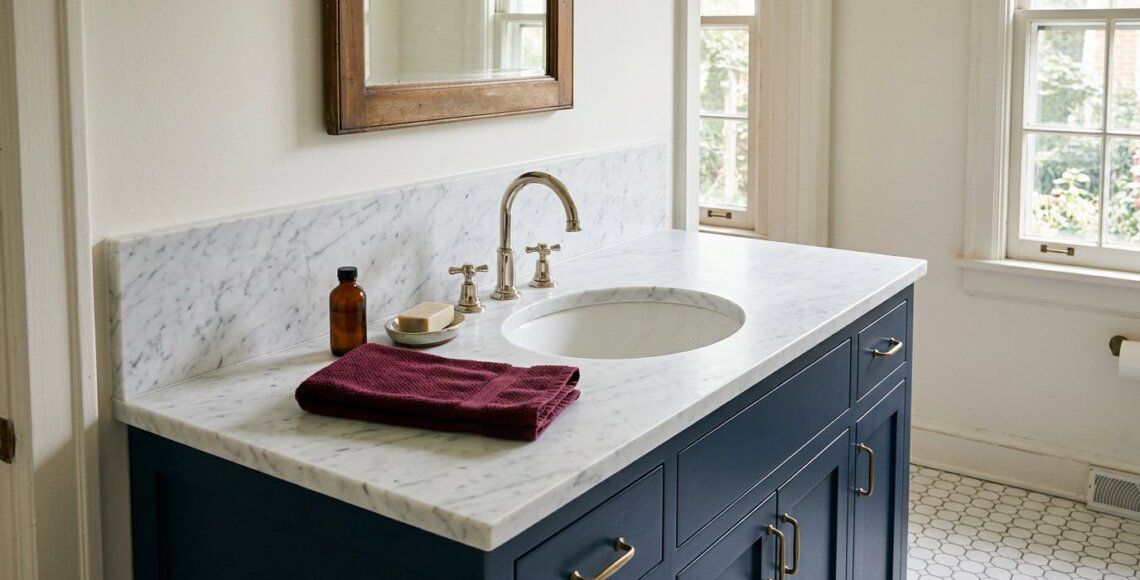
Carrara marble bathroom countertop with natural gray veining in a Richmond bungalow vanity

Marble Bathroom Countertops: Slab Costs and Design Examples

Marble bathroom countertops bring natural veining and a refined feel to a vanity, while offering heat resistance that can be useful around shower steam and styling tools. Their beauty does come with care considerations: marble can be susceptible to staining, etching, and moisture intrusion, so choosing the right design also means thinking about how the surface will be used and maintained. If you’re drawn to marble, you’re likely weighing its timeless look against everyday practicality; this guide explores bathroom design ideas, the factors that shape slab selection, and how marble’s heat resistance fits into a real home, so you can make a more confident choice for your space.

Key Takeaways

  • Compare marble colors, veining, and finishes to find a vanity surface that suits your bathroom’s style and everyday care needs.
  • Explore design choices such as pairing a stone countertop with coordinated bathroom tile for a more unified look.
  • Marble offers heat resistance, but its porous surface can be vulnerable to staining, etching, and moisture, so plan for thoughtful care.
  • Weigh marble’s natural character against quartz and granite to choose a countertop material that fits your priorities.

Marble Slab Options for Bathroom Countertops

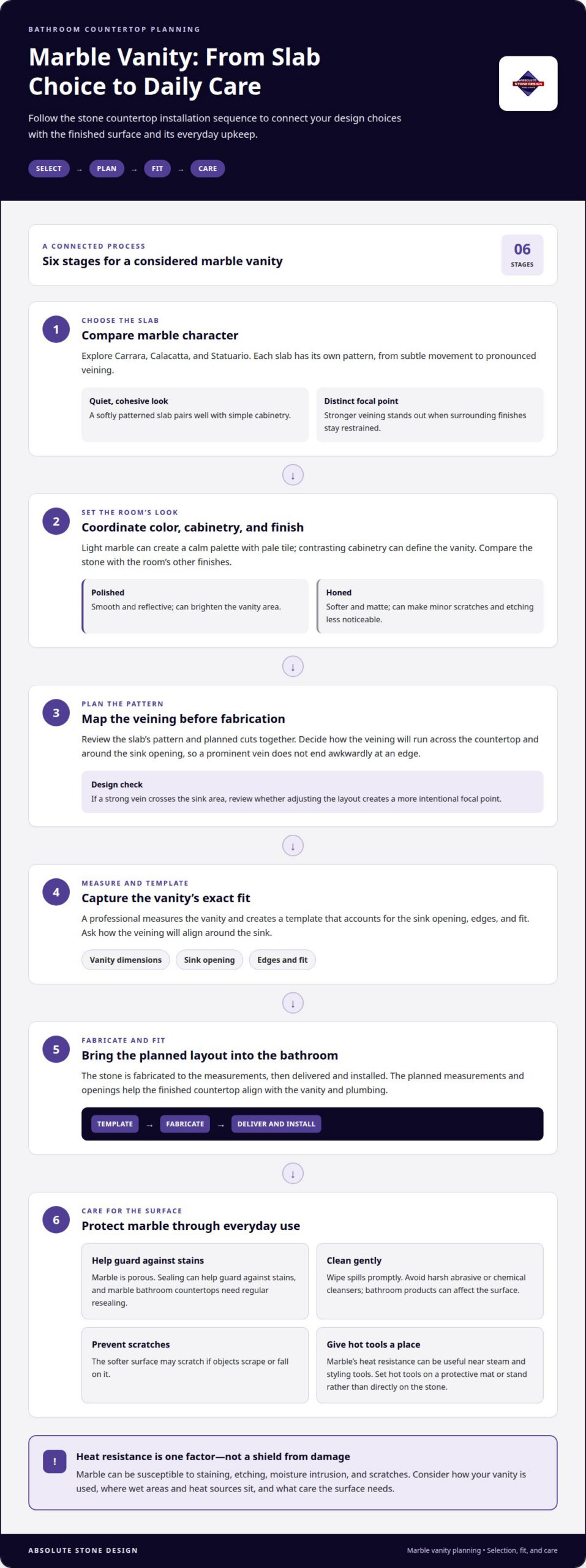
Carrara, Calacatta, and Statuario are familiar marble choices for bathroom vanities. Each slab has its own natural pattern, from subtle movement to pronounced veining. For a quiet, cohesive design, pair a softly patterned slab with simple cabinetry. To make the vanity a focal point, choose stronger veining and keep surrounding finishes restrained.

Finish affects both appearance and how minor wear shows. Polished marble has a smooth, reflective surface that can brighten a vanity area. Honed marble has a softer, matte look and can help conceal minor scratches and etching. In a busy shared bathroom, for example, a honed finish can make small marks less noticeable. It changes the look, but marble still needs care.

Color and layout work together. Light marble can complement pale tile for a calm, continuous palette, while contrasting cabinetry can define the vanity. Before fabrication, plan how the veining will run across the countertop and around the sink opening. This helps the finished surface look intentional, rather than leaving a prominent vein awkwardly cut at an edge.

Marble is porous, so moisture and staining are considerations in a bathroom. Sealing can help guard against stains, and marble bathroom countertops need regular resealing.

Marble can stain or etch, and its softer surface may scratch if objects scrape or fall on it. Avoid harsh abrasive or chemical cleansers. Wipe spills promptly and use gentle cleaning methods, since bathroom products can affect the surface.

Before buying, ask the countertop installer how the slab will be measured, how its veining will align around the sink, and what finish and sealing care it needs. Those details connect your design choice to fabrication and everyday maintenance.

Bathroom design inspiration featuring marble countertops

Marble brings natural pattern and a refined focal point to a bathroom. Its distinctive veining and heat resistance are advantages; susceptibility to staining, etching, moisture, and scratches are drawbacks to consider. In a calm, light-toned bathroom, for example, a marble vanity can add movement while simple surrounding finishes keep the space balanced.

For a cohesive look, coordinate the slab’s veining with the room’s other finishes. In a compact bathroom, a pale marble top paired with understated cabinetry can keep the vanity from feeling visually heavy. In a larger room, a more strongly veined slab can anchor the design. Simpler tile and fixtures allow the stone to stand out.

Care matters after installation. Marble is porous, so regular sealing can help guard against stains. A professional can renew the protective seal as part of ongoing maintenance; timing depends on the surface’s condition and exposure to moisture. For daily cleaning, wipe spills promptly and avoid harsh abrasive or chemical cleansers.

For installation, a professional measures the vanity and creates a template that accounts for the sink opening, edges, and fit. The stone is fabricated to those measurements, then delivered and installed. This process helps align the finished countertop with the vanity and planned plumbing openings. For homeowners undertaking a broader renovation, working with an experienced team like Black Bear Construction can help coordinate the vanity, plumbing, and surrounding finishes into a cohesive space.

Before fabrication, review the slab’s pattern and planned cuts together. If a prominent vein crosses the sink area, for instance, adjusting the layout may create a more intentional focal point. This connects material selection to the finished room.
Marble Bathroom Countertops: Slab Costs and Design Examples

Heat resistance

Marble’s heat resistance can be useful around shower steam and heat-styling tools. After a warm shower, for example, steam may linger near the vanity, making marble a suitable surface for this setting. Heat resistance does not make the countertop immune to damage, so thoughtful placement and care still matter.

Consider a morning routine that includes a curling iron or hair dryer. Set styling tools on a protective mat or stand rather than directly on the stone. This gives hot tools a dedicated resting place and keeps them off the vanity surface. Clearing space near the mirror can also make getting ready easier.

Heat is only one part of bathroom performance. Marble is porous and can be susceptible to staining, etching, and moisture intrusion, so pay attention to regular exposure to water and personal-care products. If a bottle leaks beside the faucet, wipe it up promptly and use gentle cleaners. These habits help protect the surface without changing its natural appearance.

During design planning, consider where heat sources and wet areas sit in relation to the countertop. If styling tools are kept beside the sink, include a safe resting spot in the vanity arrangement. If steam gathers around a mirror, consider how the countertop finish and surrounding materials work together. A well-planned layout reflects your routine as well as the slab’s appearance.

Marble’s heat resistance can make it a fitting option for a bathroom exposed to steam and styling tools. Pair that advantage with sensible care, especially around moisture and personal-care products. This balance lets you enjoy the stone’s distinctive look while accounting for everyday use.

How does marble compare with quartz and granite for bathroom countertops?

One difference you’ll notice first is marble’s natural veining, which gives each slab individual movement. Granite is also natural stone, while quartz countertops offer an engineered surface option. Marble can add distinctive pattern to a calm bathroom palette. If you prefer a more consistent look, compare quartz slabs alongside marble before choosing.

Marble’s beauty comes with care considerations. It is porous and may be susceptible to staining, etching, and moisture intrusion. Its softer surface can also scratch if an object drops or scrapes across it. In a busy family bathroom, for example, frequent spills and daily grooming may make maintenance an important part of your material decision.

Compare materials according to your priorities rather than assuming one always performs best. If natural variation matters to your design, review marble and granite slabs for their patterns. If you want to consider an engineered option, view quartz samples beside your tile and cabinetry. Seeing the materials together shows how each choice may shape the room.

Use a simple selection process: decide how much natural pattern you want, consider the care you’re comfortable providing, then compare samples in your bathroom’s lighting. Honed marble, for instance, can help conceal minor scratches and etching, but it still needs care. Choose a surface that balances appearance with how the vanity will be used.

For marble bathroom countertops, plan on regular resealing and avoid harsh abrasive or chemical cleansers. Granite and quartz have different material characteristics, so discuss the specific slab and finish during selection. Reviewing marble, granite, and quartz side by side can clarify which surface best suits your bathroom’s design and daily routine.

Marble can scratch when objects are dropped or scraped across it, so consider how the vanity is used when comparing it with granite or quartz. A countertop choice is about more than appearance: the possibility of surface marks may affect how comfortable you feel using the space. Weigh that concern against marble’s distinctive veining and the care routine you’re prepared to maintain.

Absolute Stone Design: Countertops

Absolute Stone Design helps you move from comparing marble and quartz to planning a bathroom countertop that fits your space. Its countertop work includes precision measuring, templating, in-house stone fabrication, delivery, and installation. That process is useful when you’ve chosen a marble look and need the slab shaped for your vanity and sink.

For a marble design, the slab’s veining and finish guide the visual plan. Measurements and a template shape the countertop to the vanity, while fabrication turns the selected stone into a fitted surface. Granite is another natural-stone option. Comparing both materials with your bathroom’s tile and cabinetry can help you choose a cohesive pattern.

Bathroom tile work can coordinate the surfaces around the vanity. A quieter tile, for example, lets expressive marble veining take the lead, while more detailed tile creates a layered look. Considering these finishes together helps clarify the room’s design direction.

Absolute Stone Design handles residential and commercial countertop projects. If you’re considering a marble or granite countertop, share your material preferences and project needs to plan a surface suited to your bathroom. The team’s process covers measurements, fabrication, delivery, and installation, with the details shaped around your space.

To discuss your bathroom countertop project, contact Absolute Stone Design.

Frequently Asked Questions

What types of marble are best for bathroom countertops?

Carrara, Calacatta, and Statuario are popular choices for marble bathroom countertops, each with distinctive natural veining. The right fit depends on the look you want and how much variation suits your room. Compare slab samples with your vanity cabinet and tile to see whether the stone’s pattern complements your planned finishes.

What project details shape a marble vanity installation?

The installation plan depends on the vanity’s dimensions, selected slab, edge design, sink opening, and site conditions. These details determine how the stone is measured, fabricated, and fitted. A vanity with an unusual shape, for example, needs a template that captures its full outline. Reviewing the layout before fabrication helps align the finished surface with the room.

What edge profiles and finishes are available for marble vanity tops?

Common marble edge choices include eased, rounded, and beveled profiles; finishes often include polished and honed. For marble bathroom countertops, a rounded edge can soften a vanity’s outline, while a crisp eased edge suits a simpler design. Review the profile alongside the slab and cabinet style before fabrication, since the edge affects the finished appearance and how the countertop thickness looks.

Can a marble vanity top be repaired if chipped or stained?

Some chips and stains can be treated, but the right approach depends on the damage and marble’s condition. A small edge chip, for example, differs from a stain that has penetrated the stone. Avoid abrasive cleaners and improvised repair products, which may worsen the surface. A stone professional can assess the affected area and recommend a suitable repair or cleaning approach.
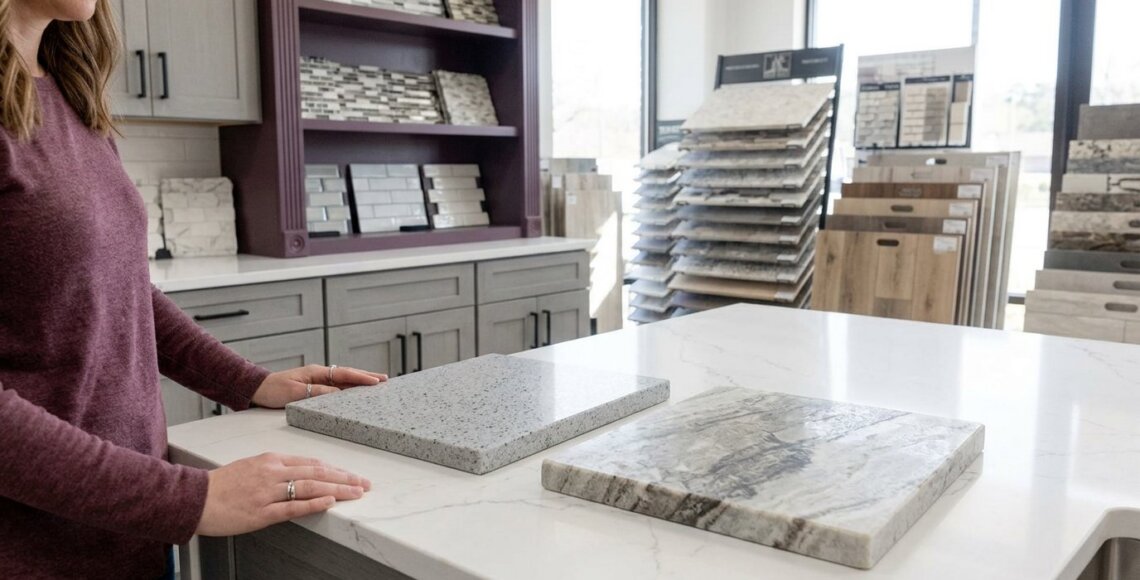
A homeowner compares engineered quartz and naturally veined quartzite countertop samples in a Richmond showroom.

Quartz vs Quartzite: Which Countertop Should You Choose

The most natural-looking countertop isn’t always the one that asks the most of your care routine. In the quartz vs quartzite decision, quartz is an engineered surface that generally doesn’t need sealing, while natural quartzite needs periodic sealing to help resist stains.

Both can bring lasting beauty to a kitchen or bathroom. The right fit depends on what matters most in your home: a more consistent appearance and simpler upkeep, or the natural veining and variation of stone. Weigh everyday care alongside the look you want, especially for a busy kitchen.

Learn how the materials are made, how their appearance and everyday care differ, and what quartzite sealing involves, including how to tell when it may be time to reseal. These practical details can help you choose a countertop that suits your space and routine.

Key Takeaways

  • Choose based on the look and upkeep you prefer: engineered quartz has a more consistent appearance, while natural quartzite has distinctive veining and variation.
  • Understand how each surface responds to heat so you can build practical habits around cooking and countertop care.
  • Quartzite needs periodic sealing, and a simple water test can help indicate when it’s time to reseal.
  • Learn how each material is made to better understand the differences you’ll see in your finished countertop.

Quartz vs Quartzite: What’s the Difference and Which Should You Choose?

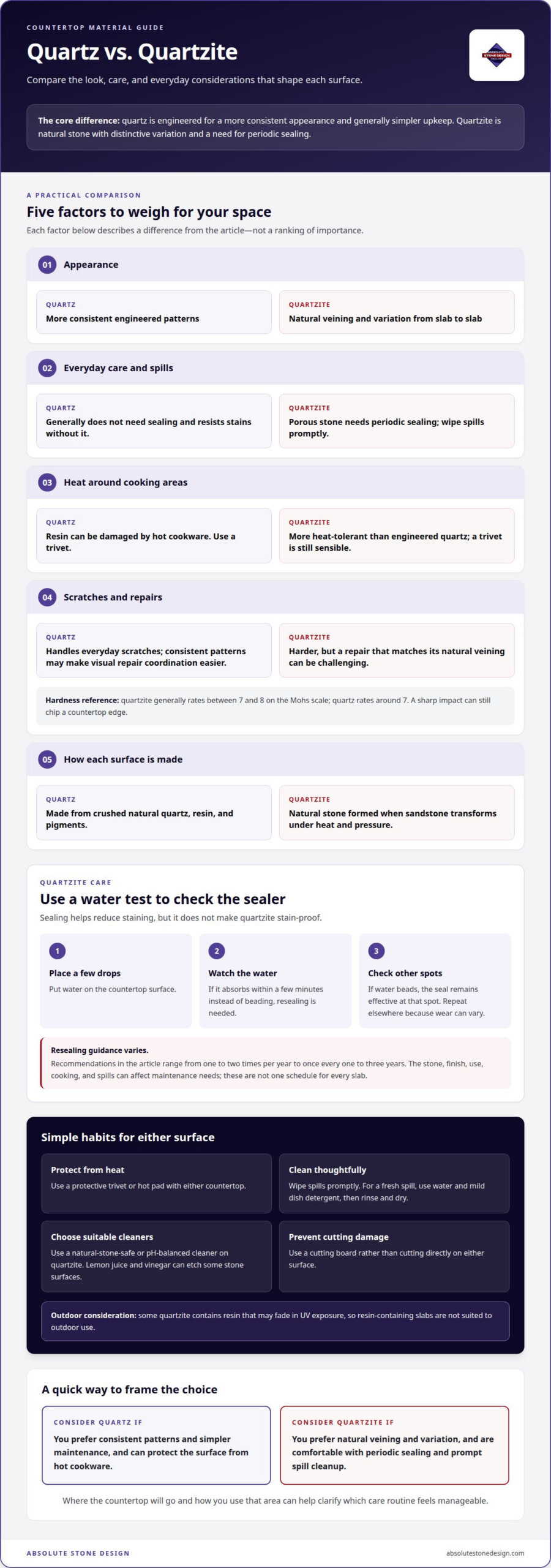
Quartz is an engineered countertop material made with crushed quartz, resin, and pigments; quartzite is natural stone formed from sandstone. That difference affects appearance and care: quartz usually has more consistent patterns and generally doesn’t need sealing, while quartzite has natural variation and needs periodic sealing to help resist stains. Both can suit a kitchen, but their upkeep differs.

What are the pros and cons of quartz versus quartzite countertops? Quartz offers a consistent look and simpler care, but hot cookware can damage its resin, so use a trivet. Quartzite offers natural veining and greater heat tolerance, but its porous surface needs sealing and prompt spill cleanup.

Which countertop is easier to maintain and repair? Quartz is usually simpler to maintain because it generally doesn’t need sealing. Repair depends on the type and location of damage. Matching a repair to quartzite’s natural veining can be challenging, while quartz’s more consistent patterns may make visual coordination easier.

How can you tell genuine quartzite from mislabeled or soft quartzite? Apply lemon juice to a sample or offcut for several minutes; true quartzite shouldn’t develop an etched, dull spot from acid. Don’t test an installed countertop, since another material could be damaged.

Countertop Appearance Care Kitchen consideration
Quartz More consistent engineered patterns Generally no sealing Protect from hot pans with a trivet
Quartzite Natural veining and variation Periodic sealing; clean spills promptly More heat-tolerant, but porous

Choose quartz if consistent patterns and simpler maintenance fit your priorities. Choose quartzite if you prefer natural variation and are comfortable with sealing and prompt cleanup. Before deciding, consider where the countertop will go, how you use that area, and which surface’s care needs feel manageable for your household.

Quartzite vs Quartz: What are Quartzite Countertops?

Quartzite begins as sandstone, then forms under heat and pressure over millions of years. Its natural colors and veining vary from slab to slab, unlike the more consistent patterns often found in engineered quartz. That natural character is part of its appeal, but the surface also needs care suited to natural stone.

Which is harder and more durable, quartz or quartzite? Quartzite generally ranks between 7 and 8 on the Mohs hardness scale, while quartz rates around 7. Both resist everyday scratches, but quartzite is harder; granite also stands up well to scratches, heat, and general wear. Marble is softer than quartzite and more likely to scratch.

How resistant are quartz and quartzite to stains, scratches, heat, and UV light? Quartz resists stains without sealing and handles everyday scratches, but its resin can be damaged by high heat. Porous quartzite can stain if spills penetrate, yet it offers strong scratch and heat resistance. Some quartzite contains resin that may fade in UV exposure, so resin-containing slabs aren’t suited to outdoor use.

Heat tolerance matters beside a range or on a kitchen island. Quartzite tolerates heat better than engineered quartz, whose resin can be damaged by hot cookware. Granite also resists heat, but using a protective trivet is sensible with any countertop. According to Cambria, use a closed-weave hot pad or solid trivet to protect quartz and quartzite surfaces.

Quartzite’s hardness doesn’t make it immune to damage. A sharp impact can still chip a countertop edge, and acidic foods can affect some natural stones. Wipe up lemon juice promptly, for example, and use a cutting board instead of cutting directly on either surface.

For a material choice that balances natural veining with everyday kitchen routines, explore quartzite countertop options and consider how heat, spills, and sunlight affect your space.

Quartz vs Quartzite: Which Countertop Should You Choose

Does quartzite require sealing and how often?

Yes. Quartzite is porous, so liquids can enter the stone and leave stains; sealing adds protection but doesn’t make the countertop stain-proof. Sandstone transforms under heat and pressure to form quartzite, and differences between slabs and finishes affect how readily each surface absorbs moisture. That’s why sealing needs can vary, even for a premium countertop material.

Resealing guidance varies: quartzite countertops generally need resealing one to two times per year, while another typical interval is once every one to three years, depending on the stone and its use. These are different recommendations, not one schedule for every slab. A polished finish, daily cooking, and frequent spills can all affect maintenance needs.

Use a water test to judge whether the sealer is still working. Place a few drops of water on the countertop and watch what happens. If the water absorbs within a few minutes instead of beading, resealing is needed. If it beads, the seal remains effective at that spot; repeat the test elsewhere, since wear may differ across the counter.

For daily cleaning, wipe spills promptly and choose a natural-stone-safe or pH-balanced cleaner. Lemon juice and vinegar can etch some stone surfaces, so clean them up quickly rather than letting them sit. For a fresh spill, start with water and mild dish detergent, then rinse and dry the area.

Sealing helps reduce staining, but routine care still matters. Coffee left on a porous section can penetrate despite a sealer, while a promptly wiped spill is less likely to linger. Avoid harsh, acidic cleaners, which can affect the surface or sealer. Follow the care directions for your countertop, and repeat the water test if absorption suggests protection has weakened.

How engineered quartz and natural quartzite are made

Engineered quartz countertops are made by combining ground natural quartz aggregate with resin and pigments, then forming the mixture into slabs. Many engineered surfaces contain about 90 to 95 percent quartz aggregate; the rest includes resin and colorants. This process lets manufacturers create patterns with a more consistent appearance than natural stone. For example, repeated slabs can offer similar color and veining across a kitchen.

Natural quartzite forms when sandstone undergoes heat and pressure over millions of years. The pressure transforms the original rock into a hard, quartz-rich natural stone. Its composition and color depend on the minerals present as the sandstone forms. Quartzite slabs are typically more than 90 percent quartzite, and some can reach 99 percent. Each slab develops its own pattern rather than following a manufactured design.

The distinction between quartz and quartzite is clear in their patterns. Engineered quartz can offer repeatable colors and visual movement, which helps when coordinating multiple countertop areas. Natural quartzite has veins and color variation shaped by its geological formation. Even slabs sold under the same stone name can look different, so a large kitchen may show noticeable variation between pieces or seams.

Production also influences everyday care. The resin in engineered quartz helps create a nonporous surface that resists stains without sealing, while quartzite’s natural pores can absorb spills and benefit from stone sealing. Pigments and resins give engineered surfaces their selected appearance, but high heat can damage the resin. Quartzite’s natural composition tolerates heat better, though its veining and slab-to-slab differences call for thoughtful layout planning. To compare how these materials may look across your kitchen, explore quartz and quartzite countertop options before choosing a surface.

Absolute Stone Design: Quartz

Absolute Stone Design serves homeowners in Richmond and nearby communities with quartz and quartzite countertops, helping you choose between a consistent engineered pattern and the natural variation of stone. The team can help you consider how each material’s appearance and care needs fit your kitchen. Granite is another option to compare if you’re considering natural stone.

Once you’ve chosen a direction, Absolute Stone Design handles measuring, fabrication, delivery, and countertop installation for homes in the Richmond area. The team can help translate your material choice into a surface tailored to your space, including the kitchen layout and details that shape the finished look.

For help planning a quartz or quartzite countertop in Richmond or a nearby community, contact Absolute Stone Design.

Plan a countertop that fits your home

In the quartz vs. quartzite decision, picture the surface in its finished setting. Consider how its colors will work with your cabinets, backsplash, flooring, and natural light. Viewing a sample beside those elements can help you decide whether the overall look feels calm, coordinated, or more expressive.

Think, too, about the routines around the counter. A busy cooking area, a frequently used island, or a bathroom vanity may each call for different priorities. The Absolute Stone Design team can help connect your design goals with a practical countertop selection. If you’re also weighing natural-stone alternatives, the company offers granite and marble countertops.

Give yourself room to consider the full design, not just the slab on its own. The right choice should feel at home in your space and suit the way you use it. Contact Absolute Stone Design to talk through your countertop plans and explore service for your Richmond-area project, then take the next step with confidence.

Frequently Asked Questions

What does quartzite look like compared to quartz?

Quartzite’s appearance can shift noticeably from one slab to another, while quartz offers more predictable patterning. If you’re planning several countertop runs, look at the actual slabs and consider how their visual movement will carry across the room. A small sample may not show the full pattern, so assess the larger surface before deciding how it fits your design.

How do you plan quartzite seams in a large kitchen?

Plan seam locations as part of the kitchen layout, especially where long runs meet an island or turn a corner. Natural veining may not line up across separate pieces, so seam placement can affect how continuous the surface appears. Considering the overall pattern before fabrication helps you decide which areas should draw attention.

Is Quartz or Quartzite Better for Your Kitchen?

Choose according to the kitchen’s design priorities and your care preferences. If you want a coordinated look across separate work areas, consider how closely the selected surface can match from one run to another. If the countertop is a focal point, decide whether you prefer a uniform pattern or the distinct character of natural stone. Your routine matters, too.

What should you compare when viewing countertop samples?

Look at color, pattern, and how the surface relates to fixed elements such as cabinet fronts and flooring. For a kitchen with perimeter counters and an island, consider whether you want the surfaces to coordinate closely or create contrast. Reviewing the material in the context of your design can make the choice more intentional.

Quartz vs. Quartzite vs. Granite: Which is Best?

There isn’t one best surface for every kitchen. Think about whether you prefer engineered consistency or natural variation, then weigh the care each material requires. Granite adds another natural-stone option to compare. Narrow your choices by considering the look you want across the full countertop layout, rather than judging a small section in isolation.

What is the difference between quartz and quartzite countertops?

The key distinction is how each countertop material is made: quartz is engineered, while quartzite forms naturally. That difference can guide design decisions, particularly when matching surfaces across several areas. For instance, a homeowner coordinating a long counter and an island may prioritize a predictable pattern, while someone seeking a one-of-a-kind focal surface may prefer natural variation.

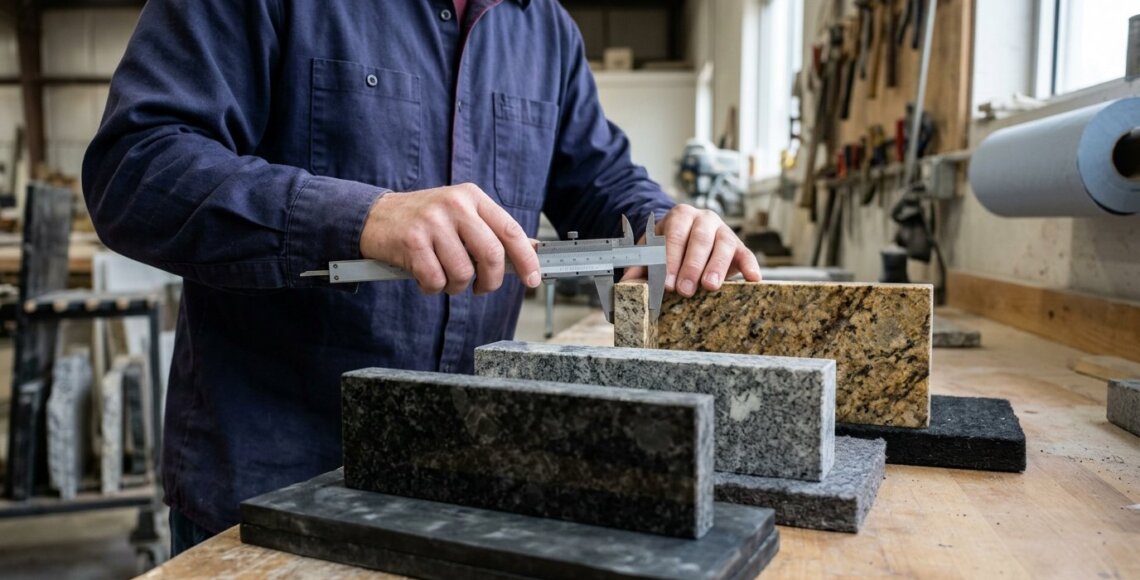
A fabricator checks granite slab thickness beside charcoal, gray, and gold-brown granite offcuts.

Types of Granite Compared by Color, Grade, and Slab Thickness

No granite color is automatically the most durable. The right choice depends on the specific stone and how its slab will suit the countertop. Types of granite are often grouped by appearance, including black, red, green, gold, yellow, pink, gray, and blue. Geologically, granite is defined by its mineral composition: feldspar, quartz, mica, and hornblende. Color can guide the look of your kitchen or bathroom, but it does not tell you everything about performance. Grade labels and slab thickness offer additional points of comparison, but neither is a stand-alone measure of durability. This guide explains how color, grade, thickness, and granite’s geological meaning fit together to help you make an informed selection. Viewing the full slab matters too: natural veining and tone can vary, and the stone may look different across a large surface than in a small sample.

Key Takeaways

  • Learn why a commercial grade label and a geological classification describe different things about a slab.
  • Compare slab thickness thoughtfully, instead of assuming a thicker option or higher grade automatically means greater durability.
  • See how regional names can help you make sense of granite varieties and narrow your material choices.
  • Explore popular kitchen selections and weigh appearance alongside practical factors such as porosity and intended use.

Does the granite’s strength differ between granite colors?

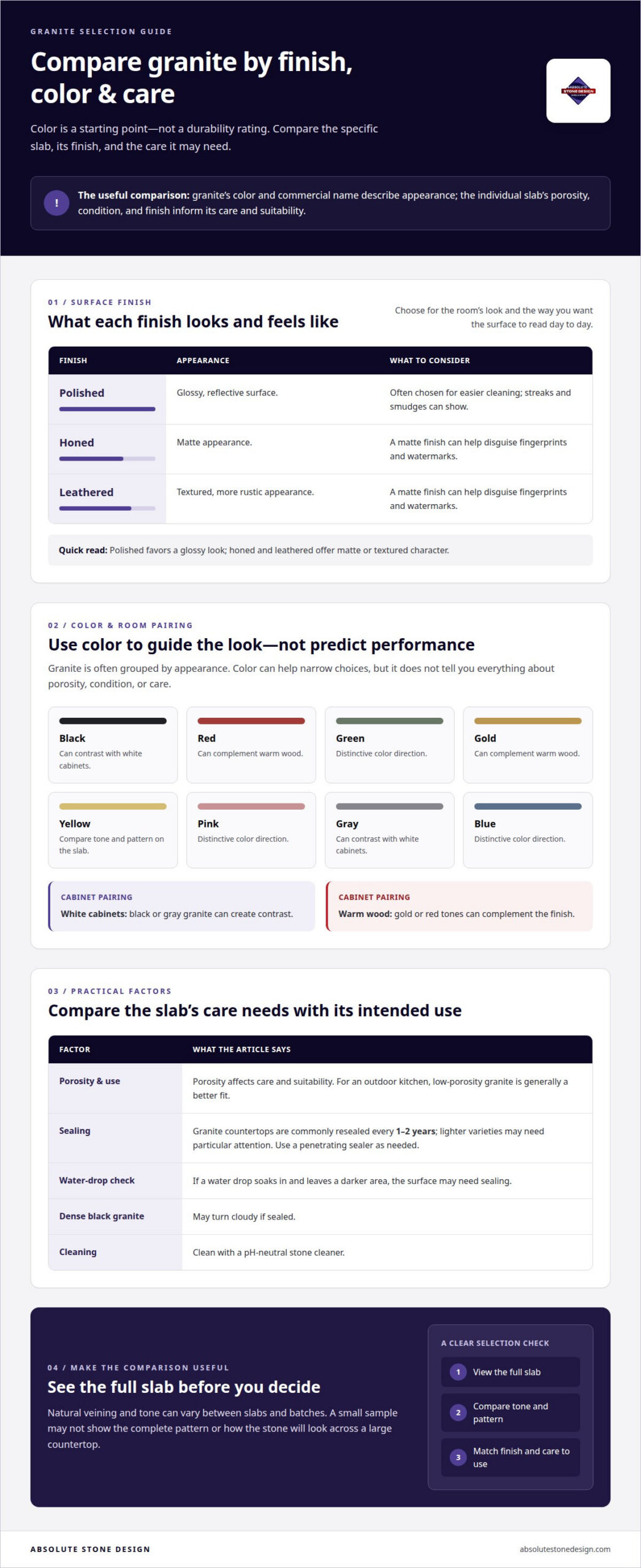
Color alone doesn’t determine how durable a granite countertop will be. Black, red, green, gold, yellow, pink, gray, and blue describe appearance, while a stone’s porosity and condition affect its care and suitability. For an outdoor kitchen, low-porosity granite is generally a better fit. Compare the available colors with the room’s needs and the stone’s care requirements.

Cabinet color can help narrow your choices. Black or gray granite can contrast with white cabinets, while gold or red tones can complement warm wood. Green, pink, and blue varieties add distinctive color, so consider how their patterns will work with cabinet finishes and other surfaces. Granite colors and textures can vary between batches. View the full slab, because a small sample may not show its complete veining or tone.

Granite, quartzite, and engineered quartz are different materials: granite and quartzite are natural stones, while engineered quartz is manufactured. Granite’s geological makeup includes feldspar, quartz, mica, and hornblende, but a stone’s name or color doesn’t reveal its porosity. For a natural-stone project, assess the specific slab rather than assuming every dark or light variety performs alike.

Polished granite has a glossy surface and is often chosen for easier cleaning, though streaks and smudges can show. Honed granite has a matte look, while leathered granite has a textured, more rustic appearance. Matte finishes can help disguise fingerprints and watermarks, making them worth considering for busy countertops.

For maintenance, clean granite with a pH-neutral stone cleaner and use a penetrating sealer as needed. Granite countertops are commonly resealed every 1-2 years; lighter varieties may need particular attention. A water drop that soaks in and leaves a darker area can indicate that the surface needs sealing. Dense black granite may turn cloudy if sealed.

Natural granite comes in varied colors, veining, and textures, giving each slab its own look. Its porosity is an important care consideration, and sealing may be part of upkeep. Compare the slab’s appearance, finish, and care needs together. That gives you a more useful basis for choosing than color alone.

Commercial and geological definitions of granite

“Granite” can mean different things in a geology book and a countertop showroom. Geologically, granite is a natural igneous rock identified by its mineral composition and coarse-grained structure. In commercial stone, the label may describe a broader category of durable, polishable natural stone. So a slab marketed as granite may not fit the narrow geological definition.

For geological classification, mineral content matters more than a slab’s color or trade name. Granite includes feldspar, quartz, mica, and hornblende, and its visible crystals contribute to its natural texture. A geologist evaluates composition and structure, while homeowners typically encounter commercial labels that help distinguish materials during selection.

That difference matters when you compare samples. A product tag reading “granite” is useful when shopping, but it doesn’t tell you every detail about mineral proportions, porosity, or appearance. Looking closely at the slab can reveal crystal size, veining, and color variation that a category name alone can’t convey.

Commercial names also help organize choices by appearance. Two slabs sold as granite may have very different patterns and tones, even though both are natural stone. In a bathroom, one homeowner might prefer a quiet, consistent look, while another might choose pronounced movement as a focal point. The geological label can’t decide which appearance suits the room.

Use each definition for its purpose: geological classification describes what the rock is, while commercial terminology helps identify materials for a project. When reviewing a slab, consider its actual appearance and intended use alongside its sales label. That distinction can make conversations about natural stone clearer and help you compare options with confidence. For a closer look at granite material options, focus on the slab’s visible character and how it will work in your space.

Types of Granite Compared by Color, Grade, and Slab Thickness

What are the main types of granite?

Granite is often grouped by color or variety name, rather than by one universal classification. Common color groups include black, red, green, gold, yellow, pink, gray, and blue. These labels help you start comparing appearance, but they don’t capture every detail of an individual slab. Patterns, crystal distribution, and tone can differ even within one color group.

Variety names offer another way to describe granite. They identify specific commercial options, often with names that suggest a color or visual character. Examples include Absolute Black, Black Galaxy, New Kashmir White, Vizag Blue, Steel Grey, and Imperial Gold. Names can help organize your choices, but they don’t replace seeing the stone itself.

Other named varieties include:

  • New Imperial Red and Jhansi Red
  • Crystal Yellow and Alaska White
  • Blue Dunes, Platinum White, and Rajasthan Black

These labels provide a starting point for narrowing your selection by broad appearance. For example, Steel Grey suggests a different color direction from Imperial Gold, while Blue Dunes points to another palette. The names alone don’t establish how much veining, contrast, or variation a particular slab will have. Natural stone can differ from slab to slab.

Use color groups and variety names to organize your options, then compare actual slabs for tone, pattern, and how each will look in your room. If you’re considering a kitchen countertop, view the stone alongside your cabinets and other finishes. Types of granite may be described by color or by a specific variety name. Understanding both labels helps you compare appearance without treating a name as a ranking of quality or durability.

There isn’t one universal ranking that makes a granite variety right for every kitchen. The useful question is how a candidate will work with your room’s shape and planned countertop details. A long peninsula, compact work area, and broad kitchen island each present the stone differently. Consider where you want the surface to draw attention before settling on a selection.

Countertop planning also affects how a slab becomes a finished surface. Sink and cooktop openings interrupt the stone, while seams divide longer runs into sections. A bold feature near an opening may be partly removed during fabrication, so planned cuts matter as much as the slab’s overall appearance. Mapping those details early helps you understand what will remain visible after fabrication.

  • For a long run: Consider how the visual movement carries across the usable counter area.
  • For a sink zone: Think about which parts of the pattern will remain around the opening.
  • For a kitchen island: Decide whether the surface should anchor the room or complement other design elements.

Edge selection is another design decision. A simple edge keeps attention on the stone’s surface, while a more defined profile adds detail along the counter’s perimeter. The choice can change how the countertop relates to cabinet doors, nearby trim, and the room’s overall style. Consider the edge alongside the planned shape of each countertop section.

Rather than choosing solely by a variety’s reputation, consider how the planned pieces will look after fabrication. A coordinated selection accounts for visible areas, cutouts, edges, and transitions as one design. This gives you a practical way to compare popular options based on the finished kitchen, not just a catalog label.

Ready to plan your kitchen surface? Plan your granite countertop selection around the details of your project.

Absolute Stone Design: Granite

Absolute Stone Design helps Richmond-area homeowners turn a granite selection into a countertop planned for their space. If you’re comparing colors, patterns, or slab details, the team can guide material selection and coordinate precision measuring, in-house fabrication, and installation. This is especially useful when you want the finished surface to fit your kitchen layout and complement your cabinets.

Granite is one option alongside marble and quartz, and each material brings a different look to your project. Consider your priorities, such as natural variation or a more consistent appearance, to clarify which surface suits your plans.

Contact Absolute Stone Design to discuss your countertop project.

Shape a Granite Choice Around Your Home

Your next step is to turn your preferences into a clear design direction. Decide whether the surface should feel quiet or expressive, and how it should support the room’s everyday use. This makes comparisons between types of granite more purposeful, because you’re judging each option against your space rather than an abstract ranking.

Absolute Stone Design offers granite and marble countertops, with a team that can connect material selection to your project’s design. Bring your priorities for color, pattern, and the overall feel of your kitchen or bath into the conversation. The team’s stone expertise can help shape a considered, personal direction.

Whether you’re planning a new surface or refining a renovation plan in Richmond or the surrounding area, make the choice around your home, not a passing trend. Contact Absolute Stone Design to talk through your project and take the next step with confidence.

Frequently Asked Questions

What is the most durable type of granite?

No variety name by itself establishes which slab will be most durable. Start with how you use the surface: a kitchen used frequently for food preparation has different demands from a guest bathroom vanity. Then consider how much routine care you’re comfortable providing. These practical priorities help you compare options without treating a color, label, or grade as a guarantee of performance.

Granite: What’s In a Name?

A variety name helps distinguish one marketed granite selection from another, but it shouldn’t be the only identifier in your project notes. Record the exact name alongside the slab you selected and its intended location. This can keep design discussions clear when coordinating a kitchen countertop, island, and other surfaces. The physical slab remains the reference for its particular appearance.

Which granite is best for outdoor use?

Choose a slab with the outdoor setting in mind, including the surface’s exposure and the look you want alongside nearby materials. For example, an outdoor kitchen beside stone paving may call for a different visual balance from a covered entertaining area next to wood cabinetry. Consider the whole setting and intended use together, rather than choosing based on a granite name alone.

What are the different granite colors and patterns?

Granite ranges from pale, relatively quiet appearances to darker stones with stronger visual movement. For a practical comparison, look at how a pattern reads across the full surface, then picture it around a sink or cooktop opening. Cutouts can change which parts of the design remain visible. This helps you judge the finished countertop, not just an isolated patch of stone.

How do granite types differ in hardness, durability, and porosity?

These properties represent different considerations, so don’t treat one as a substitute for another. A surface may suit your preferred appearance yet require care that doesn’t fit your routine. Think about daily use, likely spills, and how you clean your counters. These habits help you assess what performance means for your household, beyond a broad label or a single material characteristic.

Which granite types are best for indoor and outdoor use?

A slab marketed for a bathroom countertop may also work in a kitchen, but suitability depends on the specific slab and its intended use. For outdoor spaces, consider the setting and the surface’s exposure as part of your selection. Matching the slab to its location means looking beyond the room name and considering how the surface will be used and experienced there.

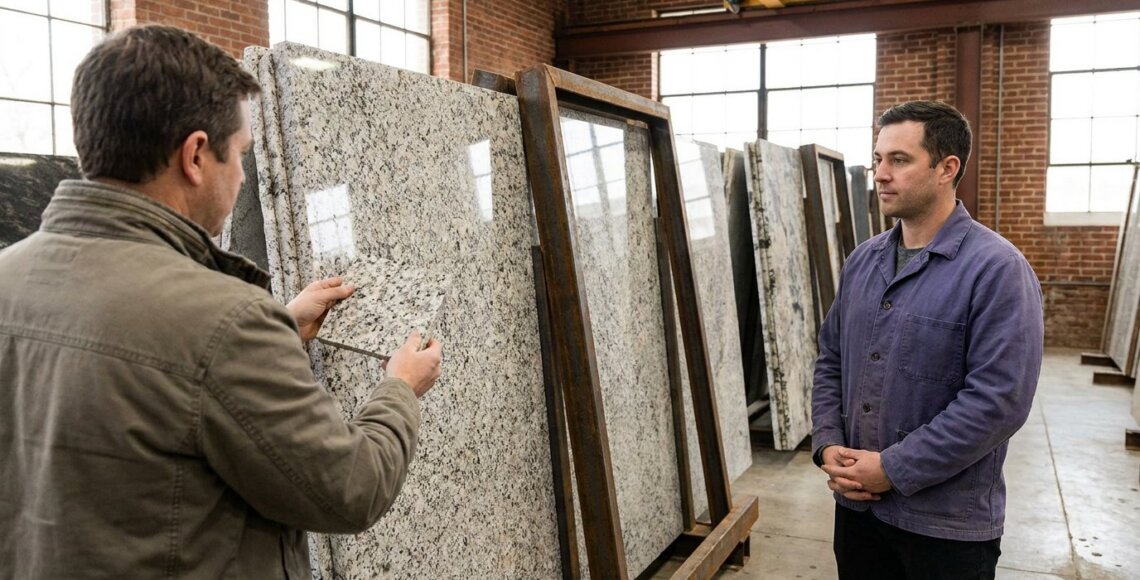
A Richmond homeowner compares a small sample with full-size granite slabs in a stone showroom.

Granite Countertops in Richmond, VA: Costs and Slab Selection

Yes, you can choose the exact natural-stone slab for your project. With granite countertops in Richmond, VA, each slab has its own pattern and color variation, so viewing the specific stone helps you picture the finished space. One Richmond customer review describes a project completed from the first phone call to installation in ten days.

The stone’s appearance is only one part of the decision. Project pricing depends on factors such as dimensions, material, cutouts, edge details, and backsplash work; a quote reflects the specific scope.

It’s natural to want a countertop that suits your home and a clear understanding of the practical details. This guide explains what affects custom countertop pricing, how to compare materials and select a slab, and what shapes installation timing, so you can plan your Richmond project with confidence.

Key Takeaways

  • See which project details shape a custom countertop quote, from the material and layout to the fabrication choices.
  • Learn how granite, marble, and quartz differ so you can narrow your material options to suit your home.
  • Understand which steps and project conditions can affect installation timing for kitchen, bathroom, fireplace, and outdoor countertops.
  • Get a clearer sense of how to plan a Richmond-area countertop project from material decisions through installation.

How much do custom countertops cost in Richmond, VA?

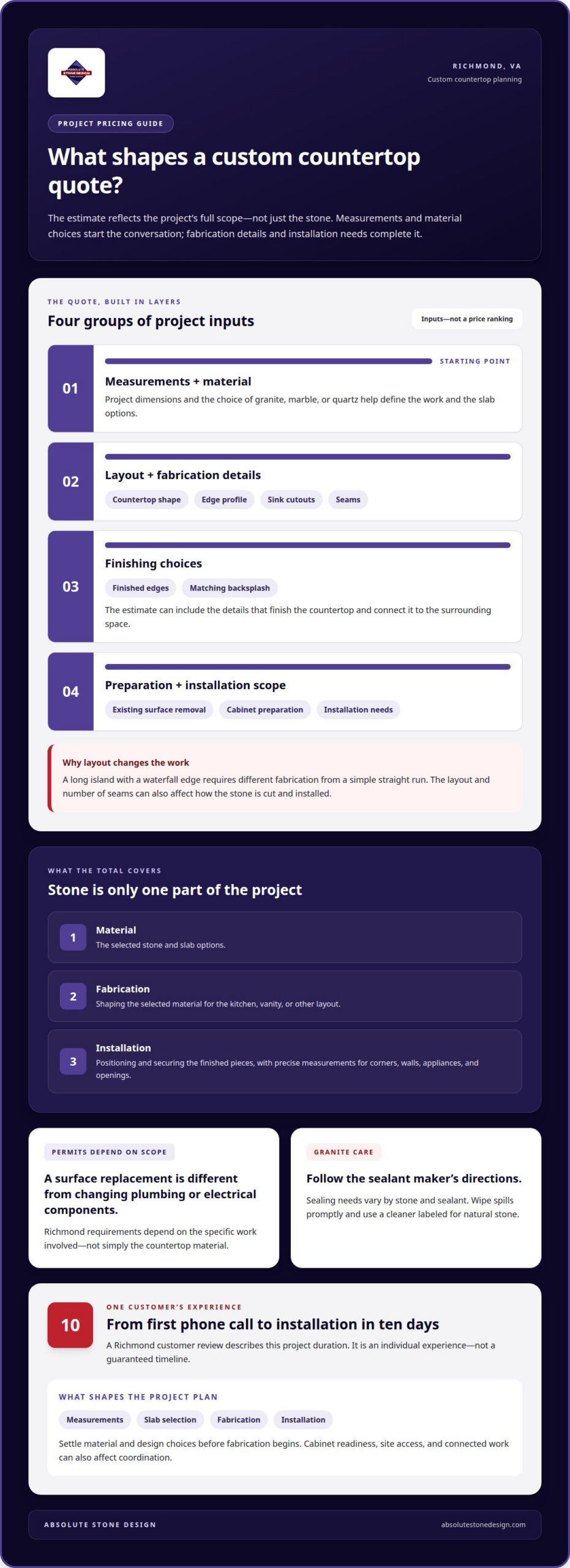
Custom countertop pricing starts with the project measurements and material choice. Granite, marble, and quartz each involve different slab options and fabrication needs. A quote also accounts for the countertop’s shape, edge profile, sink cutouts, and backsplash details. For example, a long island with a waterfall edge requires different fabrication from a simple straight run. The layout and number of seams can affect how the stone is cut and installed. Removing an existing surface or preparing cabinets may also change the project scope.

The total covers more than the stone itself. Fabrication shapes the selected material for your kitchen or vanity, while installation positions and secures the finished pieces. Precise measurements account for corners, walls, appliances, and openings. A custom countertop project can also include finished edges or a matching backsplash. The estimate depends on the material, dimensions, layout, cutouts, edges, backsplash, and installation needs.

Are permits required to replace kitchen countertops in Richmond, VA? It depends on the work involved, not simply the countertop material. A surface replacement differs from a project that also changes plumbing or electrical components, so Richmond requirements depend on the specific scope.

How should granite countertops be sealed and maintained? Sealing needs vary by stone and sealant, so follow the sealant maker’s directions. Wipe spills promptly and use a cleaner labeled for natural stone to care for granite.

Customer experiences can show how a project may unfold, but they don’t establish a standard schedule. One Richmond customer review describes a countertop project completed from the first phone call to installation in ten days. That is one customer’s experience, not a guaranteed timeline. For granite countertops in Richmond, VA, measurements, slab selection, fabrication, and installation all shape the project plan. Settling material and design choices helps define the work before fabrication begins.

Stone countertop materials and slab selection

Start with the material’s appearance, care needs, and how each slab will fit your design vision. Granite, marble, and quartzite are natural stone, so veining, color, and movement vary from slab to slab. For these materials, selecting the exact slab helps you see the pattern that will become your finished surface. A premium stone may have striking movement, while a quieter slab can keep attention on cabinetry and lighting.

How does granite compare with quartz and quartzite for cost, durability, and maintenance? Cost depends on the selected material, slab, layout, and fabrication, rather than a single statewide rate. Wiley describes engineered-stone countertops as durable, affordable, and easier to maintain than natural stone; granite and quartzite are natural stones with individual patterns.

Which granite colors and slab styles are popular in Richmond, VA? No single local style suits every kitchen, so consider how warm beige, gray, or darker tones work with your cabinets and floors. A broad, flowing pattern can make an island a focal point, while fine speckling gives surrounding surfaces a more restrained look. Bring a cabinet or flooring sample to compare colors directly.

Where can I view granite slabs near Richmond, VA? View the exact slab as part of your stone selection, rather than relying only on a small sample or photograph. This matters because natural stone’s pattern can shift across the full slab. For a project in Virginia, countertop material selection can help connect your preferred stone with the finished layout.

Quartz offers a different selection process because its engineered pattern is designed for a more consistent appearance. Compare samples in the room’s lighting, then consider edge shape, seams, and how the pattern will meet around a sink or corner. A responsive selection process keeps those details aligned with your design and practical needs. Highly recommend viewing full slabs before settling on natural stone, especially when a prominent vein or color contrast matters.

Granite Countertops in Richmond, VA: Costs and Slab Selection

How long does countertop installation take?

Countertop installation is one stage in a longer sequence: material selection, measurements, fabrication, delivery, and fitting. The time between stages depends on the material, layout, and preparation. A kitchen with an island, sink openings, and several corners requires different fabrication from a single straight bathroom vanity. Installation itself is only part of the overall schedule.

For a kitchen, accurate measurements account for cabinet edges, appliances, sink placement, and wall angles. After fabrication, installers position the pieces, join seams where needed, and fit the countertop around cutouts. A change in sink choice or cabinet setup can affect the sequence because the finished surface must match the final layout. A clear design and ready cabinets help keep each step coordinated.

Bathroom countertops may be smaller, but a vanity still needs precise sink and faucet openings. A remnant can suit a compact vanity if its dimensions and pattern work with the layout. The finished edge, backsplash, and wall alignment also shape fabrication. For a bathroom project that includes tile work, coordinating the countertop and wall finish helps the components meet cleanly.

Fireplace surrounds require careful attention to the opening, hearth, and adjacent wall surfaces. Measurements and cutouts must follow the design so the stone fits without disrupting the room’s lines. Outdoor countertops bring another consideration: the selected material and installation details need to suit the intended location. Site access and countertop shape also affect delivery and fitting.

To understand your project schedule, distinguish fabrication from installation day. Confirm the final material, layout, sink or appliance openings, and edge profile before fabrication begins. Then plan around cabinet readiness, site access, and connected work. A countertop in a prepared kitchen follows a different path from a bathroom vanity coordinated with tile or an outdoor surface requiring additional site planning. These steps clarify what must happen before the finished surface is ready for use.

Granite countertops in the Richmond area

Granite countertops in Richmond, VA, call for choices that connect the stone’s natural character with your room’s layout. A slab selected for a kitchen island may look very different from one used on a narrow bathroom vanity. Look at the full surface, not just a small sample, and note where strong veins or color changes fall. These details can guide seam placement, sink openings, and finished edges.

What granite countertop companies serve Richmond, VA? Fabricators and installers in the area handle steps such as measuring, cutting, and fitting stone. A useful project sequence is straightforward: choose the slab, confirm the layout, complete fabrication, then install the finished pieces. For a commercial counter or home kitchen, these steps connect the design to the actual space. Learn more about stone worktop supply, fabrication, and installation.

Richmond projects also benefit from decisions based on how the room will be used. A busy kitchen may call for a practical edge profile and a pattern that works with the cabinets and flooring. A bathroom vanity may put more emphasis on the sink opening and backsplash. Natural stone varies from slab to slab, so matching the specific piece to your design helps create a cohesive result. Careful fabrication and installation show in the alignment of edges, seams, and cutouts.

Before fabrication, settle the slab, layout, edge, and cutout positions. These choices give the finished surface a clear design direction and help avoid changes after cutting begins. The result can be beautiful without relying on elaborate details; a simple granite pattern can make an amazing focal point when it complements the surrounding room. For help planning a Richmond granite project, start a granite countertop project.

Absolute Stone Design: Countertops

Absolute Stone Design helps you choose countertops that suit your home, preferred material, and room design. If you’re weighing granite’s natural variation against marble’s distinctive veining or quartz’s more consistent appearance, the team can help you consider what fits your project. Choices about color, pattern, and edge detail bring the surface into harmony with your cabinets and flooring.

Turn to Absolute Stone Design when you’re ready to move from ideas to a countertop project. Whether you’re updating a kitchen surface or planning a bathroom vanity, you can discuss the material and look you have in mind. Start with how you want the room to feel and function.

Contact Absolute Stone Design to discuss your countertop project.

Shape a countertop plan around your home

A countertop is part of daily routines, from setting out breakfast to gathering around the kitchen island. Before moving forward, decide what matters most in your space: a distinctive natural pattern, a particular color relationship with your cabinets, or a surface suited to everyday use. That priority can guide your choices while keeping the room as a whole in view.

For granite countertops in Richmond, VA, consider how the stone will look beside existing finishes and where its most noticeable patterns should appear. Discuss your preferences, room, layout, and material with Absolute Stone Design. The company offers granite and marble countertops to suit a range of project plans.

Ready to take the next step? Contact Absolute Stone Design about your countertop project and begin shaping a surface that feels at home in your space.

Frequently Asked Questions

Can I pick my exact slab?

Yes, you can select the specific granite, marble, or quartzite slab for your project. Natural stone varies from slab to slab, so choosing the actual piece lets you consider its color and pattern. For example, you can choose veining that works with the direction of a kitchen island or the scale of a bathroom vanity. That choice helps shape the finished design.

Do you offer free estimates?

Request a quote for project-specific countertop pricing. The estimate reflects the scope, including material, measurements, cutouts, edge details, and installation needs. For example, a countertop with a sink opening and a full-wall backsplash involves different work from a simple vanity surface. Share the project details so the quote reflects its requirements.

What areas do you serve near Richmond?

Absolute Stone Design serves Richmond, Henrico, Glen Allen, Midlothian, Chesterfield, and Charlottesville. Local projects include kitchen countertops in Henrico and bathroom surfaces in Midlothian. Your project location helps shape planning for measurements, fabrication, and installation. Mention your city and the room you’re updating when you request project pricing.

What countertop materials do you offer?

Countertop materials include granite, marble, quartz, and quartzite. Granite, marble, and quartzite are natural stone, while quartz is engineered stone. Your choice can reflect the look you want, such as natural veining for a statement island or a more consistent pattern across adjoining counters. Material selection also shapes fabrication and care considerations for the finished surface.

How much do granite countertops cost per square foot in Richmond, VA?

Granite countertop pricing per square foot depends on the selected slab and the work required for your layout. Measurements, sink or cooktop cutouts, edge profiles, seams, and backsplash details all affect the project scope. A compact vanity and a kitchen with an island have different fabrication needs. Request a quote based on your specific design.

How long does granite countertop installation take in Richmond, VA?

The full project timeline depends on the sequence from final measurements and slab selection through fabrication and installation. Installation day is only one part of the process. A kitchen with an island, multiple cutouts, and several seams has different requirements from a straightforward bathroom counter. Finalized design choices and ready cabinets help establish the work sequence.