
Taj Mahal Quartzite Counters for Kitchen Durability and Style
Taj Mahal quartzite counters offer a durable kitchen surface with natural heat and scratch resistance, and greater hardness than marble. Their warm ivory-to-beige coloring and gold, taupe, or gray veining vary from slab to slab, while polished, honed, and brushed finishes create different looks. Learn how this stone performs in everyday kitchen use, what to consider when choosing a slab and finish, and how it can bring a coordinated look to bathrooms and other spaces in your home.
Key Takeaways
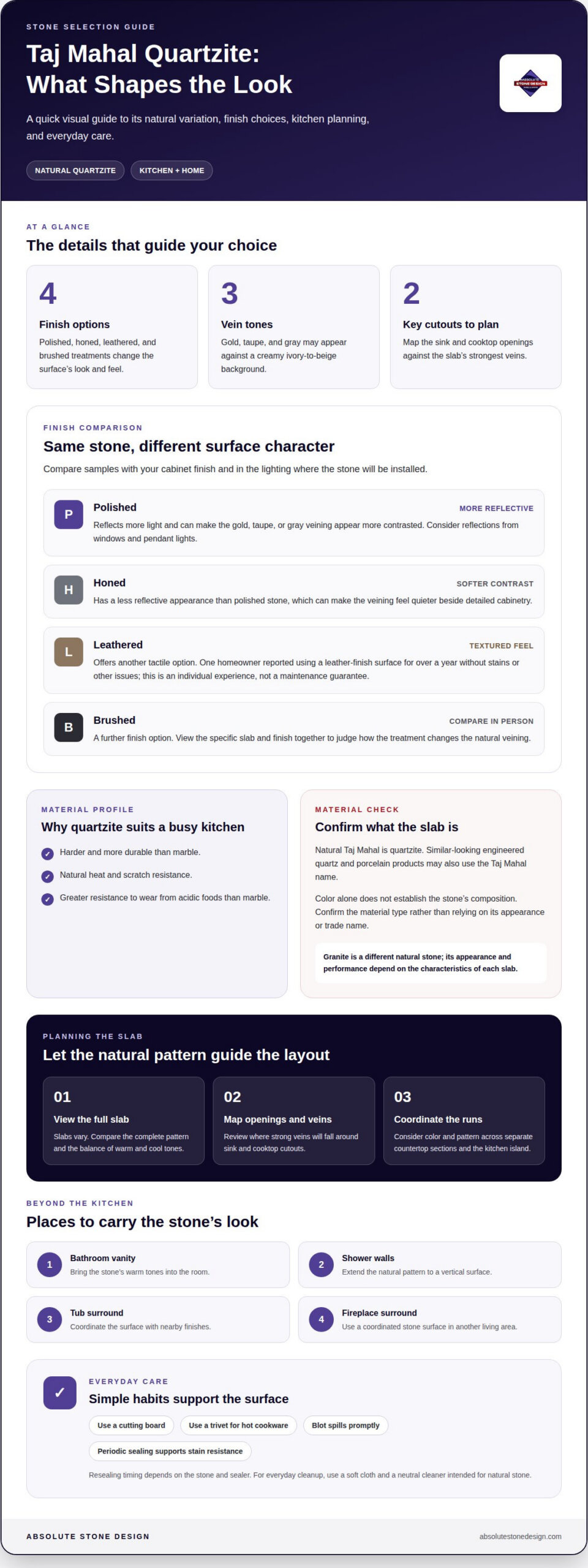
- Plan the slab layout around sink and cooktop openings so the natural veining falls where you want it.
- View the actual slab before selecting it, since each piece has its own pattern and balance of warm tones.
- Compare surface finishes in your room’s lighting to find the look and feel that suit your kitchen.
- Consider this stone beyond the kitchen, including for bathroom vanities, shower walls, tub surrounds, and fireplace surrounds.
Is Taj Mahal Quartzite Durable Enough for a Kitchen?
Taj Mahal quartzite counters can suit a busy kitchen because quartzite is harder and more durable than marble. The stone also has natural heat and scratch resistance, while fabrication planning helps position prominent veins around sink and cooktop cutouts.
Thickness and Prefabricated Sizes
Thickness and prefabricated dimensions shape the edge profile and fit. A homeowner used 2-centimeter stone with an ogee-to-square edge; another selected a 2 1/4-inch mitered edge. These examples show how edge design changes the finished appearance, not universal specifications. A countertop professional considers the countertop support structure, island overhang, and openings when planning dimensions. Prefabricated pieces need to suit the measured countertop runs, so compare their dimensions with the kitchen layout before choosing.
Slab availability varies by lot, and every slab has its own usable pattern. During fabrication planning, map sink and cooktop cutouts against the strongest veins to avoid placing a striking vein awkwardly across an opening. Reviewing the full slab also helps coordinate color and pattern across separate countertop runs.
Comparing Countertop Materials
Compared with marble, Taj Mahal quartzite offers greater hardness and durability, including resistance to wear from acidic foods. Granite is another natural stone, but its appearance and performance depend on the characteristics of each slab. Quartz is engineered, unlike natural quartzite, and some engineered quartz and porcelain products use the Taj Mahal name for a similar look. When choosing Taj Mahal quartzite counters, consider the material identity and natural pattern alongside your kitchen’s needs.
Use a cutting board and trivet for hot cookware, and blot spills promptly. Periodic sealing supports stain resistance, though resealing timing depends on the stone and sealer.
Ask the fabricator where a chosen vein will fall around sink or cooktop cutouts; one homeowner expected fabrication and installation to take 8 weeks.
Taj Mahal quartzite appearance and color variations
Taj Mahal quartzite is a natural stone with a warm, light-colored palette. Its background ranges from creamy ivory to beige, with beige and taupe accents. Some slabs have an ivory background crossed by soft gold veining. Gray may appear alongside gold or taupe, adding a cooler note while keeping the overall look light. Perla Venata is another industry name for this stone.
Each slab looks distinct, so the balance of background and veining changes from piece to piece. One slab may read as mostly creamy ivory, while another has more visible taupe, gray, or gold. This variation can shape how the surface relates to cabinet color, flooring, and a stone backsplash. View the complete slab in person, then compare its tones with your project’s finish samples.
A countertop professional identifies real Taj Mahal quartzite by confirming the slab’s stone type, rather than relying on color or its trade name alone. Light beige and gold tones can resemble dolomite or other stones, so appearance alone doesn’t establish composition. The Taj Mahal name can also describe engineered quartz or porcelain with a similar look. Natural Taj Mahal is quartzite, while granite is a different stone.
When selecting a slab, consider where the strongest veining will fall across the kitchen countertop layout. A bold section may draw attention on an island, while quieter areas can suit surrounding work surfaces. If the slab includes both warm gold and cooler gray, see how those tones relate to nearby finishes. Viewing the full piece helps you judge pattern continuity and choose a visual balance that suits the room.
Its warm, light-colored base ranges from creamy ivory to beige, with beige and taupe accents. Veining may appear gold, taupe, or gray.
Polished, honed, and leathered finishes
A finish changes how Taj Mahal quartzite looks under kitchen lighting. Common options include polished, honed, and brushed surfaces; leathered finishes also appear in homeowner projects. Each treatment gives the same natural stone a different visual and tactile character, so compare samples with your cabinet finish and room lighting.
Polished quartzite reflects more light, which can make its veining appear more contrasted than honed stone. This finish can emphasize gold, taupe, or gray lines against an ivory background. Before choosing a polished surface, consider how reflections from windows and pendant lights will fall across the kitchen island.
Honed quartzite has a less reflective appearance than polished stone. Its softer contrast can suit a kitchen where you want the veining to feel quieter beside detailed cabinet fronts. Compare both finishes under similar lighting, since a showroom sample may look different from the slab in your home.
Leathered Taj Mahal quartzite offers another finish option for a more textured look and feel. One homeowner reported using a leather-finish surface for over a year without stains or other issues. That experience is an example, not a maintenance guarantee, so consider your kitchen’s daily use and care routine.
Brushed, honed, and polished finishes are also available for this stone. Look at the specific slab and finish together, since surface treatment can change how its natural veining appears. For example, a polished sample may make gold lines stand out, while a honed sample may present them more softly.
To choose a finish, compare samples beside a cabinet door in both daylight and evening lighting. Pay attention to reflections, visible veining, and surface feel. For everyday cleanup, use a soft cloth and a neutral cleaner intended for natural stone.
Quartzite countertop and home applications
Taj Mahal quartzite counters can connect a kitchen’s work surfaces with nearby living spaces. On an island, the stone’s light background can make a broad surface feel calm. A waterfall edge carries the pattern down the island sides, while a full-height backsplash can continue the veining behind a range or sink.
For an island or waterfall design, the fabricator plans how slab sections meet, accounting for edges, seams, and the pattern across the top and sides. A coordinated layout helps the veining appear intentional rather than interrupted. The kitchen countertop plan also guides where openings and joints fall across separate runs.
Bathrooms offer several ways to extend the stone’s look. A vanity can bring its warm tones into the room, while a tub surround creates a distinct focal point. Large-format slabs on shower walls can create a refined finish with fewer grout lines. Consider how the pattern will read across the vanity, shower, and nearby wall surfaces.
A fireplace surround can carry the stone’s soft ivory, beige, or gold tones into a living room. Taj Mahal quartzite can also be considered for outdoor kitchens and entertainment areas when the design and construction are carefully planned. Outdoor seating and dining surfaces require planning the entire installation, not just selecting a visually appealing slab.
Choose applications according to the room’s layout and the role you want the stone to play. A striking vein might anchor an island, while a quieter section suits a vanity. Planning Taj Mahal quartzite counters alongside a backsplash or fireplace surround lets the fabricator consider pattern placement across the project. Reviewing the intended pieces together helps you understand how the natural variation will carry through your home.
Absolute Stone Design: Quartz
Absolute Stone Design helps you turn a Taj Mahal quartzite selection into a countertop plan suited to your home. For a project in Richmond, Henrico, Glen Allen, Midlothian, or Chesterfield, the team can guide decisions about how the material will fit your room, cabinetry, and design priorities.
With a preferred slab and kitchen plan in place, the project moves from visual choices to precise decisions. Measurements and templates establish dimensions, while in-house fabrication turns those dimensions into the finished piece. Discuss edge shape, seam placement, and how the stone should relate to nearby surfaces before fabrication begins.
Absolute Stone Design works with natural and engineered surfaces, including quartzite, quartz, and granite countertops. If Taj Mahal quartzite is your preference, share what matters most: a quiet pattern, a particular edge, or continuity across connected surfaces. This gives the team a clear design direction while respecting that each homeowner’s priorities differ.
For a kitchen update, the team coordinates measuring, fabrication, delivery, and installation as connected stages. This keeps design choices tied to the actual room rather than an isolated slab image. Bring cabinetry selections and room plans into the discussion so surface decisions work with existing finishes and your intended layout.
This is a practical next step for homeowners planning countertop work in Richmond, Henrico, Glen Allen, Midlothian, or Chesterfield, as well as designers and contractors coordinating a local project. The team handles residential and commercial countertop projects, shaping material selection around each project’s design and installation needs.
Contact Absolute Stone Design to discuss your countertop project.
Frequently Asked Questions
Which project details shape a Taj Mahal quartzite installation?
The planned scope shapes the work involved. A project may cover existing countertop runs or include connected surfaces, such as a backsplash. Changes to the kitchen footprint also affect the sequence of measuring, templating, fabrication, delivery, and installation. Clarifying which surfaces are part of the renovation helps coordinate design decisions and gives the installation team a clear picture of the finished space.
What Are Taj Mahal Countertops Made Of?
Taj Mahal countertops can refer to different materials, so the name alone doesn’t identify the surface. Natural Taj Mahal is quartzite; engineered quartz or porcelain products may use the name to evoke a similar appearance. Check the material description on the slab or product documentation. This distinction helps you understand whether you’re choosing natural stone or a manufactured surface.
What does countertop installation for Taj Mahal quartzite involve?
Countertop installation follows preparation of the measured and fabricated pieces. The installation team positions and fits each section, aligning joints and finished edges with the approved design. Before work begins, the room needs to be ready for the pieces, and the existing cabinets must provide a suitable base. The planned sequence connects the finished surface to the kitchen’s actual layout.
What should you decide before a Taj Mahal quartzite project begins?
Decide which surfaces belong in the project and how they should relate visually. For example, you might want the countertop to coordinate with a stone backsplash or remain the room’s main focal point. Cabinetry and surrounding finishes can guide those choices. Clear design decisions help the measuring and fabrication stages reflect the result you want, rather than leaving key details unsettled.
Is Taj Mahal quartzite a suitable kitchen surface?
Yes. Its natural heat and scratch resistance make it suitable for kitchen use, and it is harder than marble. These qualities describe the stone’s general performance, not a guarantee that every slab or finish will respond identically to daily use. Your surface treatment and the way you use the kitchen can shape the experience over time.
Does Taj Mahal quartzite need sealing, and how often should it be sealed?
Natural Taj Mahal quartzite needs periodic sealing, but no single schedule applies to every installation. Keep the product information for the sealer used on your surface and follow its care directions. If you don’t know which sealer was applied, the stone’s finish and treatment history can help identify appropriate maintenance guidance. Avoid assuming one calendar interval fits every slab.