
Super White Quartzite for Kitchen Countertops
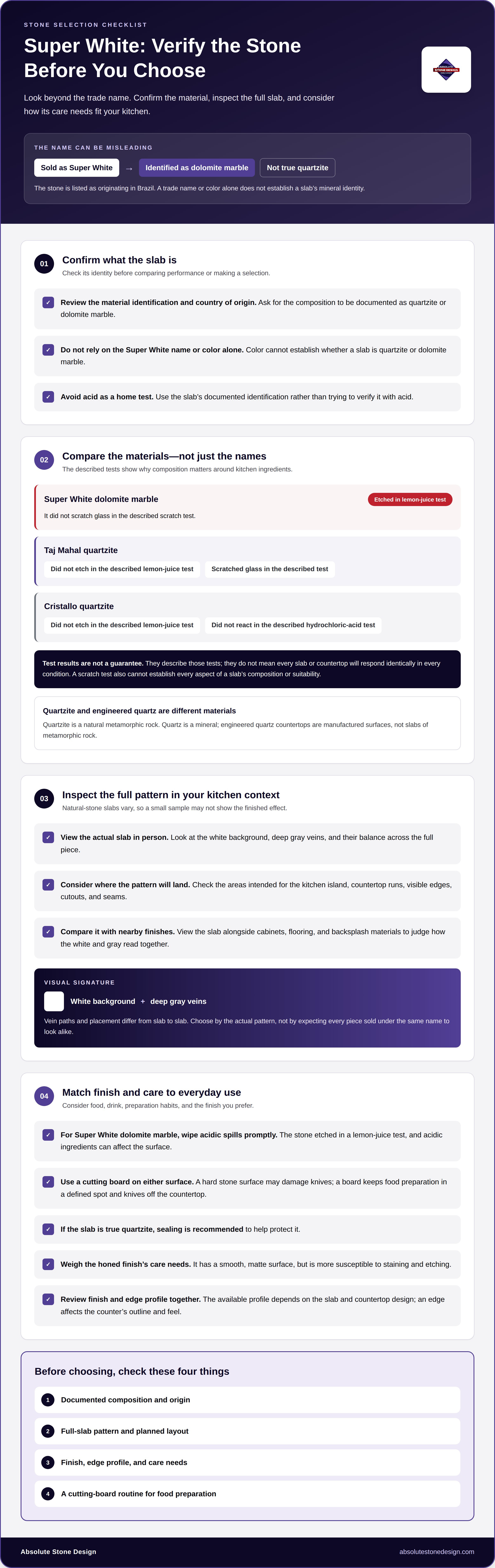
Stone sold as super white quartzite is identified as dolomite marble, not true quartzite. Its signature look is a white background crossed by deep gray veins.
If you’re drawn to its pale, expressive look, consider whether its composition and care needs suit your kitchen. Natural-stone slabs vary in pattern, so assess the actual slab before choosing.
This guide compares it with Taj Mahal and Cristallo, describes its veining, and covers kitchen use, lemon-juice etching, and why a cutting board is preferable to chopping directly on the stone.
Key Takeaways
- Learn what to consider when deciding whether this stone fits your kitchen and how its Brazilian origin informs your selection.
- See how natural pattern variation can shape the look of your counters and why viewing slabs in person helps with choosing.
- Understand the differences among Super White, Taj Mahal, Cristallo, quartzite, and engineered quartz before you settle on a material.
- Follow the key planning stages, from selecting a slab and measuring the kitchen to fabrication and installation.
Super White’s use as a kitchen countertop
Stone marketed as Super White can be used for a kitchen countertop, but its trade name needs careful attention. It is identified as dolomite marble, not true quartzite, and listed as originating in Brazil.
Countertop Suitability
Quartzite is commonly used for kitchen countertops, and stone sold as Super White is also used for this purpose. The distinction matters: Super White dolomite marble etched in a lemon-juice test. Acidic ingredients can therefore affect the surface, so wipe spills promptly and use a cutting board for food preparation. If the slab is true quartzite, sealing is recommended to help protect it.
Available Finishes and Edge Profiles
A honed finish has a smooth, matte surface, but it is more susceptible to staining and etching. That matters for a kitchen counter exposed to food and drink. The finish and edge profile are design and fabrication choices, and the available profile depends on the slab and countertop design. Review these details together, since an edge affects the counter’s outline and feel.
Verifying Slab Authenticity and Suitability
Color alone can’t establish whether a slab is quartzite or dolomite marble. Before choosing, review its material identification and country of origin, then view the actual slab to assess its white background, deep gray veins, and natural variations. Ask for its composition to be documented as quartzite or dolomite marble, rather than relying on the Super White trade name alone. Avoid using acid as a home test.
Super White quartzite’s color and veining
The stone’s signature look pairs a white background with deep gray veins. Because natural-stone slabs are unique, the balance and placement of these features vary from piece to piece.
Color Appearance
White forms the main field, while deep gray veining adds contrast. This combination can suit kitchens where you want a light stone with a distinct pattern rather than an uninterrupted solid color. The overall impression depends on the slab, so a small sample may not show the full visual effect.
View the slab alongside your kitchen’s cabinets, flooring, and backsplash materials. Compare how the white background reads against cabinet colors, then consider whether the gray marks feel balanced with nearby surfaces. This helps you judge the stone within your design, rather than by its trade name alone.
Veining Patterns
Deep gray veins are a defining feature, but their paths and placement differ from slab to slab. Some quartzite is present in the veining, even though stone sold under the Super White name is identified as dolomite marble. That distinction matters when discussing both appearance and composition.
View the full slab in person to see how its veins run across the surface. Pay attention to areas that may become the kitchen island, countertop runs, or visible edges. A vein near a cutout or seam can affect the finished layout, so consider the slab’s overall pattern rather than a small, isolated section.
The clearest takeaway: choose based on the actual slab’s white-and-gray balance and vein placement. Natural variation means two pieces may not create the same look, even when sold under the same name. Seeing the full pattern helps you picture how it will read across your kitchen, including the island and adjoining counter sections.
Comparison with Taj Mahal and Cristallo quartzites
The name “Super White quartzite” can obscure a key difference: the stone sold as Super White is identified as dolomite marble, not quartzite. Taj Mahal and Cristallo are described as quartzites, so comparing their performance means looking beyond color names and considering composition. A slab’s trade name alone does not establish its mineral identity.
In the described lemon-juice tests, Taj Mahal and Cristallo quartzite did not etch, while Super White dolomite marble did. Cristallo also did not react in the described hydrochloric-acid test. These results show why identifying the actual stone matters around acidic kitchen ingredients. They describe those tests, not a guarantee that every slab or countertop will respond identically in every condition.
The glass scratch tests offer another comparison. Taj Mahal quartzite scratched glass, while Super White dolomite marble did not. Quartzite is harder than glass and should scratch a glass surface; the Super White result is consistent with its identification as dolomite marble. Don’t treat a scratch test as a complete material assessment, since it cannot establish every aspect of a slab’s composition or suitability.
Quartzite and quartz are different materials. Quartzite is a natural metamorphic rock. Quartz is a mineral; engineered quartz countertops are manufactured surfaces, not slabs of metamorphic rock. This difference matters when describing and comparing the materials, even though their names sound similar.
For a kitchen, confirm whether the slab is quartzite or dolomite marble, then weigh the relevant etch and scratch-test information alongside its appearance and care needs. The practical takeaway is simple: choose based on the stone’s composition and your kitchen’s needs, not the word “quartzite” in a sales name.
Cutting directly on quartzite
Use a cutting board rather than chopping directly on a quartzite countertop. A hard stone surface may damage knives, so cutting directly on it can dull or harm the blade. For everyday tasks such as slicing vegetables, trimming herbs, or cutting bread, place a board between the knife and countertop. It gives you a separate work area while helping protect your kitchen tools.
Make the board part of your regular prep routine. Set it on the counter before cutting, and prepare food on it rather than moving the knife across the stone. If you use an island for several tasks, keep a board nearby so it’s ready when you switch from serving or setting down groceries to chopping.
Material identity also matters for stone sold under the Super White name. Super White is identified as dolomite marble, not quartzite, so the label alone doesn’t tell you exactly what stone is in your kitchen. A cutting board is the sensible choice for either surface: it keeps knives off the countertop and food preparation in one defined spot.
Consider your kitchen countertop layout when choosing where to keep a board. One near the sink can suit washing and trimming produce, while one near the range keeps chopping close to cooking. Keep the board stable as you work, and move it rather than cutting over seams, edges, or openings. These habits help protect your knives and finished stone during everyday food preparation.
Quartzite can be selected for kitchen counters, but its hardness isn’t a reason to use it as a chopping surface. The practical rule is simple: prepare food on a cutting board, not directly on the stone. This helps protect your knives while reserving the countertop for the tasks it was designed to handle.
Planning a Super White Quartzite Countertop
Plan around the actual slab, not its label. The trade name Super White quartzite can refer to dolomite marble, so material identification should guide care expectations and project decisions. Review the slab’s white ground and gray veining, then decide how its pattern should appear across the main counter and kitchen island. This helps the layout feel intentional rather than pieced together.
Next, establish the kitchen countertop layout. Precision measuring and templating capture counter runs, corners, sink and cooktop openings, and planned seams. The countertop’s support structure matters too, since cabinets carry the finished stone. Measurements account for the room as it stands, so the template reflects the actual space rather than estimates or a generic cabinet plan.
Fabrication turns the approved layout into a fitted surface. Before fabrication begins, approve the selected slab and design details, including edge choices and visible seam placement. In-house fabrication lets the measurements and agreed layout guide the work directly. Planning where prominent veining falls helps coordinate separate countertop sections and any island surface.
Countertop installation follows fabrication and delivery. Before installation, clear the work area and ensure the cabinets are ready to support the new surface. The installation team fits the pieces to the templated kitchen, aligning seams and openings with the approved plan. Coordinating the process from measuring through fitting helps each stage reflect the same design decisions.
Keep the central decision clear: identify the stone correctly, choose the slab for its pattern, and plan the layout around your kitchen. This approach supports a countertop that suits the room and reflects the natural variation of the selected material.
As you shape your kitchen, let the stone support the atmosphere you want to create, from a quiet, light-filled gathering place to a room with a more pronounced natural pattern. A Super White dolomite marble countertop can be part of that vision, while the right choice also depends on how you want the finished space to feel and function.
Absolute Stone Design works with countertop projects and offers granite and marble as other natural-stone options. The team’s measuring, in-house fabrication, and installation services carry the selected material from planning through to the finished kitchen.
Ready to take the next step? Plan your countertop project with Absolute Stone Design, and start shaping a kitchen that feels like yours.
Frequently Asked Questions
What are the appearance, colors, and natural variations of Super White quartzite slabs?
If a slab is marketed as super white quartzite, assess its pattern at full scale before deciding where it belongs in your kitchen. Compare the slab with cabinet and flooring samples under the room’s planned lighting. This helps you judge whether the stone’s overall movement feels balanced with nearby finishes, instead of relying on a small sample or screen image.
How hard, durable, and heat-resistant is Super White quartzite?
Hardness and heat resistance are separate considerations, so one doesn’t establish the other. For everyday kitchen use, place hot cookware on a trivet and avoid dropping heavy pots on the counter. These habits help limit sudden heat exposure and impact. The stone’s name alone isn’t a practical guide to how it will respond.
Does Super White quartzite stain, etch, or scratch easily?
Stains, etching, and scratches are different kinds of surface change. A stain affects the stone’s appearance after a substance penetrates or leaves residue; etching can alter the finish, while a scratch is a physical mark. If you notice a change, view it in good light and identify its appearance before choosing a cleaning or repair approach.
How often does Super White quartzite need sealing, and what maintenance does it require?
Follow care guidance for the specific stone and sealer rather than relying on a schedule attached to a trade name. For routine upkeep, use a stone-safe cleaner and a soft cloth, and follow the sealer maker’s application directions. Keep the product information with your kitchen records so you can refer to the right care instructions later.
What are the pros and cons of using Super White quartzite for kitchen countertops and backsplashes?
A kitchen design using super white quartzite can carry the same material across the countertop and backsplash for a coordinated look. Plan the horizontal and vertical pieces together, considering vein direction, seams, outlets, and cutouts. Careful coordination helps the finished surfaces feel connected rather than like separate choices.